Key Findings
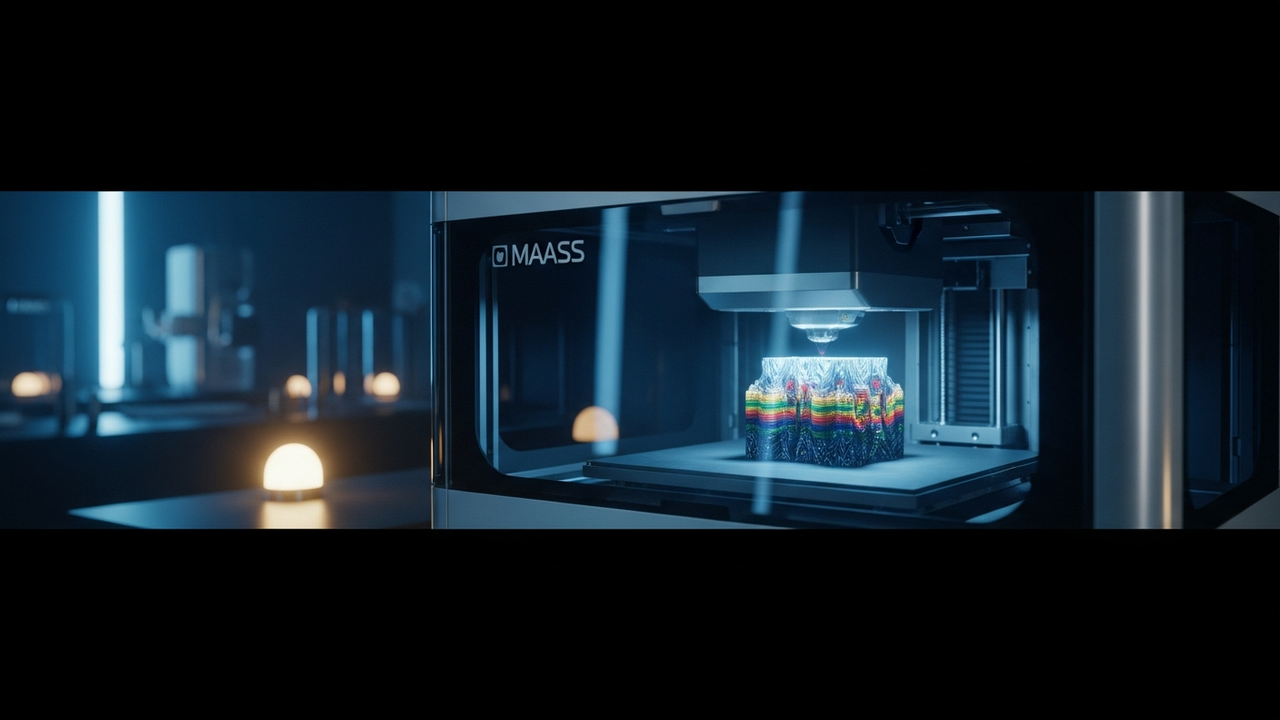
MAASS has achieved a significant milestone in additive manufacturing technology with the introduction of its pioneering multi-material stereolithography (MMSLA) 3D printer, named ‘Shimmy.’ This innovative system incorporates a dual-vat architecture, enabling the simultaneous, high-precision printing of two distinct materials—a capability that has historically posed considerable challenges in the SLA domain.
Technical / Clinical Details
At the core of the ‘Shimmy’ printer’s advanced capabilities is its dual-vat system. This allows for the seamless transition between two independent resin vats during the printing process, facilitating the incorporation of materials with differing physical or chemical properties into a single, cohesive printed object. The MMSLA technology excels in providing precise control over multiple materials at the micro-scale. This feature is particularly crucial for manufacturing integrated electronics, microfluidic devices, biomedical components, and complex smart material systems. For example, combining highly conductive materials with insulating ones within the same object enables the direct 3D printing of functional circuit boards or advanced sensors. Furthermore, its compatibility with water-soluble or photo-degradable support materials significantly simplifies post-processing for parts with intricate internal geometries. The build volume, optimized for R&D applications, provides an ideal environment for material scientists and engineers to rapidly prototype new materials and develop functional components efficiently.
Background & Context
Traditional stereolithography (SLA) technologies have typically been limited to processing a single type of material, necessitating multiple printers or complex post-processing steps for multi-material fabrication. However, modern technological demands, particularly for smart devices, biosensors, and AI chips, increasingly call for complex, multi-functional material integration. MAASS’s MMSLA technology addresses this critical gap, representing a substantial advancement that enables the production of highly functional additively manufactured parts. This innovation not only significantly enhances design freedom but also has the potential to simplify manufacturing processes and shorten product development cycles. The broader 3D printing industry recognizes the shift from single-material to multi-material capabilities as an essential trend for market expansion and the creation of novel applications across various sectors.
Strategic Significance & Outlook
The introduction of MAASS’s ‘Shimmy’ printer is expected to accelerate innovation within advanced manufacturing, particularly in integrated electronics and smart materials. As adoption increases within the R&D market, the development of more complex and higher-performance prototypes will become more efficient, leading to shorter time-to-market for new products. In the long term, if this multi-material printing capability can be scaled for mass production, it could enable the creation of entirely new classes of products with functionalities currently unattainable through existing manufacturing methods. This technology is poised to revolutionize a wide array of industrial sectors, including robotics, wearable devices, and customized medical solutions, marking a pivotal moment in the evolution of additive manufacturing.
Source: https://www.voxelmatters.com/maass-launches-multi-material-stereolithography-mmsla-printer/
Get our weekly technology intelligence — free
Receive an infographic that lets you judge at a glance whether each field’s analysis report is worth reading.
Subscribe Free — Weekly Tech Intelligence
By subscribing, you’ll receive Troy-Technical’s weekly technology intelligence newsletter.
- Your email and selected fields are used only to deliver the newsletter.
- We never share your information with third parties.
- You can unsubscribe anytime via the link in each email.
See our Privacy Policy for details.
Takes about a minute · Unsubscribe anytime






Comments