Key Findings
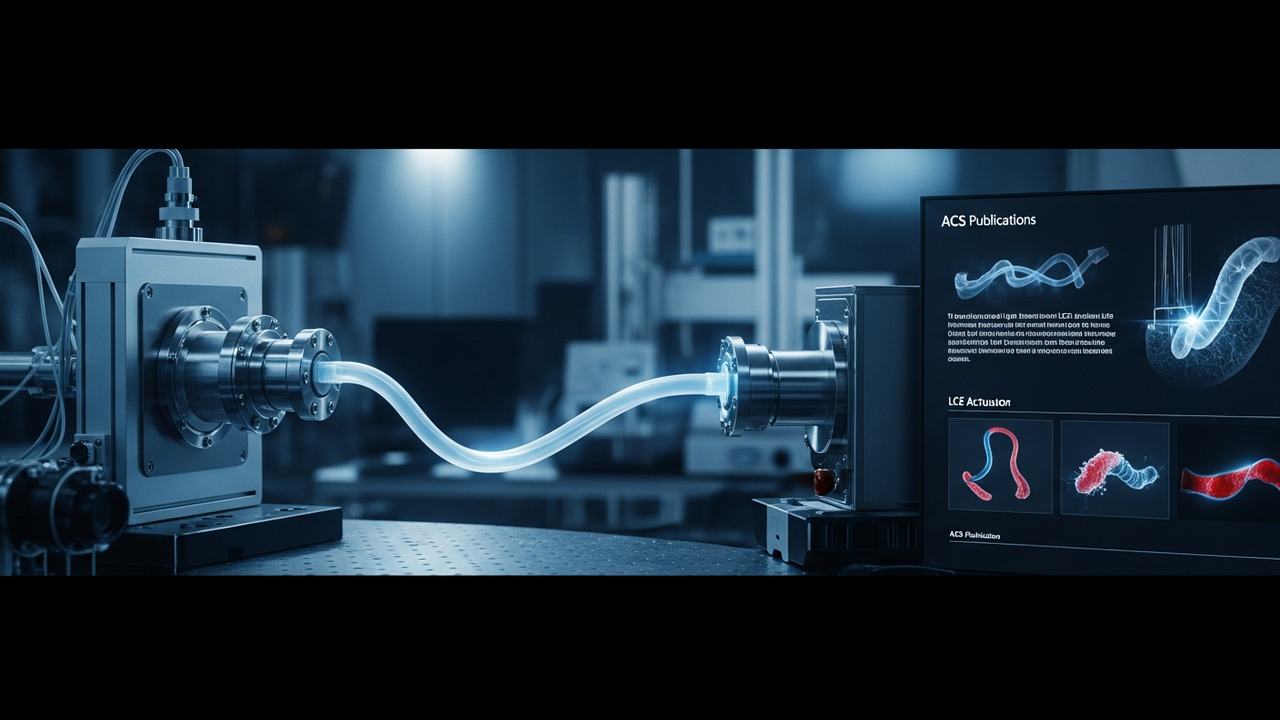
Conventional photoisomerization-based liquid crystal elastomer (LCE) actuators, which typically rely on ultraviolet (UV) irradiation, have faced significant limitations in biomedical applications due to UV’s inherent phototoxicity and low tissue penetration depth. This research successfully addresses these challenges by developing a groundbreaking photoisomerization actuator driven by 808 nm near-infrared (NIR) light. This novel system opens new avenues for applications in the biomedical field as a NIR-addressable soft actuator platform.
Technical / Clinical Details
The developed NIR light-driven actuator is achieved through the ingenious integration of an azobenzene-crosslinked LCE with specific upconversion nanoparticles (CSS-UCNPs). These CSS-UCNPs possess the unique ability to absorb 808 nm NIR light and convert it into UV/blue region light through upconversion luminescence. This upconverted light then triggers the photoisomerization of azobenzene molecules, consequently inducing macroscopic shape changes (bending) in the LCE film. Compared to conventional UV light, NIR light offers significant advantages in biological contexts due to its higher tissue penetration and lower phototoxicity. This enables biomedical applications that were previously challenging for LCE actuators, such as implantable devices, soft robots directly interacting with biological tissues, and cell manipulation devices.
Background & Context
In the fields of soft robotics and smart medical devices, there is active research into developing actuators capable of precise motion control in response to external stimuli. LCEs have garnered considerable attention as ideal soft actuator materials due to their ability to undergo large, reversible deformations in response to stimuli like light, heat, or electric fields. However, issues of biocompatibility and tissue penetration have posed significant barriers to their in vivo applications. NIR light, known as the ‘therapeutic window’ due to its deep tissue penetration and minimal biological impact, has long been a desired control mechanism for actuators in this domain.
Strategic Significance & Outlook
This NIR light-driven LCE actuator holds immense potential for a wide range of biomedical applications, including medical diagnostics, therapy, biosensing, and soft robotics. For instance, it could contribute to the development of smart drug delivery systems that reach target sites within the body and release drugs when activated by NIR light, or micro-robots that navigate the body for minimally invasive manipulations. The research team plans to further optimize this technology and develop more complex actuator designs, ultimately aiming for next-generation smart medical devices that span from diagnosis to treatment. This breakthrough represents a crucial step forward in extending soft actuator technology into biological environments.
Source: https://pubs.acs.org/doi/10.1021/acsami.6c07815
Get our weekly technology intelligence — free
Receive an infographic that lets you judge at a glance whether each field’s analysis report is worth reading.
Subscribe Free — Weekly Tech Intelligence
By subscribing, you’ll receive Troy-Technical’s weekly technology intelligence newsletter.
- Your email and selected fields are used only to deliver the newsletter.
- We never share your information with third parties.
- You can unsubscribe anytime via the link in each email.
See our Privacy Policy for details.
Takes about a minute · Unsubscribe anytime









Comments