Key Findings
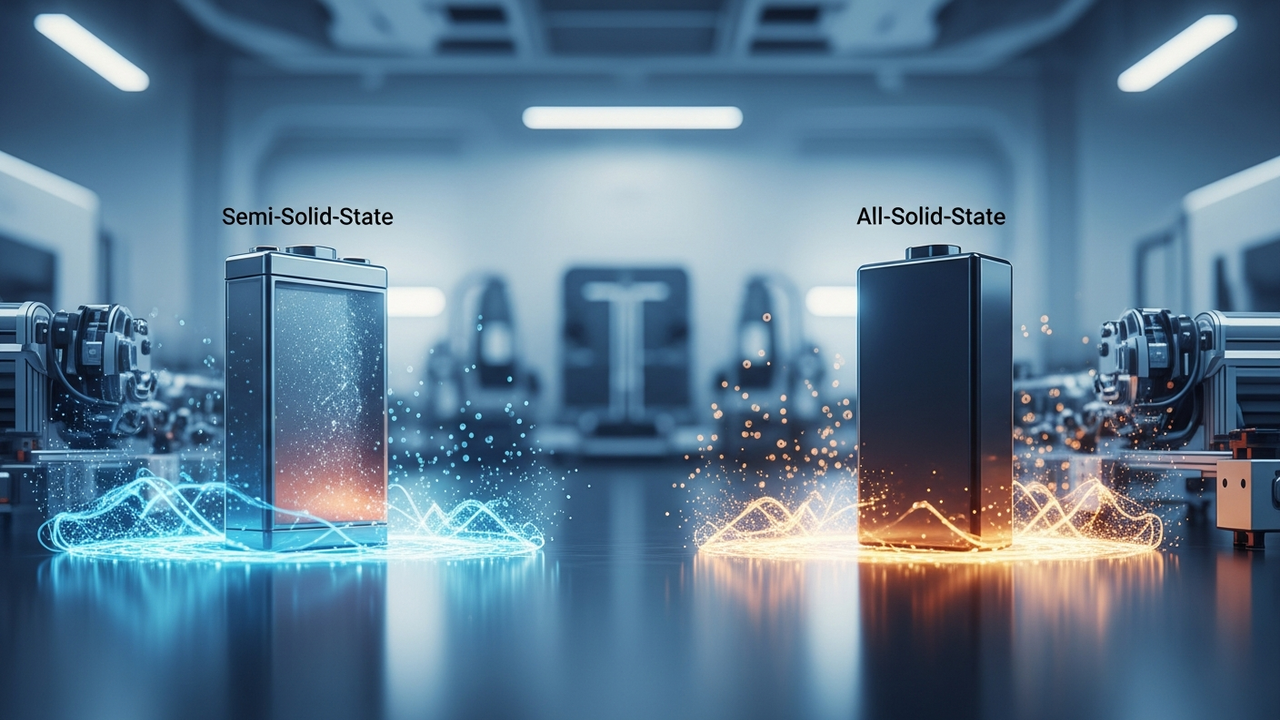
Semi-solid-state batteries and all-solid-state batteries are both next-generation battery technologies, yet they exhibit fundamental differences in electrolyte composition and function. Semi-solid-state batteries, containing a small amount of liquid or gel electrolyte, act as a ‘bridging technology’ that partially improves the limitations of existing lithium-ion batteries. In contrast, all-solid-state batteries aim to be the ‘ultimate battery’ by completely replacing liquid electrolytes with solid ones, promising revolutionary advancements in safety, energy density, and charging performance.
Technical/Clinical Details
There are eight key differences between these two battery types:
- Electrolyte Composition: Semi-solid-state batteries typically contain 5% to 20% liquid electrolyte, whereas all-solid-state batteries use less than 5%, ideally 0%, liquid electrolyte.
- Safety: All-solid-state batteries inherently offer higher safety by eliminating flammable liquids, significantly reducing the risk of thermal runaway. Semi-solid-state batteries also improve safety by reducing liquid electrolyte content, but not to the same extent.
- Energy Density: All-solid-state batteries can achieve the highest theoretical energy densities (over 500 Wh/kg) when combined with lithium metal anodes. Semi-solid-state batteries also improve energy density through high-performance materials but have limitations.
- Manufacturing Complexity: All-solid-state batteries present significant manufacturing challenges due to solid-solid interface issues and the need for high-pressure stacking processes. Semi-solid-state batteries are relatively easier to transition to from existing technologies.
- Cost: Currently, the manufacturing cost of all-solid-state batteries is very high, posing a major barrier to mass production. Semi-solid-state batteries can leverage existing manufacturing infrastructure to some extent, offering a cost advantage.
- Charging Performance: All-solid-state batteries can achieve ultra-fast charging if high-speed lithium ion transport is realized. Semi-solid-state batteries also allow for fast charging but are constrained by their liquid electrolyte component.
- Separator Design: In all-solid-state batteries, the solid electrolyte itself often acts as the separator, allowing for thinner designs and higher energy density. Semi-solid-state batteries still require a porous separator.
- Compatibility with Lithium Metal Anodes: All-solid-state batteries are better at suppressing dendrite growth from lithium metal anodes, which is advantageous for achieving higher capacities. Dendrite issues may persist in semi-solid-state batteries.
Background & Context
The evolution of battery technology is crucial for extending the range and adoption of electric vehicles (EVs) and for integrating renewable energy sources. As the technical limits of liquid-electrolyte lithium-ion batteries become apparent, there is a strong demand for safer and higher-performing alternatives. Semi-solid-state batteries are positioned as an ‘intermediate step’ from current technologies to all-solid-state batteries, facilitating earlier market entry and risk diversification. Conversely, all-solid-state batteries are the long-term ultimate goal, attracting massive investments from governments and leading corporations worldwide.
Strategic Significance & Outlook
In the coming years, semi-solid-state batteries are expected to be gradually introduced into the EV market, balancing performance and cost. Meanwhile, research and development for all-solid-state batteries will continue, focusing on resolving fundamental issues such as interface resistance, volumetric changes, and manufacturing costs. In the long term, all-solid-state batteries hold the potential to become mainstream across a wide range of applications, from mobile devices to EVs and grid-scale energy storage. However, achieving both technological breakthroughs and economic viability will be essential for this vision to materialize.
Source: https://evinsightdaily.com/semi-solid-battery-vs-solid-state/
Get our weekly technology intelligence — free
Receive an infographic that lets you judge at a glance whether each field’s analysis report is worth reading.
Subscribe Free — Weekly Tech Intelligence
By subscribing, you’ll receive Troy-Technical’s weekly technology intelligence newsletter.
- Your email and selected fields are used only to deliver the newsletter.
- We never share your information with third parties.
- You can unsubscribe anytime via the link in each email.
See our Privacy Policy for details.
Takes about a minute · Unsubscribe anytime