Key Findings
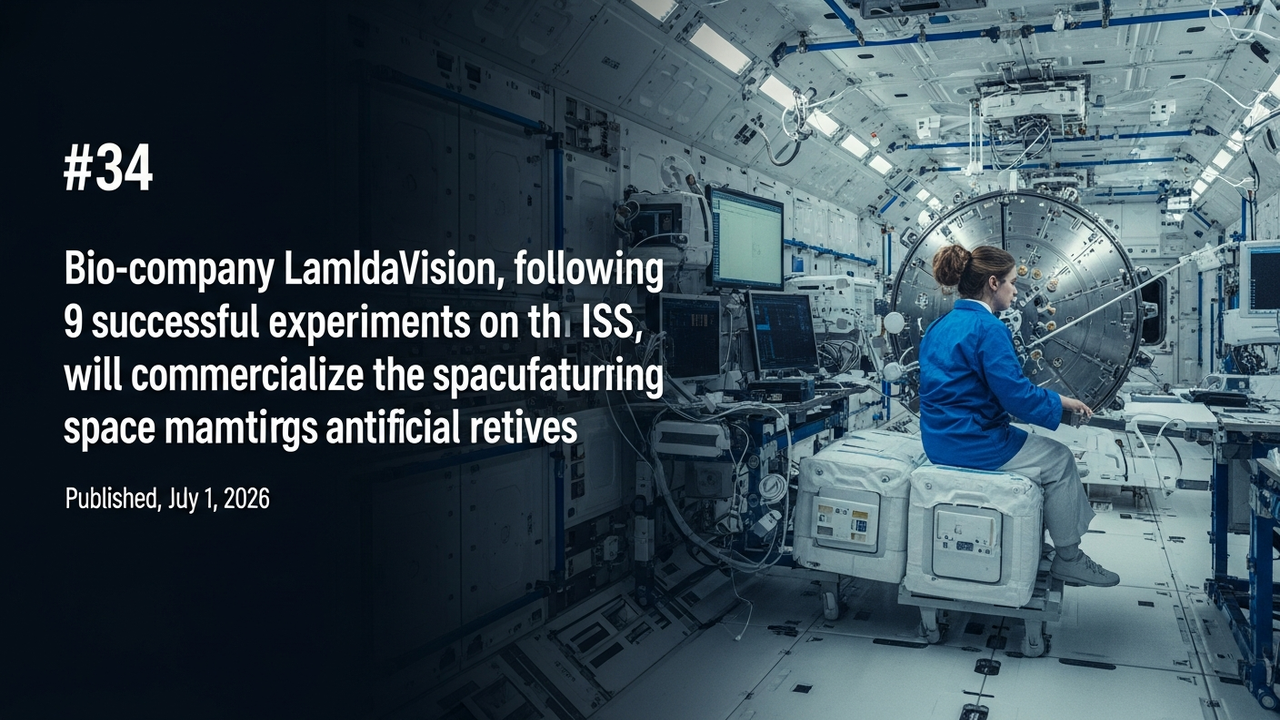
Biotechnology firm LambdaVision has announced its intent to commercialize artificial retinas manufactured in the microgravity environment of space, leveraging an automated production system refined through nine successful experiments aboard the International Space Station (ISS). This pioneering approach effectively resolves the challenges of non-uniform layer formation inherent in terrestrial manufacturing, enabling the production of high-purity and highly functional artificial retinas for the treatment of retinal degenerative diseases. The company plans to continue its in-orbit manufacturing operations on future commercial space stations, such as Starlab and Vast’s Haven, after the ISS’s planned decommissioning, underscoring the growing commercial viability of space-based production.
Technical Details
LambdaVision’s artificial retina is constructed using bacteriorhodopsin, a light-converting protein that transforms light into electrical signals. On Earth, gravity causes sedimentation and convection, leading to inconsistent protein layer formation and variability in the final product’s quality and functionality. In contrast, the microgravity environment of space allows for uniform layer deposition, critical for achieving precise nanometer-scale control over protein layering. Through extensive R&D on the ISS, LambdaVision developed an automated manufacturing system that capitalizes on this unique advantage, enabling the efficient production of artificial retinas with superior uniformity and functional integrity. This enhanced quality is expected to lead to more effective and reliable treatment options for patients suffering from blindness.
Background & Context
Retinal degenerative diseases affect millions globally, with limited effective treatment options. Artificial retinas represent a promising avenue for vision restoration, but quality and manufacturing costs have been significant hurdles. Microgravity manufacturing has emerged as a new frontier for producing ultra-pure and homogeneous materials, with potential applications spanning pharmaceuticals, semiconductors, and advanced alloys. LambdaVision’s success is a landmark achievement, demonstrating that space-based manufacturing is moving beyond research into tangible commercial medical products. This development is significant for both the space industry, by creating demand for commercial space stations, and the biotechnology sector, by offering new solutions for previously intractable manufacturing challenges.
Strategic Significance & Outlook
LambdaVision’s artificial retinas are initially targeted at patients with conditions such as retinitis pigmentosa and age-related macular degeneration. The superior quality of products manufactured in orbit is expected to enhance efficacy and safety profiles in clinical trials, accelerating market introduction. The company’s strategic pivot to commercial space stations signifies the maturation of space-based manufacturing into a sustainable business model. This success is likely to encourage other biopharmaceutical and advanced materials companies to explore microgravity manufacturing, accelerating the trend towards using space as a new ‘production hub.’ In the long term, this could lead to the production of various high-value products in space that are either impossible or prohibitively expensive to manufacture on Earth, opening up new dimensions for industrial innovation.
Get our weekly technology intelligence — free
Receive an infographic that lets you judge at a glance whether each field’s analysis report is worth reading.
Subscribe Free — Weekly Tech Intelligence
By subscribing, you’ll receive Troy-Technical’s weekly technology intelligence newsletter.
- Your email and selected fields are used only to deliver the newsletter.
- We never share your information with third parties.
- You can unsubscribe anytime via the link in each email.
See our Privacy Policy for details.
Takes about a minute · Unsubscribe anytime








Comments