Key Findings
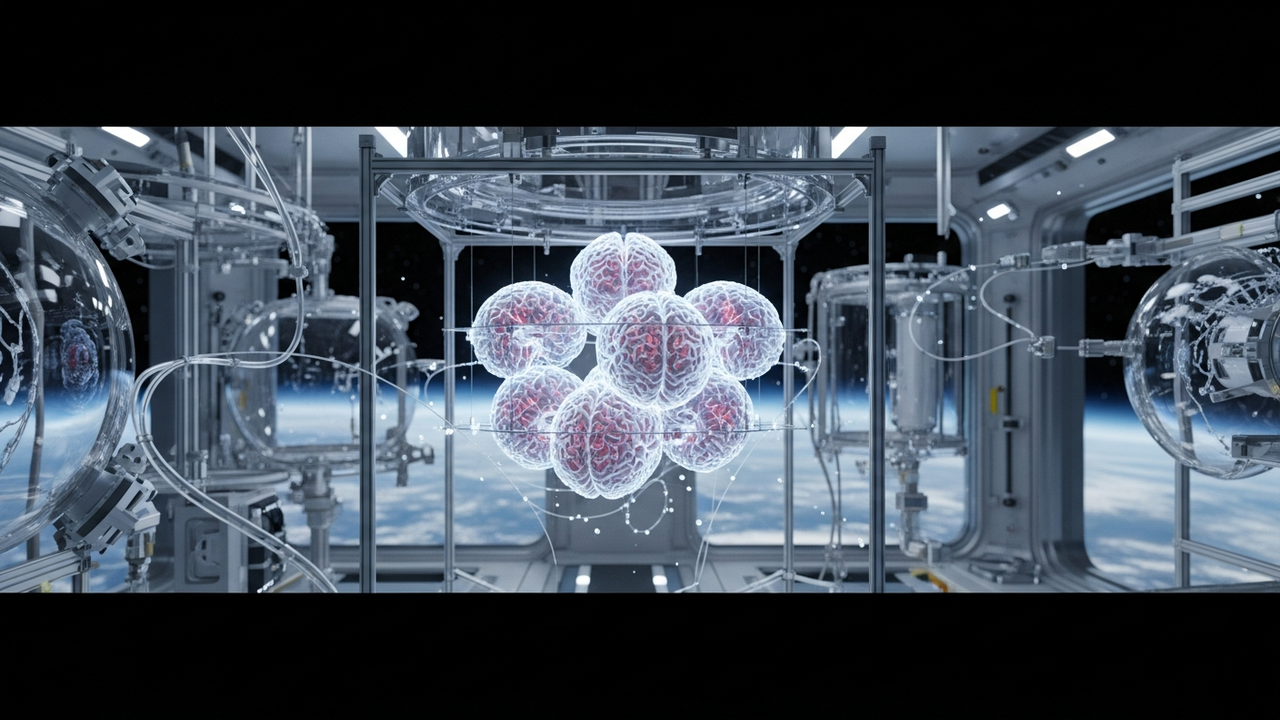
Axiom Space has achieved groundbreaking results in its brain organoid research conducted in the microgravity environment of the International Space Station (ISS). Organoids cultivated in microgravity demonstrated accelerated maturation towards an adult-like state compared to those grown on Earth, representing a significant advance, particularly for establishing novel modeling methods for age-related neurodegenerative diseases.
Technical & Clinical Details
Brain organoids, miniature brain tissues derived from stem cells, are critical in vitro models for studying complex neurological disorders and developing new drugs. However, terrestrial cultivation often faces challenges with structural uniformity due to gravitational forces and delayed maturation processes. Experiments conducted by Axiom Space on the ISS indicated that the microgravity environment optimizes 3D structural formation and intercellular interactions within brain organoids, promoting more physiologically relevant maturation. This could enable more accurate replication of the pathogenesis of age-related neurodegenerative diseases like Alzheimer’s and Parkinson’s, significantly improving the efficiency of screening potential therapeutic candidates. Microgravity cell culture techniques are key to building bio-manufacturing pipelines that transcend Earth’s limitations.
Background & Context
In-space bio-manufacturing and research leverage the unique environment of microgravity, which impacts cell growth, protein crystallization, and tissue formation, to yield high-quality materials and insights unattainable on Earth. Axiom Space is leading efforts to establish space as a new industrial platform, including providing commercial modules for the ISS and developing Axiom Station, the first private successor to the ISS. This brain organoid research is central to that vision, demonstrating that space can function not just as an arena for exploration, but also as a vital R&D hub for addressing terrestrial medical challenges.
Strategic Significance & Outlook
The discovery of accelerated brain organoid maturation in microgravity holds the potential to revolutionize drug discovery for age-related neurodegenerative diseases. Axiom Space plans to build on these findings to expand its bio-manufacturing and research pipelines on the ISS and future Axiom Station. If this technology is established, research institutions and pharmaceutical companies on Earth may be able to develop more effective therapies and drugs by utilizing the unique environment of space. This positions the space industry as a new frontier for value creation, directly contributing to human health and well-being.
Get our weekly technology intelligence — free
Receive an infographic that lets you judge at a glance whether each field’s analysis report is worth reading.
Subscribe Free — Weekly Tech Intelligence
By subscribing, you’ll receive Troy-Technical’s weekly technology intelligence newsletter.
- Your email and selected fields are used only to deliver the newsletter.
- We never share your information with third parties.
- You can unsubscribe anytime via the link in each email.
See our Privacy Policy for details.
Takes about a minute · Unsubscribe anytime






Comments