Key Findings
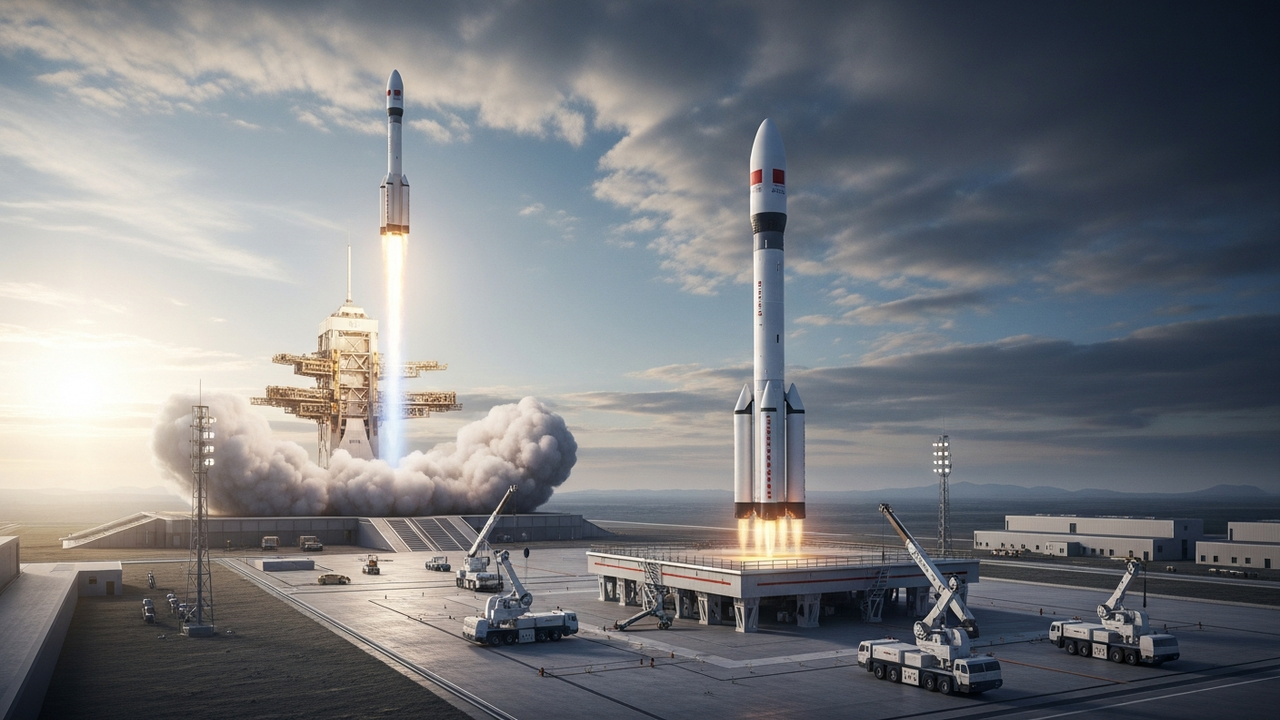
China has achieved a historic milestone in its space program by successfully launching and then landing the first stage booster of its new reusable Long March-10B rocket from orbit. This groundbreaking accomplishment significantly reduces the cost of space launches for China, strengthening its foundation for ambitious space objectives. The booster executed a controlled vertical descent, landing precisely on a floating recovery platform in the ocean, mirroring advanced techniques used by industry leaders.
Technical / Clinical Details
The reusability technology demonstrated by the Long March-10B involves the booster re-entering the Earth’s atmosphere and performing a propulsive landing, similar to SpaceX’s Falcon series. This innovation eliminates the need for expendable rocket stages, promising substantial savings in manufacturing costs and preparation time. Domestically, several private Chinese space companies, including Landspace, CAS Space, Galactic Energy, and Deep Blue Aerospace, are also actively developing their own reusable launch vehicles, indicating a concerted national effort to master this critical technology. While some reports suggest the landing method might be less efficient than SpaceX’s at present, it represents a substantial step forward.
Background & Context
Rocket reusability is one of the most transformative trends in the contemporary space industry. While SpaceX has held a dominant lead, China has made it a strategic national priority to catch up and rapidly advance its space capabilities. Reducing launch costs is vital for China’s expansive space agenda, which includes building vast satellite internet constellations, ensuring regular resupply missions to its space station, and achieving a crewed lunar landing by 2030. This success positions China not merely as a follower but as a formidable challenger in the global space race, solidifying its status as a leading space power.
Strategic Significance & Outlook
The successful reusability of the Long March-10B implies that China will be able to access space more frequently and economically in the future. This will enable China’s space sector to expand activities across diverse fields such as satellite communication, Earth observation, and space science research. In particular, the deployment of its large-scale satellite constellations is expected to accelerate, increasing China’s influence in the international space infrastructure market. Furthermore, this technological breakthrough is likely to act as a catalyst, spurring further innovation and adoption of reusable launch technologies within the broader international space development community.
Get our weekly technology intelligence — free
Receive an infographic that lets you judge at a glance whether each field’s analysis report is worth reading.
Subscribe Free — Weekly Tech Intelligence
By subscribing, you’ll receive Troy-Technical’s weekly technology intelligence newsletter.
- Your email and selected fields are used only to deliver the newsletter.
- We never share your information with third parties.
- You can unsubscribe anytime via the link in each email.
See our Privacy Policy for details.
Takes about a minute · Unsubscribe anytime





Comments