Key Findings
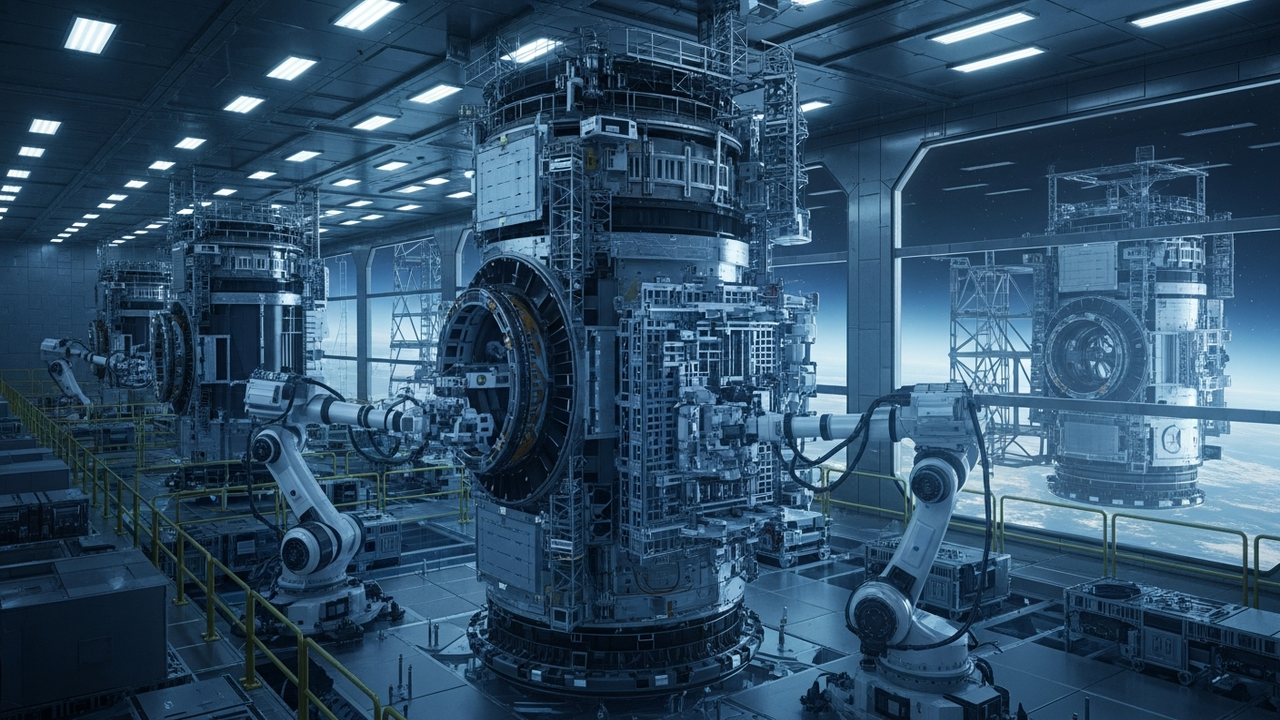
A groundbreaking announcement has been made regarding the development of In-Space Manufacturing (ISM) techniques for large space structures. This technology concretizes the concept of constructing massive structures in orbit—such as large antennas, space station modules, and space telescope mirrors—which are difficult to launch from Earth, by combining 3D printing technology with autonomous robotic systems. This innovative approach holds the potential to reduce launch costs from Earth by up to 50% and significantly enhance design freedom, representing a critical breakthrough essential for building space infrastructure and advancing deep-space exploration.
Technical Details
The announced in-space manufacturing system primarily consists of the following elements:
- **On-orbit 3D Printer**: A printer capable of precisely additive manufacturing using metal powders, polymer composites, or ceramic materials in the space environment. It is designed to withstand vacuum, extreme temperature fluctuations, and radiation.
- **Autonomous Robotic Manipulators**: High-precision robotic arms that autonomously perform 3D printer operations, component relocation, assembly, and quality inspection. Equipped with AI-based vision systems and tactile feedback, they handle complex tasks.
- **Integrated Control System**: Software and hardware for remotely monitoring, controlling, and error-correcting the entire manufacturing process from Earth, or operating fully autonomously.
Simulations and ground-based prototype tests have shown that the required precision and robustness can be achieved for scenarios involving manufacturing parts of a ~10-meter class antenna structure in orbit. Specific focus was placed on material behavior under space exposure, additive manufacturing processes in vacuum, and precise positioning control of robotic arms. This technology enables the design of optimized structural geometries that do not need to be folded for launch, maximizing performance.
Background & Context
Currently, space structures are mostly manufactured on Earth, then folded to fit within a rocket’s fairing, and deployed after launch. However, this method imposes significant constraints on the size and complexity of structures, making the realization of truly massive structures like large space telescopes or space solar power plants difficult. In-space manufacturing is gaining attention as the only way to fundamentally resolve these constraints and build truly large, high-performance space assets. This technology is expected to be a game-changer for opening up the next frontier of space utilization.
Strategic Significance & Outlook
This in-space manufacturing technology will revolutionize various space projects, including deep-space exploration outposts like the Lunar Gateway, large space telescopes, space solar power plants, and transport vehicles for future human Mars missions. Future efforts will focus on automating material supply, supporting a wider range of materials, coordinating multiple robots, and conducting long-term validation tests in the space environment. By the 2030s, the first large space structures manufactured in orbit may become operational, dramatically expanding the scale of human activity in space. This will be a fundamental technology essential for the sustained growth of the space industry and the expansion of the space economy.
Source: #
Get our weekly technology intelligence — free
Receive an infographic that lets you judge at a glance whether each field’s analysis report is worth reading.
Subscribe Free — Weekly Tech Intelligence
By subscribing, you’ll receive Troy-Technical’s weekly technology intelligence newsletter.
- Your email and selected fields are used only to deliver the newsletter.
- We never share your information with third parties.
- You can unsubscribe anytime via the link in each email.
See our Privacy Policy for details.
Takes about a minute · Unsubscribe anytime







Comments