Key Findings
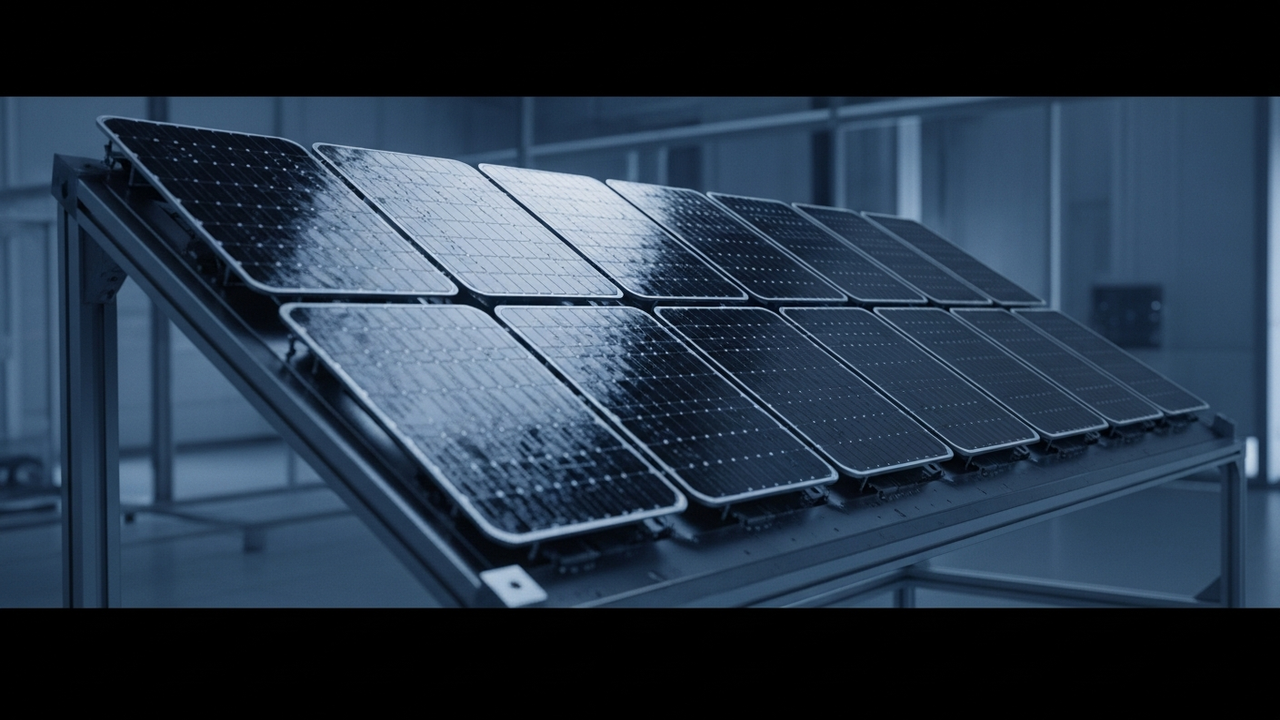
Perovskite-silicon tandem cells, developed to dramatically improve the efficiency of solar arrays for space applications, have achieved over 20% higher power conversion efficiency (laboratory cell efficiency exceeding 30%) in ground-based validation tests compared to conventional space-grade silicon solar cells. This innovative tandem cell exhibits particularly marked performance improvements under low-light conditions, where solar radiation is limited, promising to significantly alleviate power constraints faced by spacecraft and satellites. This advancement is expected to allow for larger payload masses and more complex missions, thereby greatly enhancing the flexibility of space operations.
Technical Details
This perovskite-silicon tandem cell features a stacked structure with a perovskite layer on top and an optimized silicon layer underneath, designed to efficiently absorb a broad spectrum of sunlight. The perovskite layer effectively absorbs high-energy blue light, while the silicon layer absorbs lower-energy red light, maximizing the strengths of each material. In ground tests, under AM1.5G spectrum conditions, this tandem cell consistently showed over 30% cell efficiency, compared to the average efficiency of approximately 22% for conventional single-junction silicon solar cells. Furthermore, the degradation rate of power generation efficiency under low-light conditions (e.g., 0.1 sun intensity) was contained within 5% compared to conventional silicon cells, demonstrating superiority in early morning, late evening, or deep-space exploration scenarios with low solar intensity. Crucially, thermal cycling and radiation exposure tests simulating the space environment showed no significant degradation in initial performance, indicating promising long-term reliability for space applications.
Background & Context
Solar arrays on spacecraft are paramount as power sources for missions, but their size and mass directly impact launch costs. While conventional silicon solar cells are technologically mature, their efficiency has physical limits, requiring larger arrays to generate more power. For deep-space probes and large satellites in particular, constraints on array deployment area and mass often make power shortage a bottleneck in mission design. Perovskite solar cells have recently garnered attention for their high conversion efficiency and potential for low-cost manufacturing, and tandem cells combining them with silicon are considered a promising next-generation technology to solve this challenge.
Strategic Significance & Outlook
This perovskite-silicon tandem solar cell is expected to find wide application in various space missions, from low Earth orbit and geostationary satellites for Earth observation, communication, and GPS, to lunar bases, Mars probes, and interplanetary spacecraft. The commercialization of this technology will enable the reduction of total spacecraft mass, the realization of smaller and more functional satellites, or the provision of more power for satellites of the same size. Future efforts will focus on further enhancing radiation hardness, developing large-array integration techniques, and conducting in-space validation tests. This technology has the potential to become the new standard for space solar cells by the 2030s, ushering in a new phase of space exploration.
Source: https://www.azooptics.com/News.aspx?newsID=30734
Get our weekly technology intelligence — free
Receive an infographic that lets you judge at a glance whether each field’s analysis report is worth reading.
Subscribe Free — Weekly Tech Intelligence
By subscribing, you’ll receive Troy-Technical’s weekly technology intelligence newsletter.
- Your email and selected fields are used only to deliver the newsletter.
- We never share your information with third parties.
- You can unsubscribe anytime via the link in each email.
See our Privacy Policy for details.
Takes about a minute · Unsubscribe anytime






Comments