Key Findings
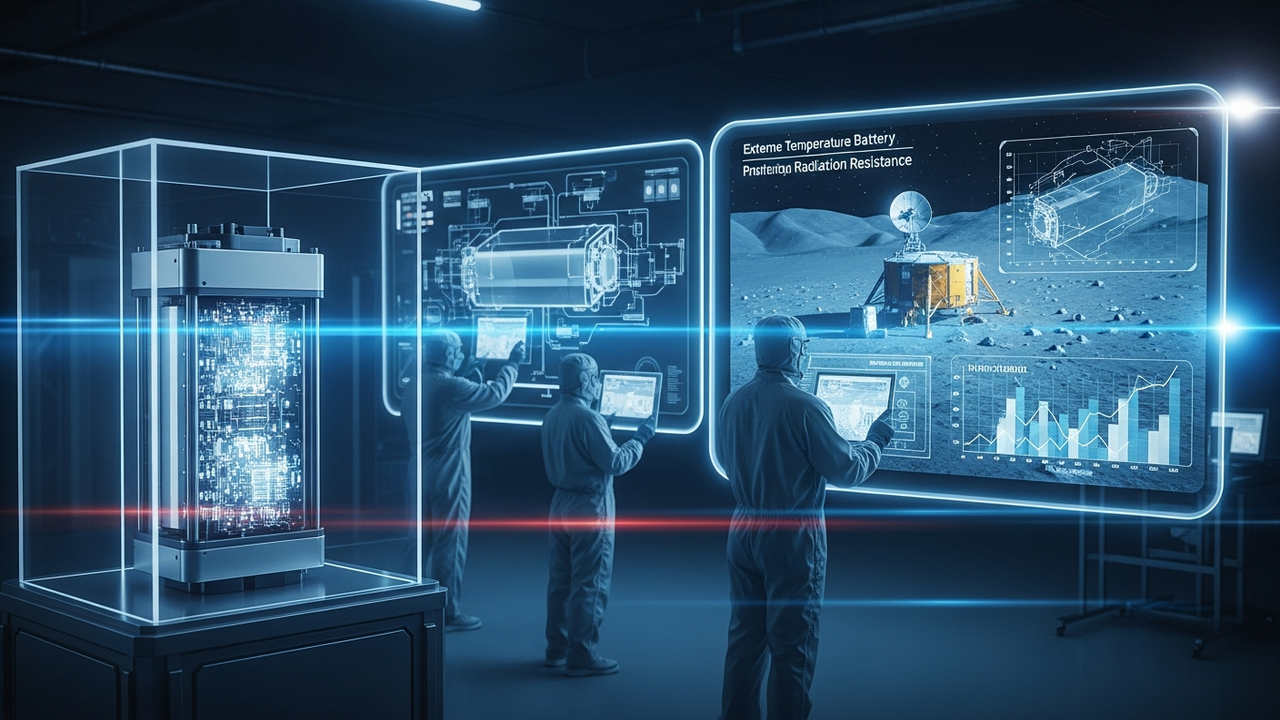
A prototype of a next-generation solid-state battery, specifically designed for use in the extreme conditions of the lunar environment, has been announced with validated superior performance. Compared to existing lithium-ion batteries, this novel solid-state battery exhibits minimal degradation in energy density and achieves more than double the cycle life, alongside significantly enhanced safety, even under extreme temperature cycles ranging from -170°C to 120°C and the harsh radiation unique to the lunar surface. This provides a critical, highly reliable, and durable power storage solution essential for lunar rovers and future lunar base power systems.
Technical Details
The developed solid-state battery incorporates a non-flammable, non-volatile solid electrolyte coupled with proprietary electrode materials that demonstrate high stability, such as nanostructured nickel-rich cathodes and silicon anodes. This design fundamentally eliminates the risks of electrolyte leakage and thermal runaway inherent in conventional liquid-based electrolytes, dramatically enhancing safety in space environments. Testing involved simulating a lunar surface environment (temperature cycles: -170°C to 120°C, vacuum: 10⁻⁷ Torr) within a thermal vacuum chamber, while simultaneously subjecting the battery to continuous space radiation (gamma rays, protons). The results showed that the battery maintained over 85% of its initial capacity after more than 500 charge-discharge cycles, significantly exceeding the average cycle life of current space-grade lithium-ion batteries (approx. 200 cycles). Furthermore, it demonstrated high resistance to external shocks and overcharging, enabling more robust operations.
Background & Context
Lunar exploration and future lunar base construction critically depend on power storage systems capable of withstanding the extreme diurnal temperature swings (approx. -173°C to 127°C) and high levels of cosmic radiation due to the lack of atmospheric shielding. Current space battery technologies, particularly lithium-ion batteries, face performance degradation and safety risks in these environments, limiting mission duration and operational scope. Solid-state batteries are anticipated as a next-generation technology to overcome these challenges. The results of this research provide a crucial technological foundation for realizing human lunar activities and long-duration autonomous lunar rover operations.
Strategic Significance & Outlook
This next-generation solid-state battery is expected to be adopted in a wide range of applications within human lunar exploration missions, such as the Artemis program, including lunar rovers, stationary power storage units, and lunar habitation modules. Its high energy density and excellent environmental resilience will enable longer and broader lunar activities, contributing to lunar resource utilization and deeper scientific exploration. Future plans include scaling up the prototype, conducting in-space validation tests, and accelerating development for integration into lunar landers and rovers. This technology represents a vital step towards establishing a sustainable human presence on the Moon.
Source: #
Get our weekly technology intelligence — free
Receive an infographic that lets you judge at a glance whether each field’s analysis report is worth reading.
Subscribe Free — Weekly Tech Intelligence
By subscribing, you’ll receive Troy-Technical’s weekly technology intelligence newsletter.
- Your email and selected fields are used only to deliver the newsletter.
- We never share your information with third parties.
- You can unsubscribe anytime via the link in each email.
See our Privacy Policy for details.
Takes about a minute · Unsubscribe anytime




Comments