Key Findings
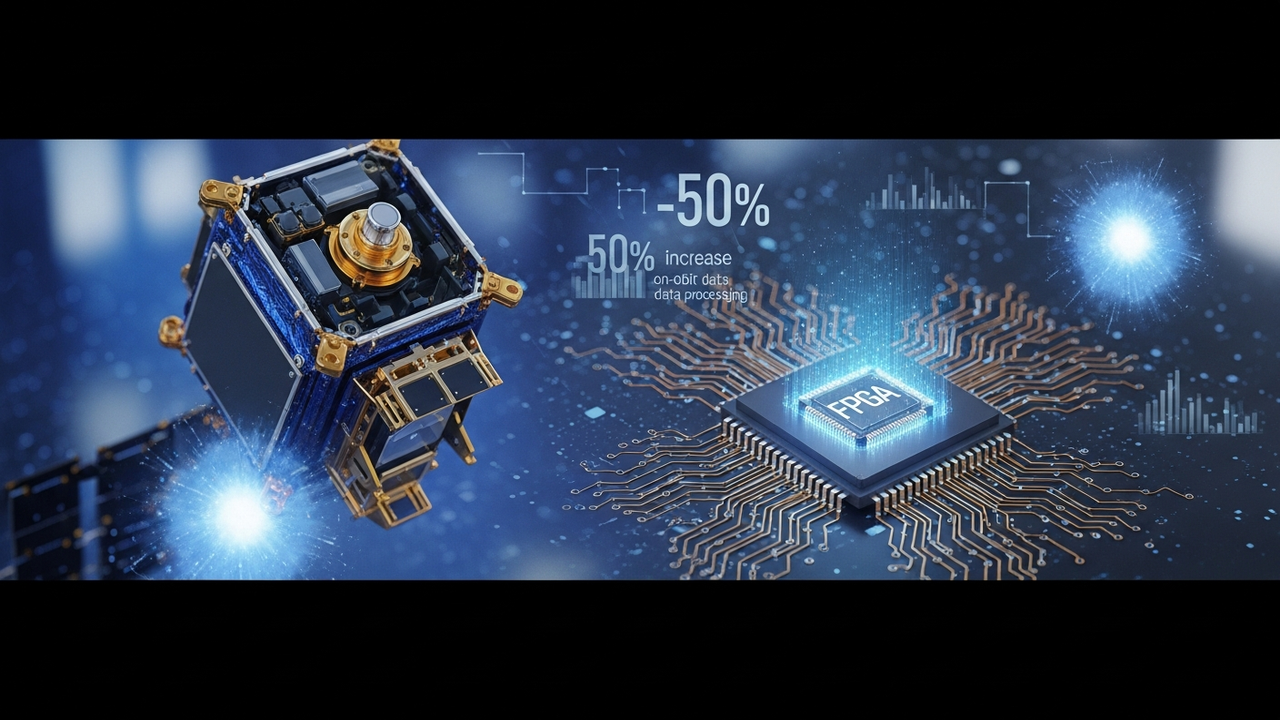
A new miniaturized and radiation-hardened FPGA (Field-Programmable Gate Array), specifically designed for small satellites, has been announced. This innovative FPGA significantly enhances robustness against Single Event Effects (SEE) and achieves a Total Ionizing Dose (TID) tolerance of over 300 krad, compared to existing commercial FPGAs. These improvements are expected to increase on-board data processing capabilities by up to 50%, marking a pivotal step towards highly capable small satellite constellations that can meet the increasing demand for real-time processing in Earth observation and communication missions.
Technical Details
The developed FPGA leverages an advanced process node combined with proprietary radiation-hardening techniques, such as optimized Triple Module Redundancy (TMR) and robust transistor structures, to maximize reliability in space environments. The device features an extremely compact footprint and low power consumption, adhering to the stringent mass, power, and volume constraints of small satellites. Radiation tests using particle accelerators demonstrated that under heavy ion irradiation with Linear Energy Transfer (LET) values of 60 MeV-cm²/mg, the error rate was reduced to less than 1/10th of conventional general-purpose FPGAs. This significantly mitigates the risk of software errors and data corruption in orbit. Furthermore, the FPGA’s reconfigurable architecture allows for in-mission functional updates and algorithm modifications, providing unprecedented operational flexibility.
Background & Context
The proliferation of small satellite constellations and the diversification and sophistication of applications—such as Earth observation, IoT communication, and space weather forecasting—have led to a surge in demand for on-orbit data processing. Historically, small satellites had limited processing capabilities, typically transmitting raw data to Earth for subsequent processing. However, the exponential increase in data volume and the necessity for real-time insights mandate advanced on-board processing. Radiation-hardened FPGAs offer an optimal solution to this challenge, becoming key enablers for small satellites to undertake more complex and autonomous missions.
Strategic Significance & Outlook
This miniaturized radiation-hardened FPGA is anticipated to be adopted across a wide array of small satellite missions, including cloud removal and image compression for Earth observation, on-board routing for communication satellites, and data analysis for space situational awareness. The enhanced reliability and processing power of this device will fundamentally reshape small satellite system design and foster further growth in the space data economy. Future efforts will focus on long-term in-space validation and establishing mass production capabilities for market entry, thereby accelerating the delivery of innovative space services via small satellites.
Source: #
Get our weekly technology intelligence — free
Receive an infographic that lets you judge at a glance whether each field’s analysis report is worth reading.
Subscribe Free — Weekly Tech Intelligence
By subscribing, you’ll receive Troy-Technical’s weekly technology intelligence newsletter.
- Your email and selected fields are used only to deliver the newsletter.
- We never share your information with third parties.
- You can unsubscribe anytime via the link in each email.
See our Privacy Policy for details.
Takes about a minute · Unsubscribe anytime









Comments