Key Findings
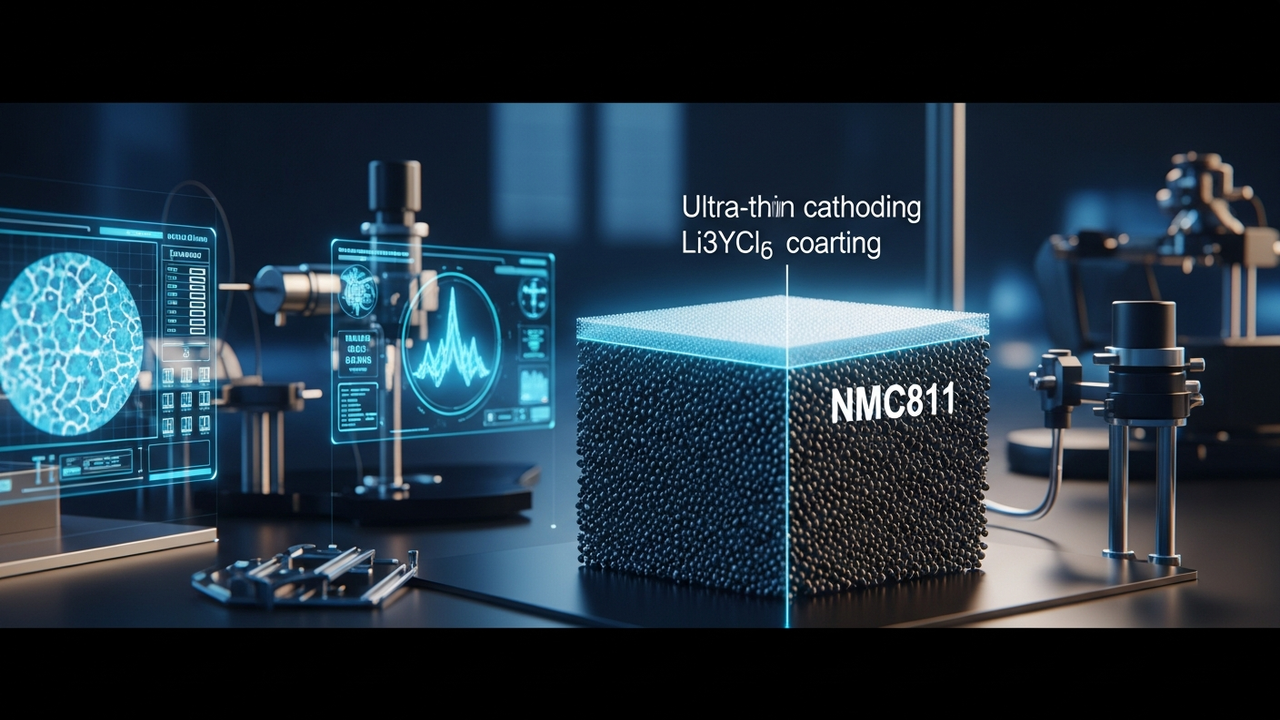
In a significant step towards realizing high-energy-density all-solid-state batteries, researchers have developed an innovative method to effectively suppress detrimental interfacial side reactions between nickel-rich layered cathodes (NMC811) and sulfide-based argyrodite solid electrolytes. Specifically, they successfully synthesized nanometer-thick Li3YCl6-based coatings on NMC811 cathode materials using a combination of liquid-phase deposition and low-temperature annealing. This ultrathin coated dry cathode demonstrated a reversible capacity of 200 mAh/g with remarkably improved cycling performance in solid-state half-cells featuring a high areal loading of 4 mAh/cm2. This represents a major advancement in the stability and high capacity potential for all-solid-state battery technology.
Technical / Clinical Details
Nickel-rich cathode materials like NMC811 are crucial for achieving high energy densities but often suffer from chemical instability and interfacial side reactions when in direct contact with sulfide solid electrolytes. The Li3YCl6-based coating acts as a protective layer on the cathode surface, physically and chemically blocking these undesirable reactions. The combined liquid-phase deposition and low-temperature annealing process allows for the precise formation of a uniform, defect-free thin film on the nanometer scale. This enables improved interfacial stability without impeding efficient ion transport. This coating technology is critical for maximizing the inherent high capacity of cathode active materials under stable cycling conditions, while also meeting practical demands for high areal loading, essential for compact and powerful batteries.
Background & Context
All-solid-state batteries are anticipated to be a game-changing next-generation battery technology for electric vehicles (EVs), promising extended driving ranges and significantly enhanced safety. However, achieving high energy density necessitates stable interfacial construction between high-capacity cathode materials and high-performance solid electrolytes, which has long been a bottleneck. High-nickel cathodes like NMC, due to their inherent reactivity, have presented particular challenges in ensuring interfacial stability. This research addresses this issue through a sophisticated interfacial engineering approach, marking a substantial step forward for the practical realization of high-energy-density all-solid-state batteries, attracting widespread industry attention.
Strategic Significance & Outlook
This Li3YCl6-based coating technology potentially offers broad applicability, not only to NMC811 cathodes but also to other high-capacity cathode materials and different solid electrolyte systems. Future efforts will focus on scaling up the manufacturing of this technology, reducing costs, and conducting comprehensive long-term reliability and safety evaluations in full-cell configurations. The achievement of stable cycling performance at high areal loading directly contributes to the miniaturization and lightweighting of EV battery packs, leading to improved driving range and cargo capacity. This breakthrough is expected to accelerate the commercialization of all-solid-state batteries, fostering further growth in the electric vehicle market and playing an indispensable role in the evolution of renewable energy storage systems.
Source: https://pubs.acs.org/doi/10.1021/acs.chemmater.6c00993
Get our weekly technology intelligence — free
Receive an infographic that lets you judge at a glance whether each field’s analysis report is worth reading.
Subscribe Free — Weekly Tech Intelligence
By subscribing, you’ll receive Troy-Technical’s weekly technology intelligence newsletter.
- Your email and selected fields are used only to deliver the newsletter.
- We never share your information with third parties.
- You can unsubscribe anytime via the link in each email.
See our Privacy Policy for details.
Takes about a minute · Unsubscribe anytime









Comments