Key Findings
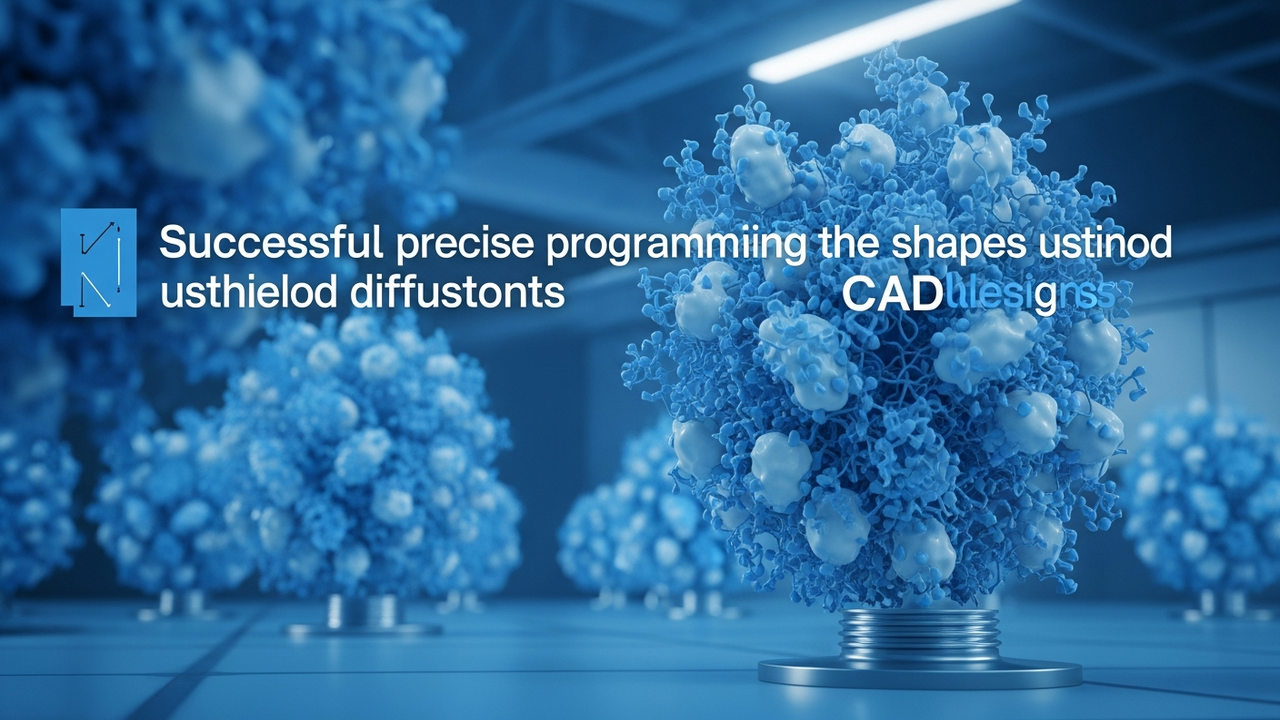
In a recent preprint, scientists have successfully established an innovative method for programming protein shapes directly from Computer-Aided Design (CAD) blueprints. This breakthrough, termed “CAD blueprint-guided diffusion,” offers unparalleled precision and control in designing protein structures, heralding a new era for advanced nanostructure engineering.
Technical Details
The method initiates by defining the desired protein structure as a digital CAD model. Subsequently, a diffusion mechanism is employed to guide the self-assembly of protein molecules based on this digital blueprint. Specifically, designed “scaffolds” spatially direct the arrangement of protein components, culminating in the formation of complex nanoscale geometries that precisely match the initial CAD design. This process diverges significantly from traditional random screening or empirical adjustments, yielding predictable and highly reproducible results. Researchers report successful construction of intricate hollow capsule structures with multiple functional sites and nanoparticles with specific interaction domains, demonstrating the technique’s versatility and precision.
Background & Context
Protein engineering has been pivotal in drug discovery, enzyme design, and biomaterial development, yet precise control over three-dimensional nanoscale structures has remained a significant challenge. The stringent control of shape at the nanoscale is critical for determining the performance of functional materials and devices. Prior techniques relied on algorithms for predicting structures from amino acid sequences or structure-based design, which faced limitations in crafting complex or multi-component architectures. The CAD blueprint-guided diffusion method represents a paradigm shift by applying macro-scale engineering design principles to the molecular level, offering a more deterministic path to novel protein architectures.
Strategic Significance & Outlook
This technology holds vast potential for applications across nanomedicine, including targeted drug delivery systems, high-performance catalytic nanobiosensors, self-healing materials, and scaffolds for regenerative medicine. For instance, it could enable the design of nanorobots that specifically bind to diseased cells or nanocages with optimized structures for maximizing enzyme activity. Furthermore, when combined with artificial intelligence, this approach could accelerate the automated design and synthesis of even more complex and diverse nanostructures, forming an indispensable foundational technology for the future advancement of materials science and bioengineering globally. The ability to dictate protein form with digital precision opens avenues for creating entirely new classes of functional biomaterials with tailored properties.
Source: #
Get our weekly technology intelligence — free
Receive an infographic that lets you judge at a glance whether each field’s analysis report is worth reading.
Subscribe Free — Weekly Tech Intelligence
By subscribing, you’ll receive Troy-Technical’s weekly technology intelligence newsletter.
- Your email and selected fields are used only to deliver the newsletter.
- We never share your information with third parties.
- You can unsubscribe anytime via the link in each email.
See our Privacy Policy for details.
Takes about a minute · Unsubscribe anytime






Comments