Key Findings
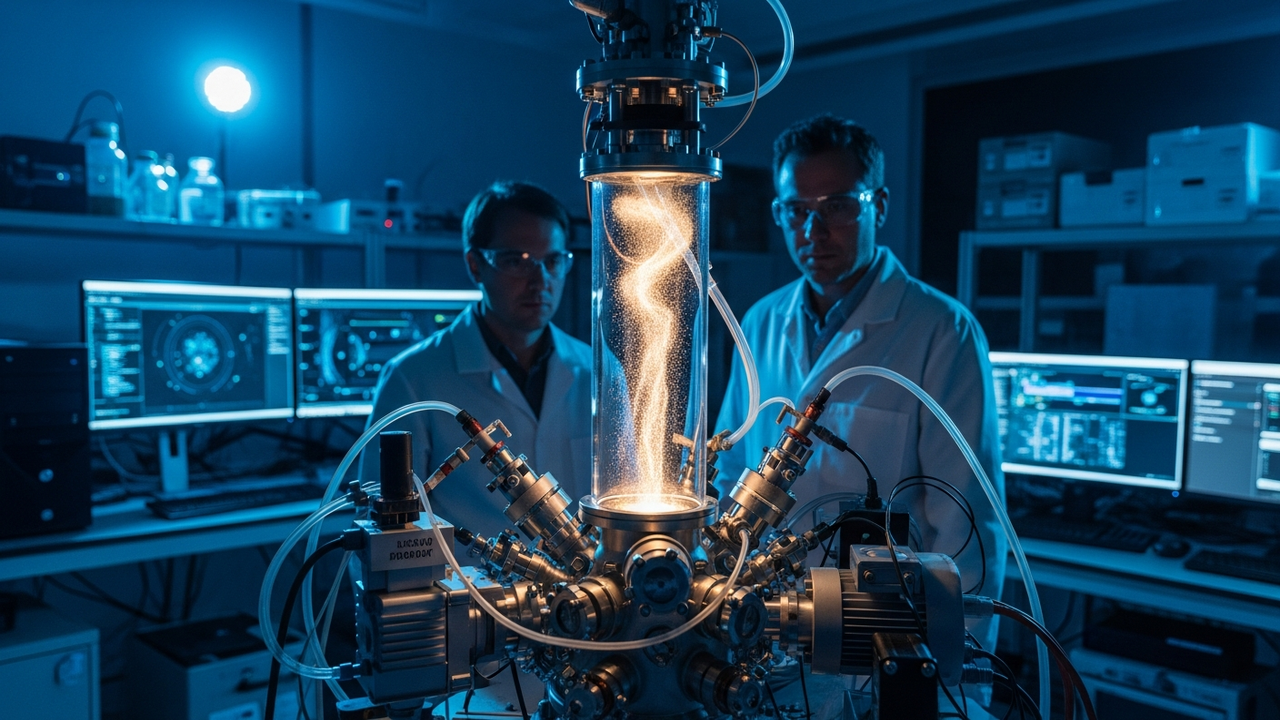
Scientists have successfully created cosmic dust from scratch by faithfully replicating the extreme conditions of outer space within glass tubes. This artificially synthesized cosmic dust has been confirmed to contain complex carbon-rich molecules, which are essential building blocks for life.
Technical / Clinical Details
The experiment involved first establishing an ultra-high vacuum inside glass tubes, followed by cooling them to extremely low temperatures, approaching absolute zero. Then, fundamental elements such as hydrogen, carbon, oxygen, and nitrogen were introduced in gaseous form and exposed to ultraviolet (UV) radiation. These conditions meticulously mimic the chemical reactions occurring in interstellar clouds and protoplanetary disks. Over a period of several weeks to months, the gaseous atoms and molecules combined to form micron-sized solid particles, i.e., cosmic dust. Analysis revealed that the generated dust is rich in polycyclic aromatic hydrocarbons (PAHs) and other organic molecules that could serve as basic skeletons for amino acids, providing direct evidence of how such molecules might form in space. This meticulous control over environmental parameters allows for precise studies of reaction kinetics and molecular evolution under extraterrestrial conditions.
Background & Context
Cosmic dust plays a pivotal role in our understanding of star formation, planet formation, and the origins of life. Specifically, carbon-rich cosmic dust containing organic molecules has been hypothesized to have delivered the ‘seeds’ of life to early Earth. However, directly observing the formation process of cosmic dust on Earth or conducting detailed compositional analyses has been challenging due to the difficulty of replicating such extreme experimental conditions. This research overcomes this long-standing hurdle, offering a powerful experimental platform to unravel the chemical origins of extraterrestrial life and the universality of complex organic molecules in the cosmos.
Strategic Significance & Outlook
This achievement in artificially generating cosmic dust will significantly advance research in astrophysics, planetary science, and astrobiology. Researchers will now be able to systematically investigate the formation pathways of organic molecules in various cosmic environments by generating dust under different initial conditions (e.g., elemental ratios, temperatures, UV radiation intensities). This capability is expected to provide crucial guidance for assessing the potential for life in exoplanetary systems and for guiding the search for biosignatures in future space exploration missions. Furthermore, the technique holds potential for the development of material synthesis technologies under extreme, space-like conditions, opening doors for creating novel materials with unique properties. The ability to control and analyze these processes in a lab setting is an unprecedented tool for cosmic discovery.
Source: https://www.sciencedaily.com/releases/2026/07/260719141011.htm
Get our weekly technology intelligence — free
Receive an infographic that lets you judge at a glance whether each field’s analysis report is worth reading.
Subscribe Free — Weekly Tech Intelligence
By subscribing, you’ll receive Troy-Technical’s weekly technology intelligence newsletter.
- Your email and selected fields are used only to deliver the newsletter.
- We never share your information with third parties.
- You can unsubscribe anytime via the link in each email.
See our Privacy Policy for details.
Takes about a minute · Unsubscribe anytime








Comments