Key Findings
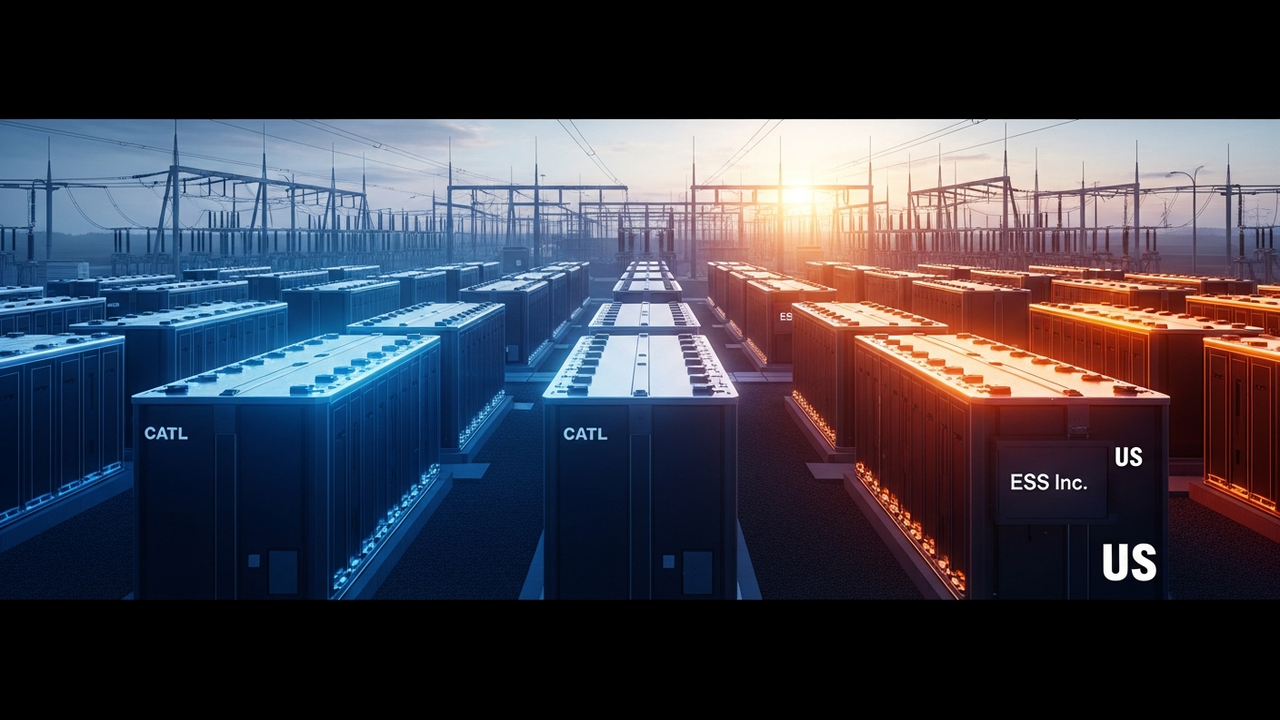
The market for grid-scale battery energy storage systems (BESS) based on non-lithium-ion chemistries is witnessing significant expansion, with major deployments announced in both Eastern Europe and the United States. Chinese battery giant CATL is collaborating with Solarpro on a 2GWh sodium-ion BESS project in Eastern Europe, signaling the technology’s readiness for large-scale application. Meanwhile, U.S.-based ESS Tech Inc. has secured a Letter of Intent (LOI) with Juniper Energy to supply over 500MWh of its long-duration iron flow battery systems across various U.S. locations.
Technical / Company Details
- CATL’s Sodium-Ion Venture: CATL, a leader in battery manufacturing, is supplying its advanced sodium-ion battery technology for a substantial 2GWh BESS project in Eastern Europe. This deployment is expected to support large-scale renewable energy integration and enhance grid stability in the region. Sodium-ion batteries offer advantages such as abundant raw materials, lower cost compared to lithium, and comparable performance in certain applications, making them an attractive alternative for utility-scale storage.
- ESS Tech Inc.’s Iron Flow Battery Expansion: ESS Tech Inc. specializes in iron flow batteries, a non-lithium, long-duration energy storage solution. Under the LOI with Juniper Energy, ESS will provide more than 500MWh of its systems, with an initial 10MW/80MWh project in California aiming for operational status by 2027. Iron flow batteries are renowned for their inherent safety, environmental friendliness, and ability to discharge for extended periods (e.g., 8-12+ hours), making them ideal for managing renewable energy intermittency and providing long-duration grid services.
Background & Context
The global energy transition is driving unprecedented demand for energy storage, particularly for integrating solar and wind power. While lithium-ion batteries have dominated the short-duration storage market, concerns over lithium supply chain vulnerability, environmental impact, and cost for very long durations have fueled the search for alternatives. Sodium-ion and iron flow batteries leverage readily available, low-cost materials, offering a compelling proposition for enhancing grid resilience and achieving decarbonization goals without increasing reliance on critical minerals. These advancements represent a crucial step in diversifying the energy storage landscape.
Strategic Significance & Outlook
These large-scale commitments by CATL and ESS Tech Inc. demonstrate that sodium-ion and iron flow battery technologies are transitioning from research and pilot stages to commercial maturity. The 2GWh deployment in Eastern Europe and the 500MWh+ rollout in the U.S. will serve as critical proof points for the performance and economic viability of these non-lithium chemistries. Their success could significantly accelerate the global shift towards more diversified and sustainable energy storage portfolios, potentially leading to reduced grid congestion, lower electricity costs, and a more robust integration of renewable energy sources worldwide. This marks a pivotal moment in expanding the options for reliable, long-duration energy storage.
Get our weekly technology intelligence — free
Receive an infographic that lets you judge at a glance whether each field’s analysis report is worth reading.
Subscribe Free — Weekly Tech Intelligence
By subscribing, you’ll receive Troy-Technical’s weekly technology intelligence newsletter.
- Your email and selected fields are used only to deliver the newsletter.
- We never share your information with third parties.
- You can unsubscribe anytime via the link in each email.
See our Privacy Policy for details.
Takes about a minute · Unsubscribe anytime






Comments