Key Findings
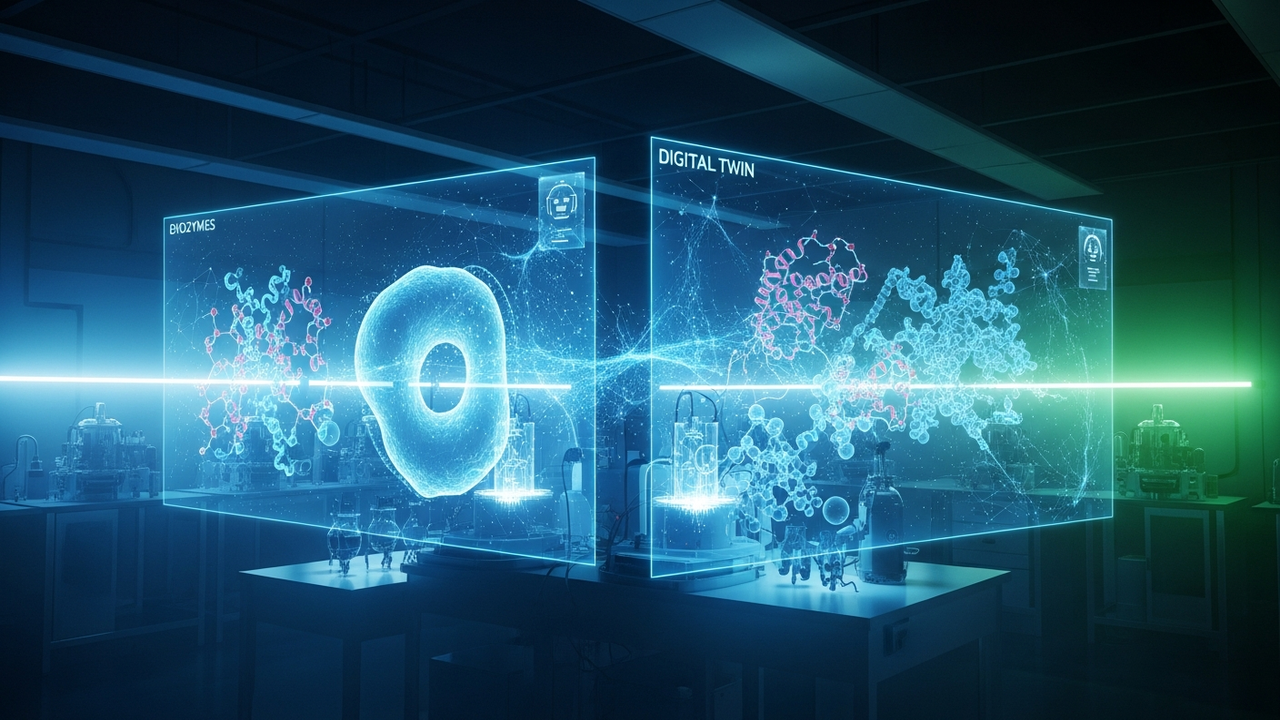
eXoZymes has been selected for the prestigious US Department of Energy’s (DOE) Genesis Mission, a pivotal initiative aimed at accelerating the development of AI-powered digital twin technology for cell-free biomanufacturing. This groundbreaking endeavor seeks to move beyond traditional trial-and-error approaches, dramatically enhancing the efficiency and reliability of bioprocesses through predictive modeling and optimization. With the support of the Genesis Mission, eXoZymes is at the forefront of innovating how biological manufacturing processes are designed, developed, and scaled, promising a paradigm shift in the biotech industry.
Technical / Clinical Details
The AI-powered digital twins developed by eXoZymes will feature a hybrid modeling approach that integrates expertise from multiple scientific disciplines. Specifically, it combines enzyme kinetics (describing reaction rates and mechanisms), reactor physics (modeling the environment where biomolecules are produced), and advanced machine learning algorithms. This integration enables the digital twin to predict the behavior of cell-free enzymatic processes with high fidelity and optimize performance under various operating conditions and raw material fluctuations. The digital twin will ingest real-time data, dynamically adjusting process parameters to explore design spaces that maximize the yield, purity, and production rate of target biomolecules. This technology is poised to significantly shorten the bioprocess development cycle and reduce the need for physical experimentation, thereby saving considerable time and resources.
Background & Context
Cell-free biomanufacturing holds immense promise for producing a wide range of bioproducts, including vaccines, diagnostics, regenerative medicine materials, and precision fermentation-derived food ingredients. However, traditional bioprocess development has historically relied on iterative and time-consuming experimentation, a factor that often delays the market entry of new products. The DOE’s Genesis Mission acknowledges this challenge and seeks to transform biomanufacturing by integrating AI and digital twin technologies. Such initiatives are aligned with broader national strategies to bolster US competitiveness in the bioeconomy and enhance the resilience of domestic supply chains. Digital twin technology, already proven successful in sectors like automotive and aerospace, is now set to bring a similar transformative impact to bioprocess engineering.
Strategic Significance & Outlook
The advancement of AI-powered digital twin technology by eXoZymes has the potential to revolutionize the field of cell-free biomanufacturing. In the future, this technology is expected to expand to other biomanufacturing platforms, including more complex cell-based processes. Digital twins will enable companies to develop and bring new biomolecule products to market more rapidly and cost-effectively. This will be a critical factor in accelerating the pace of innovation across all sectors leveraging biotechnology, including pharmaceuticals, food, and chemical industries. The DOE’s support serves as a crucial catalyst for this technology’s rapid translation from fundamental research to practical manufacturing solutions, significantly contributing to the strengthening of US biomanufacturing capabilities.
Get our weekly technology intelligence — free
Receive an infographic that lets you judge at a glance whether each field’s analysis report is worth reading.
Subscribe Free — Weekly Tech Intelligence
By subscribing, you’ll receive Troy-Technical’s weekly technology intelligence newsletter.
- Your email and selected fields are used only to deliver the newsletter.
- We never share your information with third parties.
- You can unsubscribe anytime via the link in each email.
See our Privacy Policy for details.
Takes about a minute · Unsubscribe anytime