Key Findings
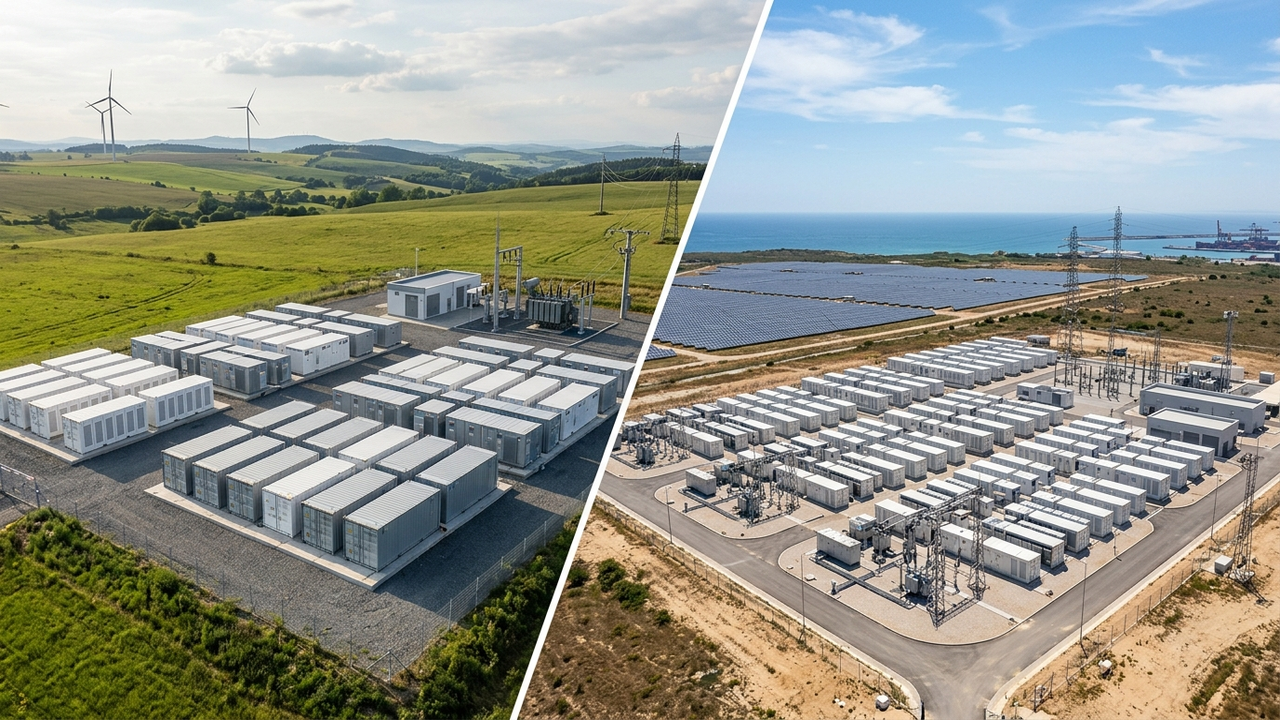
Battery Energy Storage System (BESS) deployment is undergoing a rapid acceleration across the entirety of Europe. Notably, the Czech Republic connected a substantial 318MWh of new battery capacity to its grid in the first half of 2026, featuring the operational 57MW/120MWh Lipnice project, now the largest BESS in the country. European nations are actively pursuing aggressive deployment policies, positioning BESS as a cornerstone solution to address the critical challenges of grid stabilization and enhanced flexibility brought about by the rapid expansion of renewable energy sources.
Country-Specific Initiatives and Policy Details
- Czech Republic: The addition of 318MWh in H1 2026 marks a significant milestone in the country’s clean energy transition. Large-scale BESS projects like Lipnice are crucial for absorbing fluctuations from solar and wind power, playing an indispensable role in maintaining stable grid operations.
- Portugal: Has adopted a bold policy, allocating over 1 gigavolt-ampere (GVA) of grid capacity specifically for energy storage. This demonstrates a strong governmental commitment to accelerating renewable energy penetration and alleviating grid bottlenecks.
- Ireland: Established a dedicated market pathway for procuring 500MW of energy storage with a minimum 4-hour duration. This policy aims to incentivize investment in long-duration energy storage solutions and enhance the resilience of its wind-rich power grid.
- Greece: Is actively offering attractive revenue models for BESS projects, drawing significant interest from investors and developers. This strategy is linked to power market liberalization and revisions to Feed-in Tariff (FIT) schemes, serving as a prime example of market-based mechanisms promoting storage deployment.
Background and Industry Context
The European Union (EU) is committed to achieving carbon neutrality by 2050, necessitating accelerated renewable energy integration. However, the intermittent nature of solar and wind power poses challenges to grid stability and reliability. BESS dramatically improves grid flexibility by absorbing these fluctuations, storing electricity, and dispatching it when needed. Furthermore, BESS provides various ancillary services, such as frequency regulation and black start capabilities, enhancing overall grid efficiency and reliability. Governments across Europe are leveraging a diverse toolkit of policy instruments, including FIT schemes, auction mechanisms, and grid capacity allocations, to cultivate their respective BESS markets.
Future Outlook and Strategic Significance
The vibrant BESS market in Europe signals that the clean energy transition has entered a new phase. Aggressive national deployments and policy support are expected to drive further innovation and cost reductions in BESS technology, leading to larger, more economical solutions. BESS is unequivocally becoming indispensable infrastructure in Europe’s energy landscape, serving as the ‘final piece’ for renewable energy integration. Its contribution to strengthening grid resilience and achieving decarbonization targets is highly anticipated.
Get our weekly technology intelligence — free
Receive an infographic that lets you judge at a glance whether each field’s analysis report is worth reading.
Subscribe Free — Weekly Tech Intelligence
By subscribing, you’ll receive Troy-Technical’s weekly technology intelligence newsletter.
- Your email and selected fields are used only to deliver the newsletter.
- We never share your information with third parties.
- You can unsubscribe anytime via the link in each email.
See our Privacy Policy for details.
Takes about a minute · Unsubscribe anytime









Comments