Key Findings
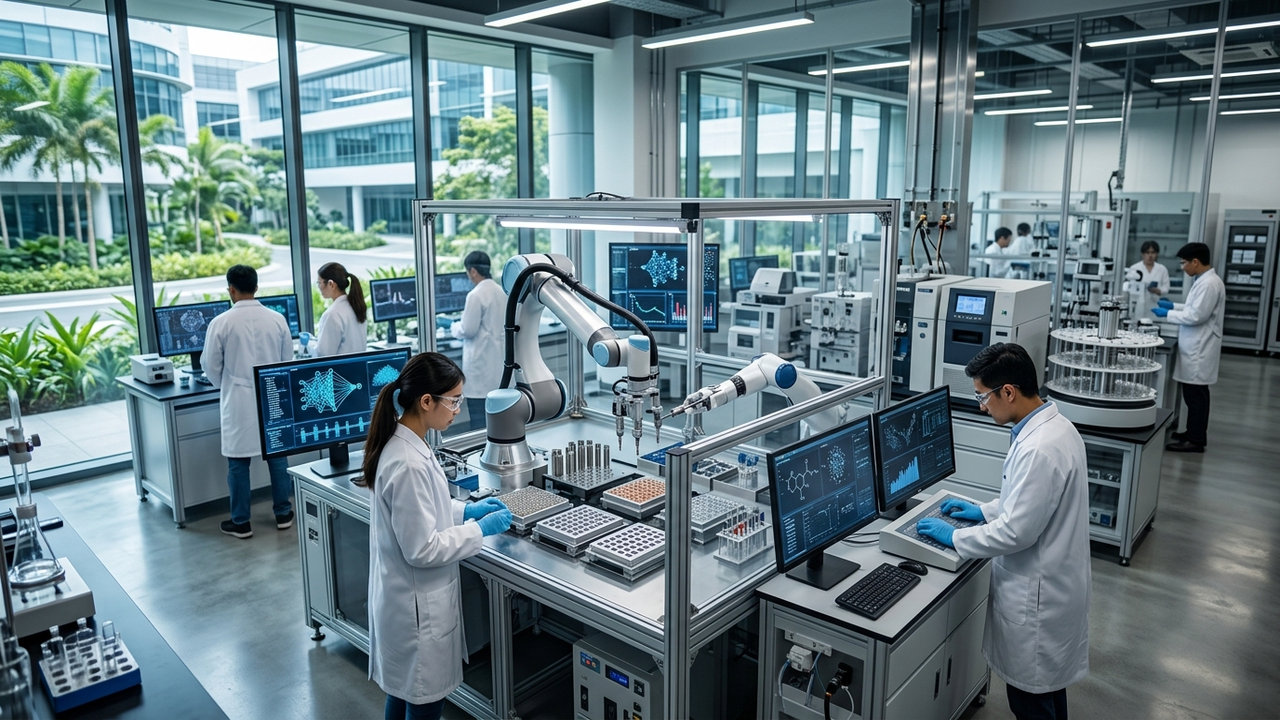
Professor Shyue Ping Ong at the National University of Singapore (NUS) is spearheading a groundbreaking initiative to establish an “AI Foundry,” a pioneering platform designed to dramatically accelerate materials discovery. By seamlessly integrating artificial intelligence, vast repositories of scientific data, and advanced automated experimental techniques, this foundry aims to compress the traditional materials discovery cycle from several months down to a mere matter of weeks. This represents a fundamental paradigm shift in how new materials are conceptualized, developed, and brought to market.
Technical / Clinical Details
- The AI Foundry leverages sophisticated data-driven AI models, high-performance computing capabilities, and robotic automation to streamline the design, synthesis, and characterization processes for novel materials.
- Initial research programs within the foundry are strategically focused on high-performance materials, including high-entropy alloys (HEAs) and advanced ceramics. These materials are critical for demanding applications in fields such as fusion energy and aerospace, where extreme environmental conditions necessitate superior material properties.
- A crucial aspect of this initiative is the establishment of a robust commercialization pathway through Elemynt, a deep-tech company based in Singapore and co-founded by Professor Ong. Elemynt is tasked with translating the AI-driven material designs and discoveries into tangible industrial practices and products, ensuring that academic breakthroughs find real-world application.
Background & Context
Historically, materials discovery has been a protracted and capital-intensive endeavor, relying heavily on iterative, labor-intensive cycles of hypothesis generation, experimentation, and characterization. This manual process has often been a bottleneck, especially in the quest for novel materials with specific, high-performance attributes. The advent of advanced AI and robotics offers an unprecedented opportunity to overcome these limitations, enabling a more efficient, systematic, and comprehensive exploration of the vast materials design space. Globally, institutions are increasingly recognizing the strategic importance of integrating AI into scientific discovery to maintain technological competitiveness.
Strategic Significance & Outlook
The NUS AI Foundry is positioned to lead a significant transformation in materials science, enabling faster innovation across various sectors. The drastic reduction in discovery cycles is expected to accelerate breakthroughs in new energy technologies, advanced electronic devices, next-generation mobility solutions, and more. The commercialization strategy through Elemynt provides a compelling model for how academic research can be rapidly translated into economic value and societal impact, potentially influencing other research institutions and startups worldwide. As the AI Foundry platform becomes more generalized, its application across diverse material systems promises to significantly advance the broader field of materials science, strengthening Singapore’s position as a hub for deep technology innovation.
Source: https://cde.nus.edu.sg/news/building-an-ai-foundry-to-transform-materials-discovery/
Get our weekly technology intelligence — free
Receive an infographic that lets you judge at a glance whether each field’s analysis report is worth reading.
Subscribe Free — Weekly Tech Intelligence
By subscribing, you’ll receive Troy-Technical’s weekly technology intelligence newsletter.
- Your email and selected fields are used only to deliver the newsletter.
- We never share your information with third parties.
- You can unsubscribe anytime via the link in each email.
See our Privacy Policy for details.
Takes about a minute · Unsubscribe anytime








Comments