Key Findings
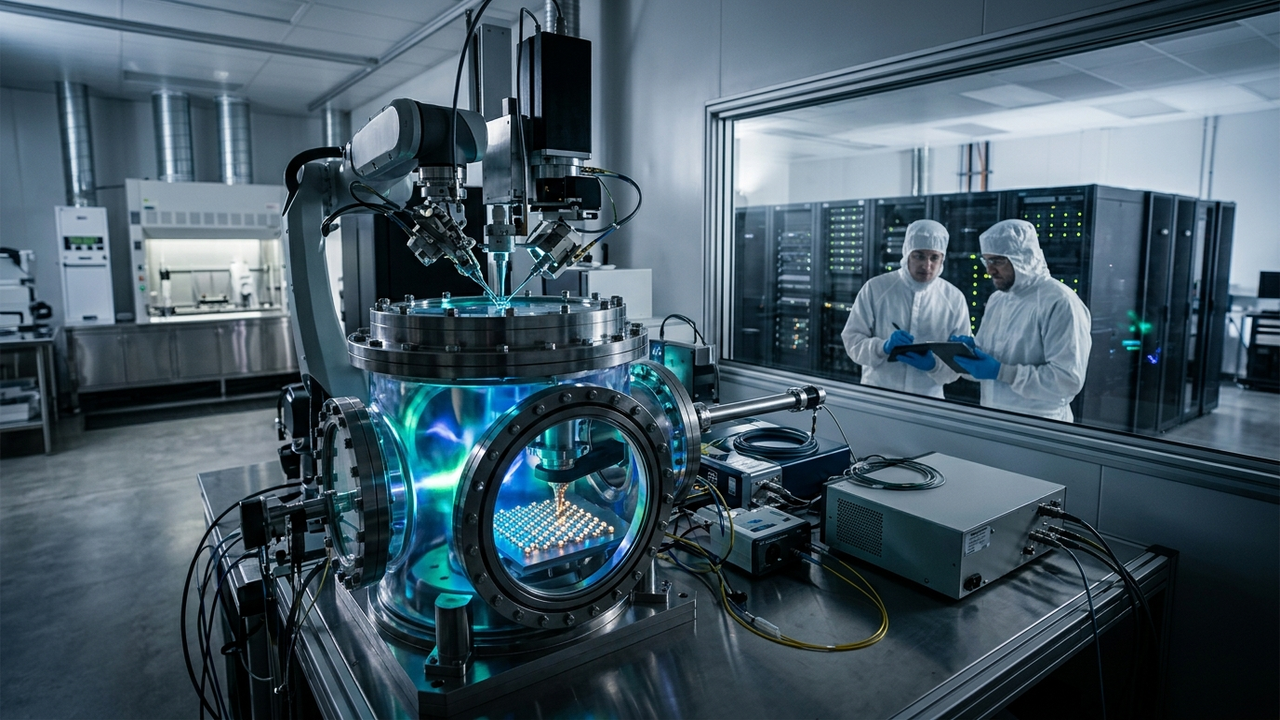
A research team at Oak Ridge National Laboratory has developed an Artificial Intelligence (AI) system capable of autonomously constructing custom atomic-scale patterns. This is achieved by guiding an ultra-sharp microscope tip to precisely manipulate individual molecules on a copper surface. This groundbreaking accomplishment represents the first time AI has independently achieved such atomic-level precision, previously only possible through manual human intervention, marking a significant step forward in the design and development of new electronic and quantum materials. The system heralds an era of autonomous discovery and synthesis in materials science.
Technical & Clinical Details
The AI system operates by controlling the probe of a scanning tunneling microscope (STM), which can perform ‘atomic manipulation’ by picking up and relocating individual atoms or molecules to predetermined positions. Historically, this operation was extremely time-consuming and relied on the manual expertise of highly skilled researchers. Oak Ridge’s AI integrates image recognition and reinforcement learning techniques to detect molecular positions in real-time and autonomously plan and execute the sequence of operations required to form target patterns. This has drastically reduced the process time from hours or days to minutes or hours, significantly boosting the efficiency of atomic-scale structure construction. Its efficacy was demonstrated in experiments where C60 fullerene molecules were arranged on a copper surface to form nanostructures with specific electronic properties. This capability holds promise for foundational research into next-generation materials such as superconductors, topological insulators, and quantum dots.
Background & Industry Context
Precise atomic-scale manipulation of materials forms the bedrock for future technologies, including quantum computing, high-performance electronic devices, and novel energy conversion technologies. However, the inherent complexity and manual limitations have long posed a bottleneck in research and development. The realization of autonomous atomic manipulation by AI offers a potential solution to this fundamental challenge. It paves the way for the ultimate form of ‘inverse design’ in materials science, where desired properties dictate the structural design. If scientists can define specific electronic or quantum properties, the AI could autonomously determine and build the atomic structures necessary to achieve those properties, shifting the materials discovery paradigm from ‘trial-and-error’ to ‘goal-driven.’
Strategic Significance & Outlook
This breakthrough from Oak Ridge National Laboratory foreshadows a future where AI is deeply integrated across all phases of materials science, from fundamental research to applied development. Future advancements are expected to enable this AI system to manipulate multiple types of molecules or atoms simultaneously, constructing even more complex 3D nanostructures. This will accelerate the prototyping of new quantum devices and the experimental validation of novel materials that were previously only theoretical. Furthermore, this technology will drive the evolution of autonomous research labs (Self-Driving Labs), enabling ‘closed-loop’ materials science research that dramatically shortens the material development cycle. Ultimately, a truly innovative materials innovation ecosystem is envisioned, where AI autonomously designs, synthesizes, and characterizes materials based on human-defined objectives.
Source: https://www.ornl.gov/news/ai-automates-creation-custom-materials
Get our weekly technology intelligence — free
Receive an infographic that lets you judge at a glance whether each field’s analysis report is worth reading.
Subscribe Free — Weekly Tech Intelligence
By subscribing, you’ll receive Troy-Technical’s weekly technology intelligence newsletter.
- Your email and selected fields are used only to deliver the newsletter.
- We never share your information with third parties.
- You can unsubscribe anytime via the link in each email.
See our Privacy Policy for details.
Takes about a minute · Unsubscribe anytime









Comments