
Key Findings
A thesis from Simon Fraser University (SFU) presents a groundbreaking application of two-dimensional (2D) materials in sensing, specifically reporting the successful development of a sensor for lung cancer biomarkers that operates at room temperature. This sensor achieved a remarkably low detection limit of 176 ppb and rapid response/recovery times, demonstrating high performance retention even on flexible substrates.
Technical & Clinical Details
The developed sensor leverages the superior physicochemical properties of 2D materials to specifically detect volatile organic compound (VOC) biomarkers, 2-butanone and 1-propanol, associated with lung cancer. The sensor’s performance is notable for the following key characteristics:
- **Low Detection Limit**: Its ability to detect biomarkers at concentrations as low as 176 ppb makes it highly valuable for early-stage disease screening.
- **Rapid Response/Recovery Time**: The fast performance, with a response time of just 3 seconds and a recovery time of 15 seconds, is crucial for real-time monitoring applications.
- **Flexibility and Durability**: In tests on flexible substrates, the sensor maintained over 80% of its performance. This indicates that the sensor is robust against bending and deformation, making it highly suitable for integration into wearable devices.
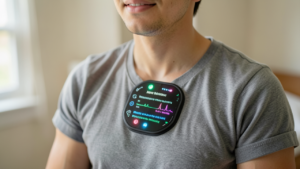
These features suggest significant potential for wearable sensors that non-invasively detect biomarkers from a patient’s breath, representing a transformative step forward in early lung cancer diagnosis.
Background & Context
Lung cancer is one of the leading causes of cancer-related deaths globally, and early detection is directly correlated with improved survival rates. However, current diagnostic methods (e.g., CT scans, biopsies) are often invasive, expensive, carry radiation exposure risks, and have limitations in screening at early stages. Non-invasive breath analysis for biomarker detection has been a promising area of research to overcome these challenges. 2D materials, with their high surface-to-volume ratio, excellent electron mobility, and tunable bandgaps, have attracted significant attention in gas sensor and biosensor applications. Their application in flexible wearable devices holds the potential to profoundly change the paradigm of daily health monitoring and disease screening.
Strategic Significance & Outlook
This 2D material-based sensor technology has the potential to revolutionize early lung cancer diagnosis. As development progresses towards flexible wearable sensors, it will enable continuous health monitoring outside of clinical settings and regular screening for high-risk populations. This will improve early detection rates for lung cancer and contribute to better treatment outcomes. In the future, this platform is also expected to be applied to detect biomarkers for other diseases, serving as a foundation for personalized preventive medicine. This research marks an important step in driving next-generation advancements in diagnostic technology.
Source: https://summit.sfu.ca/_flysystem/fedora/2026-09/etd23883.pdf
Get our weekly technology intelligence — free
Receive an infographic that lets you judge at a glance whether each field’s analysis report is worth reading.
Subscribe Free — Weekly Tech Intelligence
By subscribing, you’ll receive Troy-Technical’s weekly technology intelligence newsletter.
- Your email and selected fields are used only to deliver the newsletter.
- We never share your information with third parties.
- You can unsubscribe anytime via the link in each email.
See our Privacy Policy for details.
Takes about a minute · Unsubscribe anytime








Comments