Key Findings
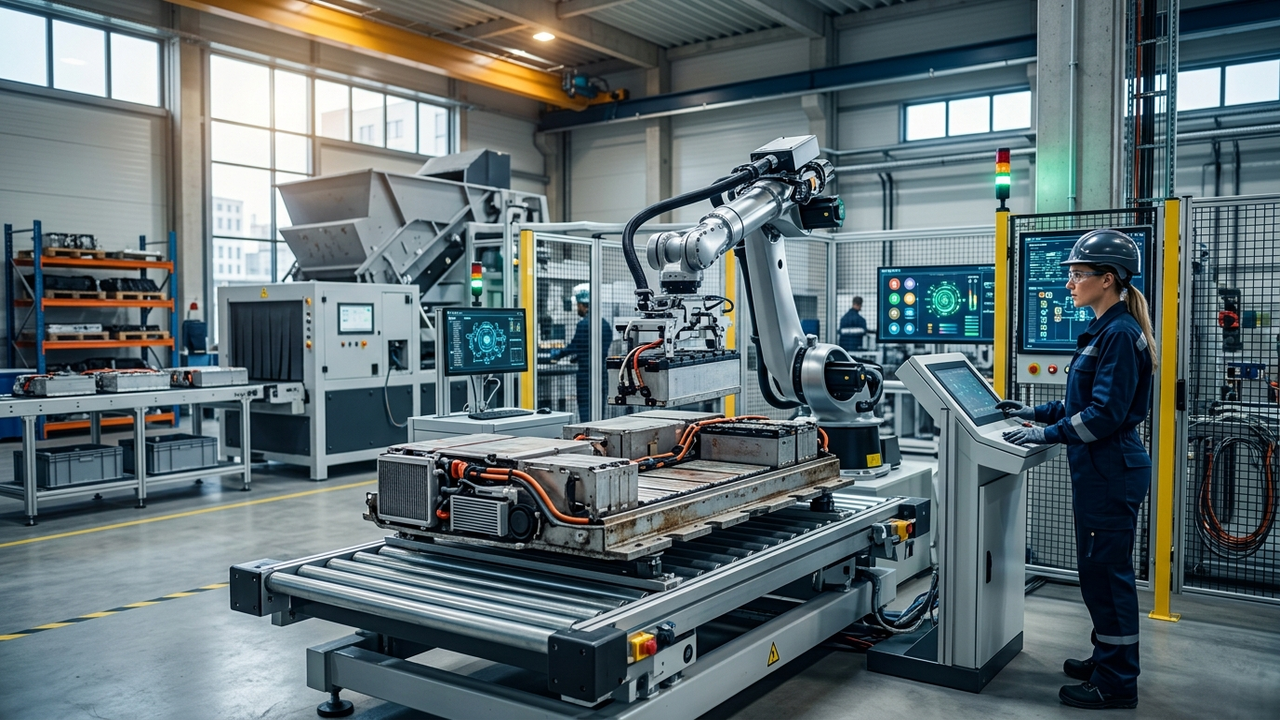
The EU-funded BATRAW research project has developed innovative technologies for the efficient disassembly, recycling, recovery, and reuse of critical raw materials such as cobalt, nickel, and lithium from end-of-life electric vehicle (EV) batteries. The project’s most significant achievement is the realization of an advanced semi-automated battery disassembly line that integrates robotics, AI-based vision systems, and laser cutting technology. This system successfully reduced processing time by 50% to 60% compared to manual disassembly, while simultaneously greatly enhancing worker safety.
Technical Details
The semi-automated disassembly line developed by the BATRAW project first uses an AI vision system to recognize the structure of battery packs, accurately identifying hazardous high-voltage points and cell arrangements. Robotic arms then utilize laser cutting technology to precisely and rapidly separate bonded modules and inter-cell connections. This process reduces the risk of physical damage compared to traditional mechanical disassembly methods, enabling the recovery of materials at higher purity. The system also integrates mechanisms to manage potentially harmful gases and heat generated during the disassembly process, contributing to a safer working environment and reduced environmental impact. The technology is designed to accommodate various battery designs and chemical compositions, offering scalability for future battery technology advancements.
Background and Industry Context
With the accelerating adoption of electric vehicles, the proper processing of end-of-life EV batteries and the recycling of their raw materials are critical challenges from both environmental protection and resource security perspectives. Rare metals like cobalt and lithium, in particular, are subject to geopolitical risks and supply constraints, making their recovery rates essential for the sustainable development of the EV industry. However, EV batteries have complex structures, high-voltage risks, and robust adhesive bonding, making their disassembly and recycling difficult and costly. The achievements of the BATRAW project resolve this bottleneck, establishing a more economical and safer battery recycling process that significantly contributes to a circular economy.
Strategic Significance and Outlook
The technology developed by the BATRAW project holds the potential to bring about significant transformation in the EV battery recycling industry. In the future, commercial scale-up of this semi-automated disassembly line and its deployment across recycling facilities worldwide are anticipated. Furthermore, the recovered high-quality raw materials will be reused in new battery manufacturing, enhancing the sustainability of the entire supply chain. This technology is expected to be applied to the recycling of other electronic devices and industrial batteries, potentially serving as a model case for promoting a circular economy. Through this project, the EU aims to foster efficient resource utilization across the entire battery value chain and strengthen its strategic autonomy.
Source: https://cordis.europa.eu/article/id/466760-new-life-for-a-dead-battery
Get our weekly technology intelligence — free
Receive an infographic that lets you judge at a glance whether each field’s analysis report is worth reading.
Subscribe Free — Weekly Tech Intelligence
By subscribing, you’ll receive Troy-Technical’s weekly technology intelligence newsletter.
- Your email and selected fields are used only to deliver the newsletter.
- We never share your information with third parties.
- You can unsubscribe anytime via the link in each email.
See our Privacy Policy for details.
Takes about a minute · Unsubscribe anytime






Comments