


Key Findings
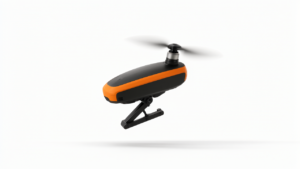
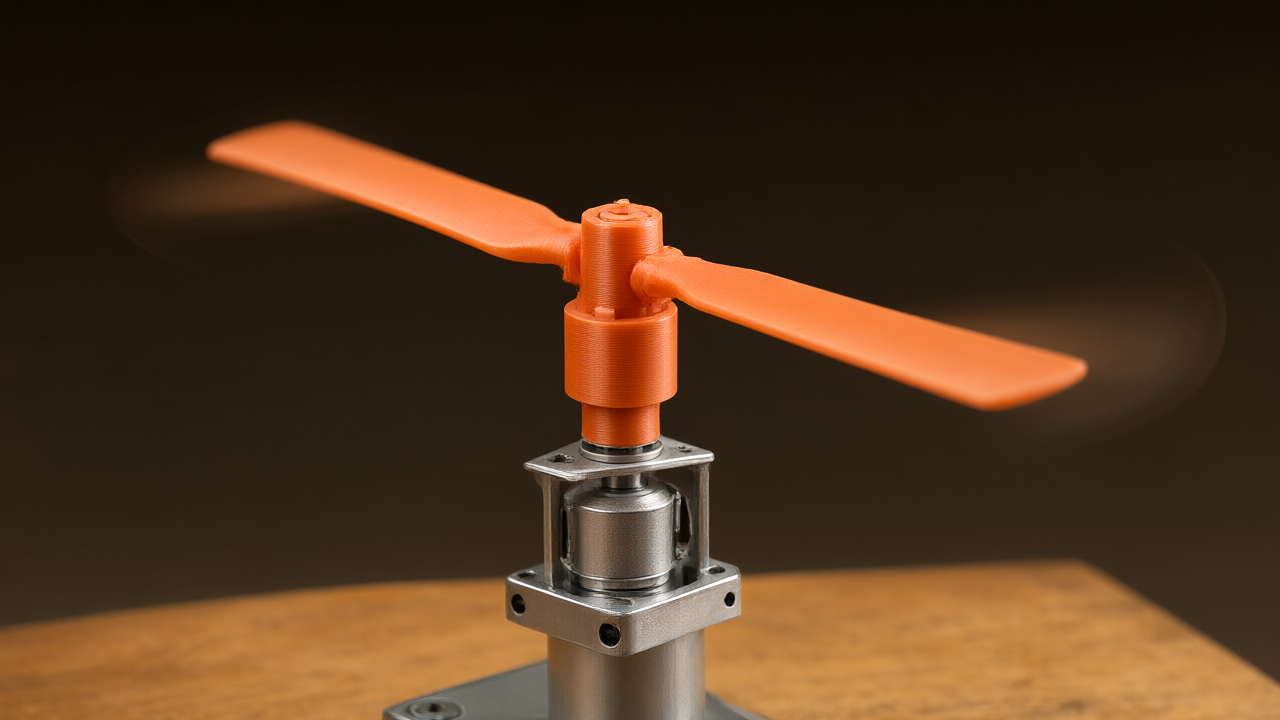
The final iteration of the 3D printed micro helicopter rotor lifts approximately 140 grams at 5,500 RPM while drawing 29 watts. Steering is achieved through a single motor that modulates speed within each turn to change blade pitch, eliminating the need for a swashplate and servos to reduce overall weight for FPV gear integration.
Technical Details
- Control Mechanism: The design utilizes a hinged underactuated rotor. A single center hinge was found to provide more control authority and faster response than dual-hinge configurations, which suffered from friction and dead zones.
- Material Science: Standard PLA outperformed high-temperature PLA in stiffness. To avoid weak layer lines, the maker used a custom Fusion script to create flat blanks, which were then heat-pressed into molds.
- Performance Gains: The final blade design improved lift by 47% and efficiency by 26% compared to an initial MATLAB-based design.
- Stability: Small bolts and nuts were added as balance weights to correct twisting caused by drag and to damp the rotor’s inertia, reducing overshoot and resonance.
Background and Context
The project initially attempted to replicate the wheeled swashplate design from the Black Hornet military nano drone. However, three versions of this design failed due to friction issues, including rotor locking and wear on the wheels. The developer shifted to the one-motor principle, similar to designs explored by Tom Stanton and Joshua Bird.
Significance and Outlook
While the rotor has only been tested on a stand and has not yet flown, the project shifts the complexity from mechanical hardware to electronics. Steering requires one speed pulse per revolution—roughly 92 pulses per second at 5,500 RPM. Because standard drone ESCs may lose sync above 50 pulses per second, the next phase involves a custom PCB to handle the necessary position sensing and control.
Source: https://dronexl.co/2026/10/21/worked-in-theory-3d-printed-micro-helicopter-rotor/
Get our weekly technology intelligence — free
Receive an infographic that lets you judge at a glance whether each field’s analysis report is worth reading.
Subscribe Free — Weekly Tech Intelligence
By subscribing, you’ll receive Troy-Technical’s weekly technology intelligence newsletter.
- Your email and selected fields are used only to deliver the newsletter.
- We never share your information with third parties.
- You can unsubscribe anytime via the link in each email.
See our Privacy Policy for details.
Takes about a minute · Unsubscribe anytime