Key Findings
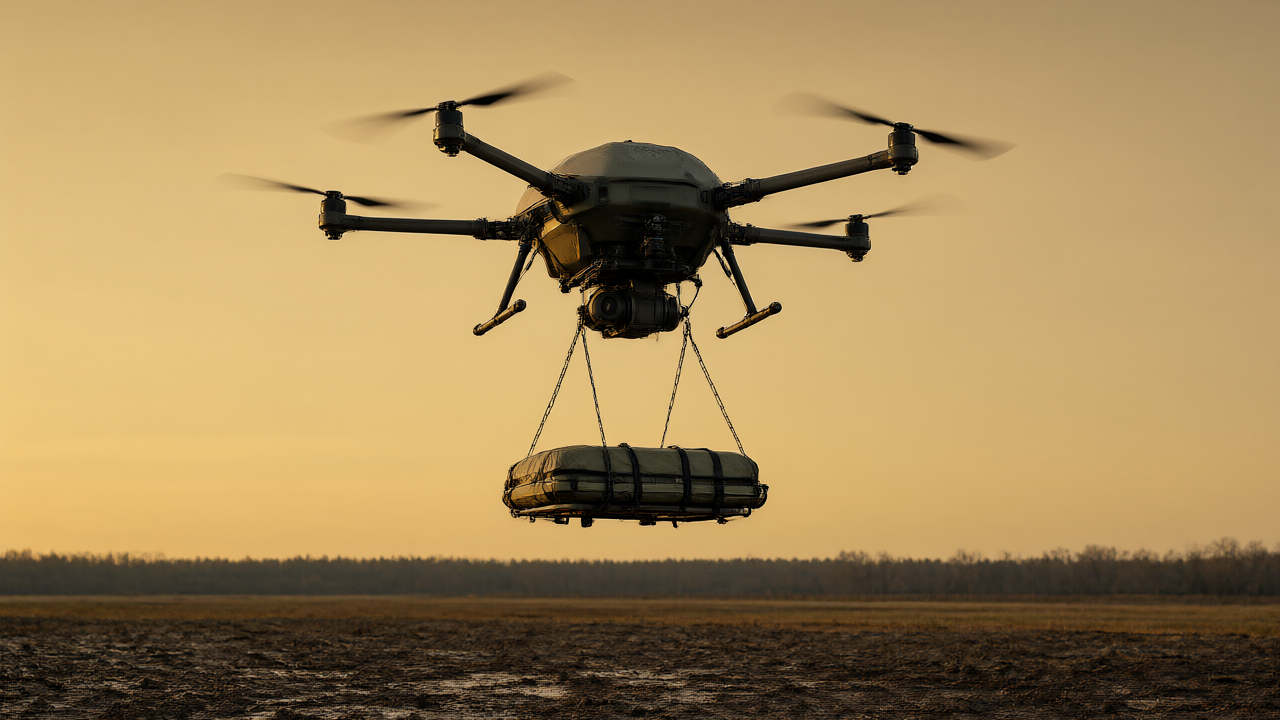
A Ukrainian soldier from the 92nd Separate Assault Brigade was successfully evacuated from a combat zone using a Heavy Shot “Ayudag-6” hexacopter. The operation was necessitated by severe leg injuries sustained by the soldier, identified as 49-year-old Kostiantyn, who was pinned down in a “grey zone” between Ukrainian and Russian positions. Due to heavy mining and Russian fire, armored vehicles and conventional helicopters were deemed impossible to deploy.
Technical Details
The Ayudag-6, developed by Gurzuf Defence, is a 98-kg aircraft capable of lifting up to 130 kg. While typically used for heavy logistics and munitions delivery, this unit was heavily modified for medevac operations. Technical upgrades included:
- Communications: Integration of a Starlink system with anti-jamming capabilities.
- Recovery Hardware: An electric cargo winch and a modular harness designed to carry supplies out and a patient back.
- Sensors: Installation of night-vision and thermal-imaging systems.
- Flight Dynamics: Airframe upgrades to increase stability and prevent the patient from swinging excessively during transit.
The mission was executed by operators from the 92nd Brigade’s Unmanned Systems unit. The drone delivered the harness to the soldier, who secured himself under guidance from fellow soldiers, before being airlifted to a secure location and subsequently transported to Kharkiv Military Hospital.
Background and Context
Aerial medevac has evolved from modified Dorand AR.1 biplanes used by the French Air Service in World War I to the first helicopter evacuations by the US Army Air Force in Burma in 1944. While modern military medevac is routine and often includes intensive care equipment, the specific conditions of this incident—characterized by heavy mining and active fire—rendered standard evacuation methods impossible.
Significance and Outlook
The collaboration between the 10th Army Corps, the 92nd Brigade, and Gurzuf Defence marks a shift in UAS application from logistics and strike missions to active casualty recovery. The successful extraction of a human patient via a modular hexacopter provides a proof-of-concept for autonomous or remotely piloted recovery in environments where manned aircraft are too vulnerable to operate.
Source: https://newatlas.com/military/ukrainian-hexacopter-drone-world-first-aerial-medevac/
Get our weekly technology intelligence — free
Receive an infographic that lets you judge at a glance whether each field’s analysis report is worth reading.
Subscribe Free — Weekly Tech Intelligence
By subscribing, you’ll receive Troy-Technical’s weekly technology intelligence newsletter.
- Your email and selected fields are used only to deliver the newsletter.
- We never share your information with third parties.
- You can unsubscribe anytime via the link in each email.
See our Privacy Policy for details.
Takes about a minute · Unsubscribe anytime