

Key Findings
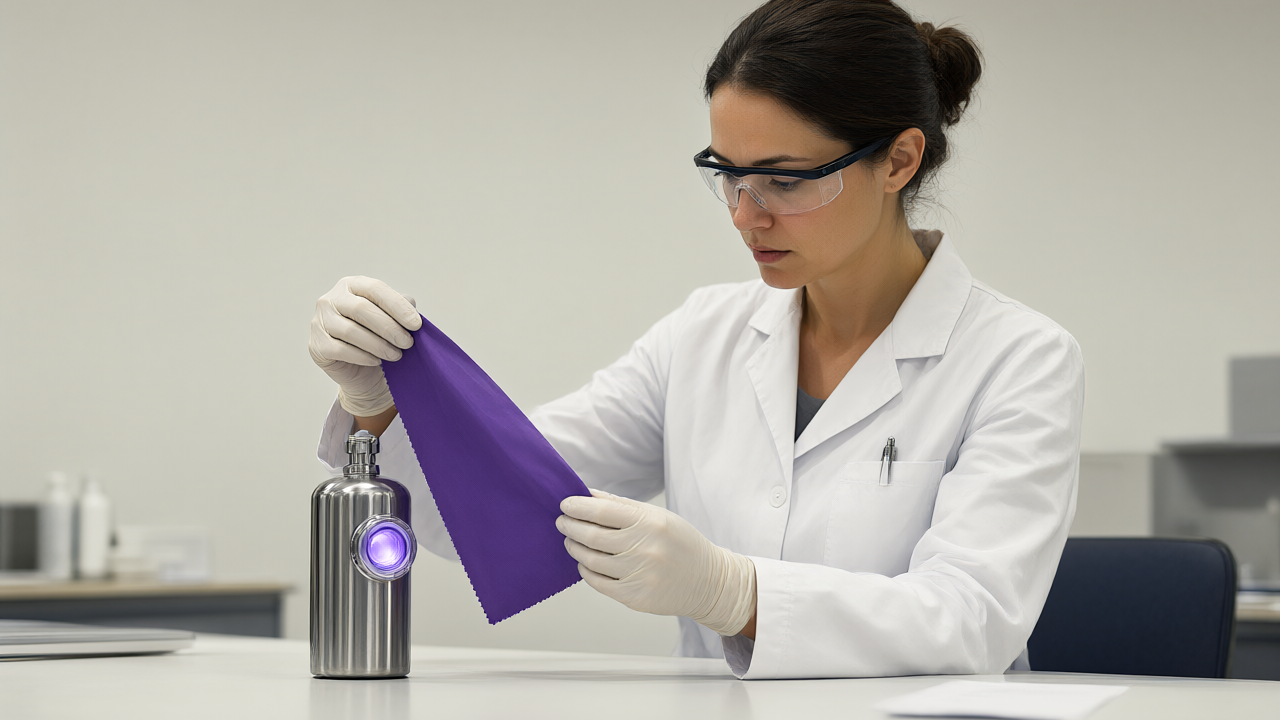
The study demonstrates that supercritical CO₂ (scCO₂) can redistribute dyes already present in polyester fibers to create a new, uniform color. By combining fabrics of different colors and adjusting their starting proportions, the researchers produced various new shades. A predictive color-matching model incorporating pairwise interactions between dyes proved more accurate than simple additive calculations in determining resulting color strength.
Technical Details
The experiments utilized polyester fabrics dyed with Blue BG, Yellow G, or Red 4 G. Treatment was conducted under consistent high-pressure conditions of 120 degrees Celsius and 25 megapascals. Under these parameters, scCO₂ penetrated the fibers, prompting dye molecules to migrate from regions of high concentration to low concentration.
- Convergence Example: Blue BG and Yellow G fabrics combined at a 1:3 ratio showed different greenish shades after 30 minutes, became nearly identical at 60 minutes, and reached the same green shade after 90 minutes.
- Quantitative Modeling: Color strength was measured using the Kubelka–Munk function (K/S values). To improve accuracy, a model using a trust region reflective algorithm was developed.
- Error Reduction: Root mean square error decreased from 0.4388 to 0.1720 at 410 nanometers, from 0.7758 to 0.2624 at 530 nanometers, and from 0.4017 to 0.0540 at 680 nanometers.
Microscopy confirmed that dyes were distributed evenly and that the polyester fiber microstructure remained unchanged after treatment.
Background & Context
Colored polyester is difficult to recycle because removing original dyes typically requires significant amounts of energy, water, or chemicals. This research, led by Senior Assistant Professor Jianhua Ren, Professor Kazumasa Hirogaki, and Researcher Isao Tabata, sought to avoid the dye-removal step entirely by converting contrasting colors into a shared shade.
Significance & Outlook
This method allows for the modification of colored polyester while retaining both the synthetic material and the original colorants. While the study used known dye compositions, the researchers identify testing with real textile waste streams, larger-scale processing, and more complex dye combinations as the necessary next steps.
Source: https://bioengineer.org/supercritical-co%E2%82%82-redistributes-polyester-dyes-for-fiber-recycling/
Get our weekly technology intelligence — free
Receive an infographic that lets you judge at a glance whether each field’s analysis report is worth reading.
Subscribe Free — Weekly Tech Intelligence
By subscribing, you’ll receive Troy-Technical’s weekly technology intelligence newsletter.
- Your email and selected fields are used only to deliver the newsletter.
- We never share your information with third parties.
- You can unsubscribe anytime via the link in each email.
See our Privacy Policy for details.
Takes about a minute · Unsubscribe anytime