


Key Findings
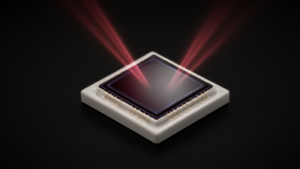
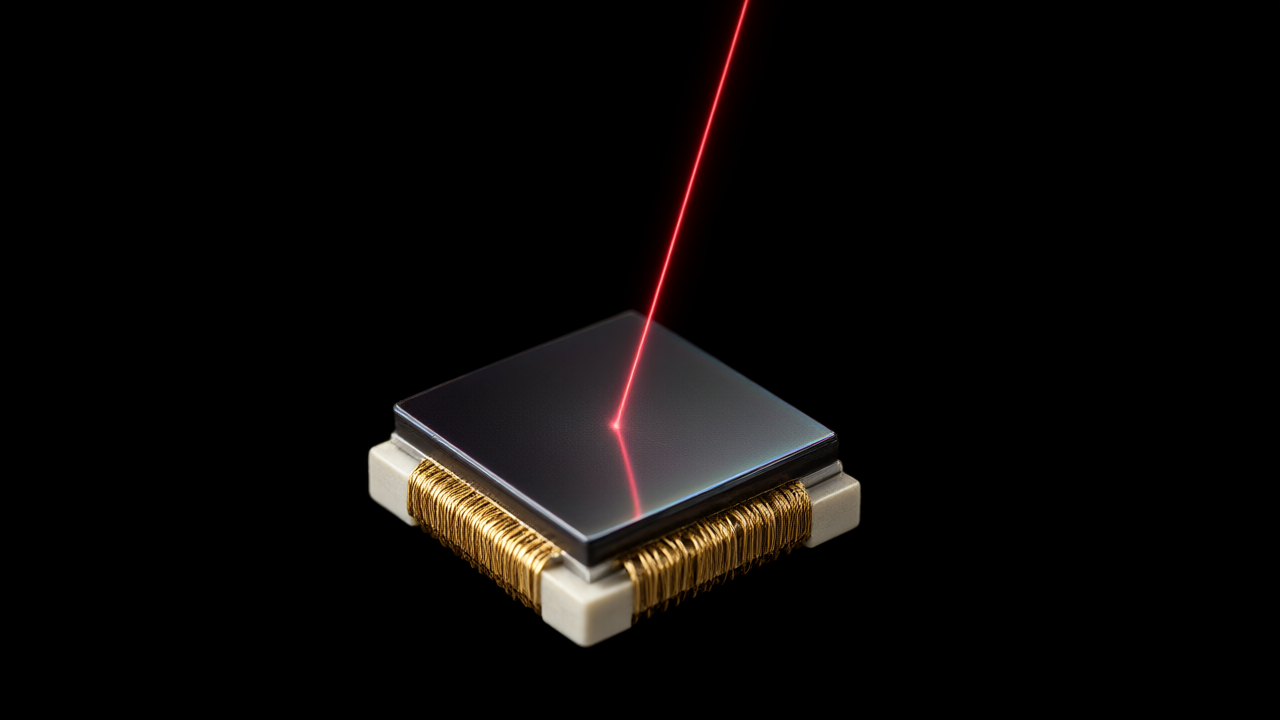
The optimized tandem PbSe quantum-dot photodiodes achieved a response time of 1.01 ns, a specific detectivity of 2.29 × 10^11 Jones at 1550 nm, and a linear dynamic range exceeding 99.6 dB. In practical ranging experiments, the device demonstrated centimeter-level spatial resolution and retained 97.9% of its pulse signal intensity under strong broadband background illumination, significantly outperforming single-junction quantum-dot photodiodes.
Technical Details
The device utilizes a tandem architecture where two matched quantum-dot photodiodes are stacked optically and connected electrically in series. This design addresses two primary bottlenecks:
- Spectral Filtering: Visible light is absorbed in the front junction, creating a photocurrent mismatch with the rear junction that suppresses the visible-light response. Conversely, 1550 nm light penetrates deeper, generating balanced photocurrents across both junctions to allow the LiDAR signal to pass.
- Response Speed: The series connection halves the effective junction capacitance, lowering the RC time constant. This allows for faster response times without reducing light-collection efficiency or shrinking the device area.
Background & Context
LiDAR systems are shifting from 905 nm to 1550 nm for improved eye safety and coherent sensing. While InGaAs photodiodes can detect this wavelength, their high cost and complex fabrication hinder the production of large-area, low-cost detector arrays. Colloidal quantum dots offer a solution due to tunable bandgaps and compatibility with silicon readout circuits, but conventional single-junction versions suffer from slow response speeds and interference from ambient visible light.
Significance & Outlook
By integrating optical pre-processing and electronic post-processing into a single device, this tandem architecture provides a solution-processed alternative to expensive InGaAs detectors. While further advances in thin-film uniformity, surface passivation, and silicon integration are required for deployment, the technology points toward low-cost 1550 nm detectors for autonomous driving, robotic vision, mixed reality, and consumer depth sensing.
Get our weekly technology intelligence — free
Receive an infographic that lets you judge at a glance whether each field’s analysis report is worth reading.
Subscribe Free — Weekly Tech Intelligence
By subscribing, you’ll receive Troy-Technical’s weekly technology intelligence newsletter.
- Your email and selected fields are used only to deliver the newsletter.
- We never share your information with third parties.
- You can unsubscribe anytime via the link in each email.
See our Privacy Policy for details.
Takes about a minute · Unsubscribe anytime