Key Findings
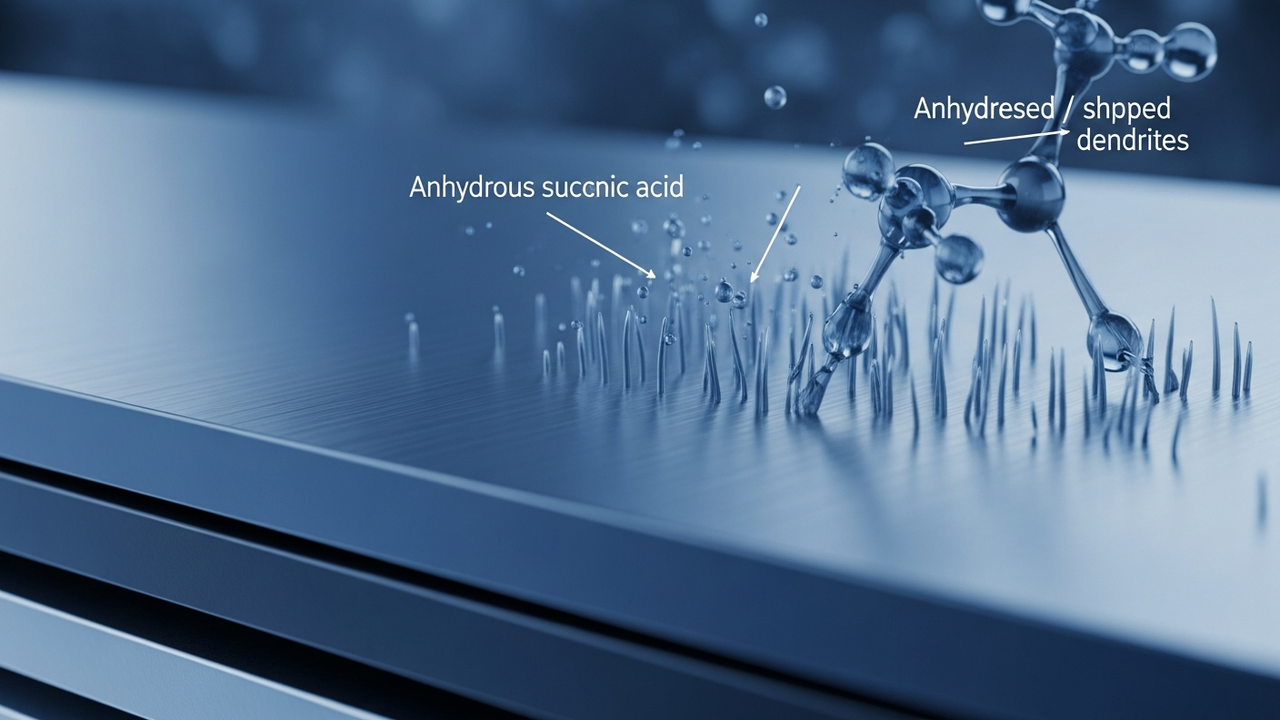
To mitigate lithium dendrite growth, a persistent challenge hindering the commercialization of all-solid-state lithium metal batteries, researchers have successfully demonstrated the high efficacy of succinic anhydride as a deposition-regulating additive. This additive effectively reinforces the chemical and mechanical stability of the solid electrolyte interphase (SEI) layer formed on the lithium anode surface, thereby blocking pathways for dendrite proliferation. Consequently, it suppresses dendrite formation and, by creating a uniform and stable interfacial layer even with Ni-rich NCM cathodes, significantly improves the battery’s overall cycle life. This marks a groundbreaking discovery that enhances both the safety and durability of all-solid-state lithium metal batteries.
Technical / Clinical Details
When added in small quantities to the electrolyte, succinic anhydride plays a crucial role in controlling the electrodeposition behavior of lithium metal. As lithium ions deposit onto the anode surface, succinic anhydride contributes to forming a more compact, uniform, and stable SEI layer. This reinforced SEI layer reduces the heterogeneous deposition sites that act as ‘seeds’ for lithium dendrite growth and serves as a physical barrier to prevent dendrite penetration. Moreover, on the Ni-rich NCM cathode side, the additive forms a stable protective layer at the interface with the electrolyte, suppressing cathode degradation and enhancing the overall stability and reversibility of the battery. This allows for long-term charge-discharge cycling while maintaining high capacity, ultimately improving battery durability.
Background & Context
Lithium metal anodes offer a theoretical capacity more than ten times higher than current graphite anodes in lithium-ion batteries, making them indispensable for achieving high energy density in all-solid-state batteries. However, the formation of lithium dendrites during charge cycles poses significant safety and durability issues, leading to short circuits, capacity degradation, and even thermal runaway, which has long been the greatest barrier to practical implementation. The discovery of succinic anhydride demonstrates the potential to effectively resolve this severe dendrite problem with relatively simple modifications to existing material systems, carrying immense significance for accelerating the commercialization of all-solid-state batteries.
Strategic Significance & Outlook
This approach, utilizing succinic anhydride as an additive, is anticipated for integration into the manufacturing processes of all-solid-state lithium metal batteries due to its simplicity and high effectiveness. Future focus will be on assessing the versatility of succinic anhydride across various solid electrolyte systems and battery configurations, its cost and scalability for mass production, and long-term reliability evaluations in actual electric vehicle (EV) environments. Widespread adoption of this technology is expected to accelerate the proliferation of safer, longer-lasting, and higher-performance all-solid-state batteries, contributing significantly to the growth of the EV market, the development of renewable energy storage systems, and the realization of a sustainable society.
Get our weekly technology intelligence — free
Receive an infographic that lets you judge at a glance whether each field’s analysis report is worth reading.
Subscribe Free — Weekly Tech Intelligence
By subscribing, you’ll receive Troy-Technical’s weekly technology intelligence newsletter.
- Your email and selected fields are used only to deliver the newsletter.
- We never share your information with third parties.
- You can unsubscribe anytime via the link in each email.
See our Privacy Policy for details.
Takes about a minute · Unsubscribe anytime









Comments