Key Findings
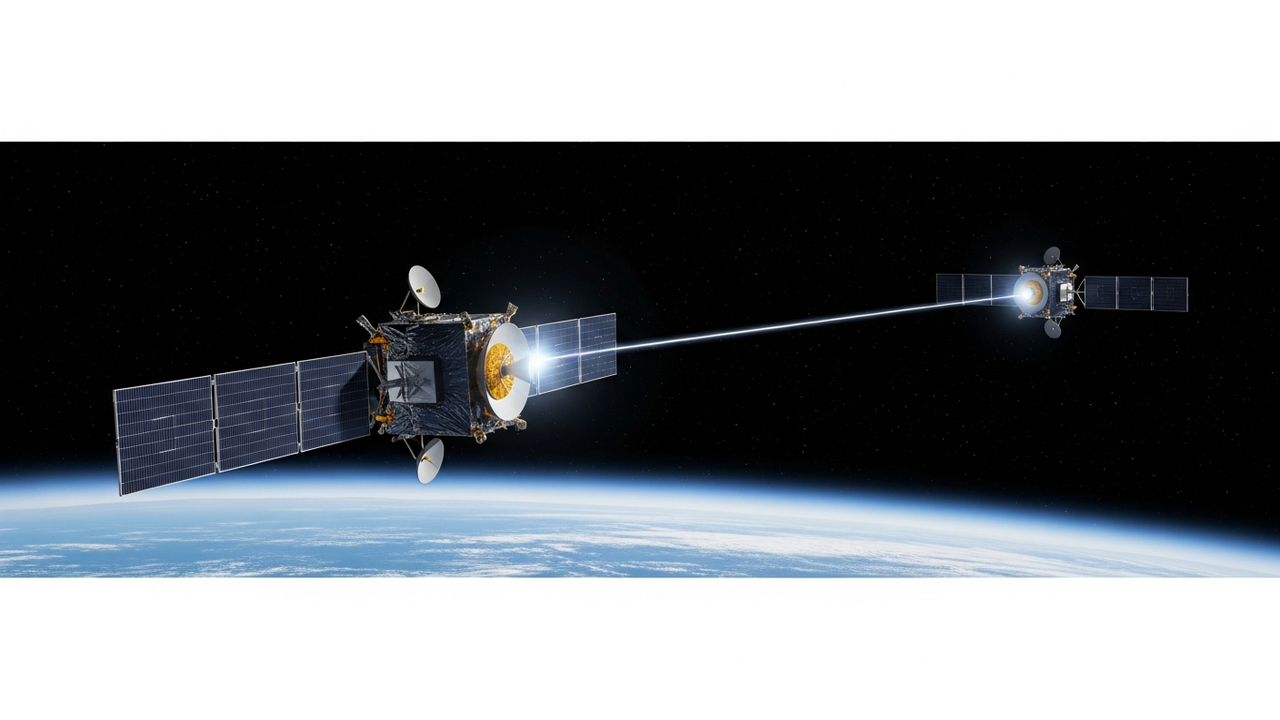
An on-orbit demonstration of high-speed laser communication for Low Earth Orbit (LEO) satellite internet has achieved stable gigabit-class data transmission between multiple LEO satellites. This groundbreaking success indicates the potential to increase data transmission speeds by approximately 10 times and significantly enhance security compared to conventional radio frequency (RF) communication. This will dramatically accelerate the realization of next-generation space internet services and space data backbone infrastructure, marking a crucial step towards bridging the global digital divide and resolving bottlenecks in high-capacity data transfer for space activities.
Technical Details
The demonstration utilized optical communication terminals installed on two small LEO satellites in orbit. Each terminal consists of a precise mechanism for generating and tracking highly directional laser beams, and optoelectronic circuitry for modulating and demodulating gigabit-class data. During the experiment, stable data transmission speeds exceeding 10 Gbps were maintained with an average data availability of 99.9%, even when satellite separation reached up to 2,000 km. This high directionality significantly improves resistance to interception and jamming, thereby enhancing security compared to existing RF communication. Furthermore, because laser light is not subject to RF spectrum regulations, the available bandwidth is virtually unlimited, indicating its potential to flexibly accommodate future explosive growth in data demand.
Background & Context
Global internet services provided by LEO satellite constellations are dramatically transforming worldwide communication environments, but their performance and capacity heavily rely on inter-satellite links (ISLs). Traditional RF ISLs faced challenges such as bandwidth limitations, congestion, and security vulnerabilities. Laser communication (optical inter-satellite communication) has been anticipated as a next-generation technology to overcome these issues, enabling faster and more secure data transmission. This technology is crucial for forming the backbone of satellite constellations and providing high-speed communication infrastructure to remote areas on Earth or during disasters.
Strategic Significance & Outlook
The success of this on-orbit demonstration is a significant milestone towards building future space internet infrastructure. This technology will not only further enhance the capabilities of existing LEO constellations like Starlink and OneWeb but also enable new high-throughput services and real-time data sharing between spacecraft. Future efforts will focus on miniaturizing and reducing the cost of laser communication terminals, developing networking technologies for multiple satellites, and improving transmission stability within the atmosphere. By the 2030s, laser communication is expected to become the dominant form of space communication, laying the foundation for an information superhighway connecting Earth to space, and space to space.
Source: #
Get our weekly technology intelligence — free
Receive an infographic that lets you judge at a glance whether each field’s analysis report is worth reading.
Subscribe Free — Weekly Tech Intelligence
By subscribing, you’ll receive Troy-Technical’s weekly technology intelligence newsletter.
- Your email and selected fields are used only to deliver the newsletter.
- We never share your information with third parties.
- You can unsubscribe anytime via the link in each email.
See our Privacy Policy for details.
Takes about a minute · Unsubscribe anytime









Comments