Key Findings
To enable future Venus exploration missions, significant progress is being made in the development of an advanced Thermal Protection System (TPS) capable of withstanding the extreme high temperatures (over 2000°C) and high pressures (over 100 atm) encountered during Venus atmospheric re-entry. This research proposes new ablator materials and innovative system designs, with ground-based rigorous environmental simulation tests validating their superior thermal shielding performance and structural integrity, surpassing conventional materials. This is building a groundbreaking technological foundation that will allow probes to reach and operate in planets with harsh environments like Venus.
Technical Details
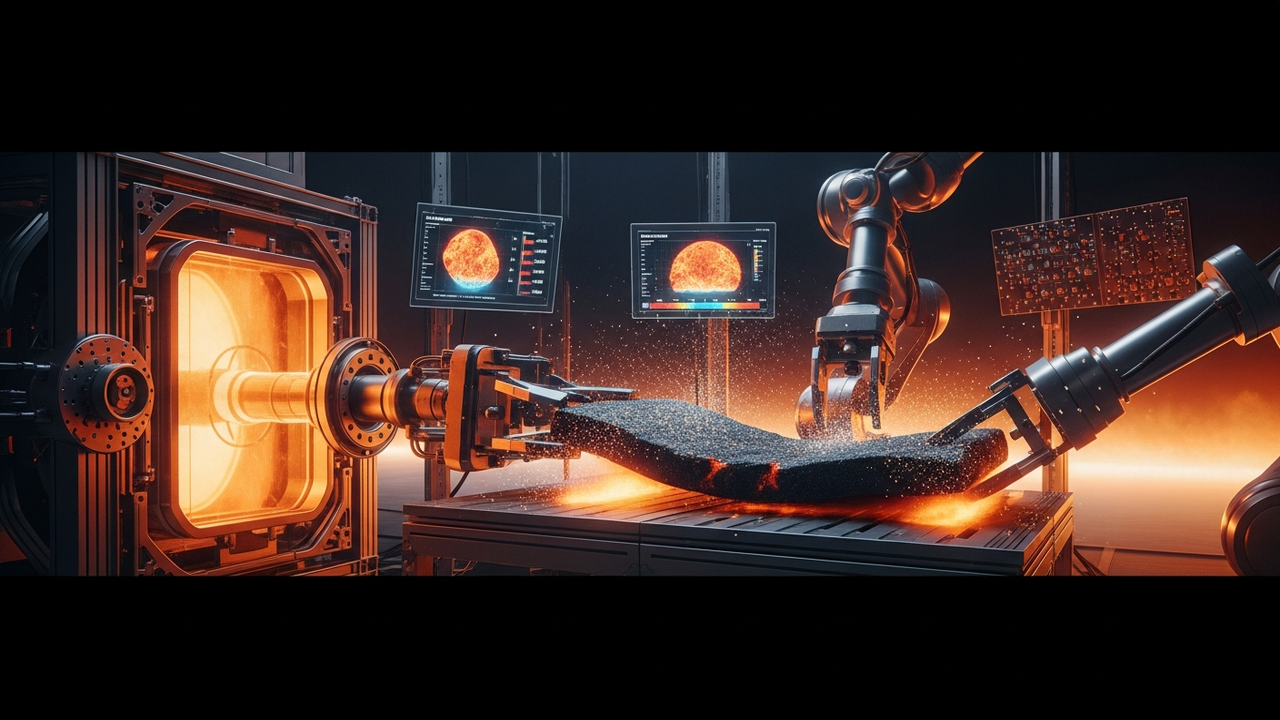
The developed TPS incorporates a novel ablator material for the surface layer exposed to high temperatures, consisting of a carbon composite material based on phenolic resin, dispersed with ceramic particles (e.g., zirconia, hafnium carbide). This material efficiently shields heat through ablation (a process where the surface sublimates or melts to absorb and dissipate heat), minimizing heat transfer to the internal structure. In ground-based high-enthalpy arc jet wind tunnel tests, the material was exposed for up to 10 minutes to a plasma flow simulating Venus atmospheric re-entry conditions, equivalent to approximately 2000°C and 100 atm. The results showed that the new ablator material reduced mass loss rate by 15% and suppressed internal temperature rise by over 20% compared to conventional high-performance ablators. No delamination or structural failure was observed, demonstrating high robustness in extreme environments. In terms of design, the re-entry capsule’s shape and material layers are optimized to balance thermal and aerodynamic loads, allowing for flexible adaptation to mission profiles.
Background & Context
Venus, while Earth’s closest planetary neighbor, is characterized by its thick sulfuric acid clouds, extremely high-temperature and high-pressure surface environment (approx. 460°C, 90 atm), and corrosive atmosphere. Probes re-entering this atmosphere are subjected to far more severe heat and pressure than during Earth return. Traditional TPS technologies have struggled with long-term survival and precise scientific measurements in extreme Venusian environments, leading to short mission durations for many past probes. However, Venus holds crucial clues for understanding the evolution of terrestrial planets and the potential for life, making advanced TPS key to enabling new Venus exploration missions.
Strategic Significance & Outlook
This advanced thermal protection system will be an indispensable technology for future Venus atmospheric probes and landing missions, such as NASA’s DAVINCI+ and ESA’s EnVision. Its commercialization will enable the acquisition of detailed data on Venus’s deep atmosphere, surface composition, and geological activity, significantly advancing research into Venus’s past habitability and current traces of life. Future plans include scaling up material manufacturing processes, long-duration durability testing, and accelerating development for flight demonstration in the actual Venusian environment. This technology has the potential to usher in a new golden age of Venus exploration.
Source: #
Get our weekly technology intelligence — free
Receive an infographic that lets you judge at a glance whether each field’s analysis report is worth reading.
Subscribe Free — Weekly Tech Intelligence
By subscribing, you’ll receive Troy-Technical’s weekly technology intelligence newsletter.
- Your email and selected fields are used only to deliver the newsletter.
- We never share your information with third parties.
- You can unsubscribe anytime via the link in each email.
See our Privacy Policy for details.
Takes about a minute · Unsubscribe anytime








Comments