Key Findings
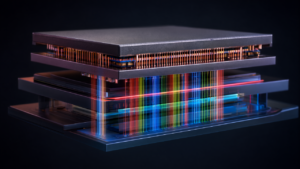
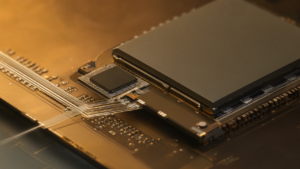
To meet escalating data processing demands, AI data centers are rapidly transitioning beyond the physical limits of copper interconnects towards optical interconnects. Currently, 800G pluggable transceivers are seeing rapid adoption, with next-generation 1.6T optical products beginning to enter the market. To standardize this transition and ensure interoperability within AI infrastructure, leading technology companies have formed the Optical Compute Interconnect (OCI) Multi-Source Agreement.
Technical Details and Standardization Efforts
- Copper to Optics: Traditional copper cables are reaching their limits in terms of signal attenuation and power consumption for the terabit-scale bandwidth, low latency, and long-distance transmission required by AI workloads. Optical fibers overcome these challenges, enabling data transmission at significantly higher speeds and efficiencies.
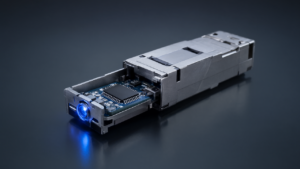
- 800G and 1.6T Pluggable Transceivers: 800G pluggable transceivers are already widely adopted in AI data centers, offering easy integration into existing infrastructure. Furthermore, the development and market introduction of 1.6T products will double data transmission capacity, further enhancing the scalability of AI clusters. These devices deliver higher bit rates, longer reach, and lower power consumption.
- OCI Multi-Source Agreement (MSA): Industry leaders including AMD, Broadcom, Meta, Microsoft, Nvidia, and OpenAI have converged to establish the OCI MSA. This agreement aims to define a common optical physical interface specifically for scale-up systems—high-speed, high-capacity optical connections within a single rack or between adjacent racks. Standardization is crucial for ensuring interoperability, diversifying the supply chain, and reducing costs.
Background and Industry Context
The rapid advancement of generative AI and large language models (LLMs) has dramatically increased demands on communication speed and capacity between GPUs within data centers. AI clusters connecting hundreds to thousands of GPUs require each GPU to exchange massive amounts of data in real-time. Such demands are challenging for conventional data center infrastructure, making optical communication technology indispensable as a solution. This copper-to-optics shift represents one of the most critical infrastructure transformations facing the AI industry.
Strategic Significance and Outlook
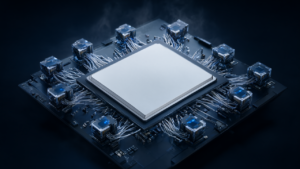
The establishment of common standards by the OCI MSA will accelerate the adoption of optical interconnects in AI data centers. This will enable interoperability among optical components from various vendors, leading to supply chain stability and improved cost competitiveness. In the future, further advancements are expected in higher-density optical integration technologies and chip-level optical connections (Co-Packaged Optics, CPO). This evolution will support the further development of AI, enable the realization of larger and more complex AI models, and revolutionize diverse fields such as autonomous driving, healthcare, and scientific research.
Source: https://mlq.ai/news/inside-the-copper-to-optics-shift-in-ai-data-centers/
Get our weekly technology intelligence — free
Receive an infographic that lets you judge at a glance whether each field’s analysis report is worth reading.
Subscribe Free — Weekly Tech Intelligence
By subscribing, you’ll receive Troy-Technical’s weekly technology intelligence newsletter.
- Your email and selected fields are used only to deliver the newsletter.
- We never share your information with third parties.
- You can unsubscribe anytime via the link in each email.
See our Privacy Policy for details.
Takes about a minute · Unsubscribe anytime