Key Findings
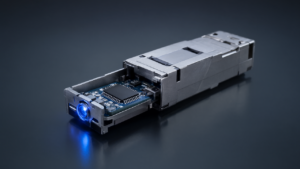
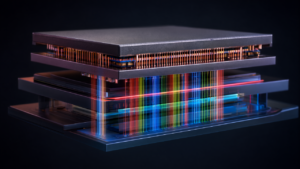
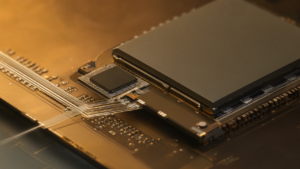
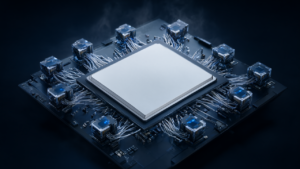
Broadcom unveiled its groundbreaking solutions at OFC 2026, designed to enable exponential scaling of AI infrastructure. Central to this offering is ‘Taurus,’ the industry’s first 400G/lane optical Digital Signal Processor (DSP). When integrated with Broadcom’s high-performance 400G Electro-absorption Modulated Lasers (EMLs) and photodiodes, this innovative DSP facilitates cost-effective, low-power 1.6T optical transceivers, establishing a crucial foundation for future 3.2T optical transceivers.
Technical Details
The ‘Taurus’ DSP achieves an astonishing 400G/lane data transmission rate, significantly surpassing the performance of previous optical interconnects. By integrating this DSP with Broadcom’s proprietary 400G EMLs and corresponding photodiodes, a single optical transceiver module can deliver a total bandwidth of 1.6 Terabits per second (T). This advancement enables data centers and AI clusters to efficiently handle immense data traffic with fewer transceivers. The low-power design is particularly critical for curbing the escalating energy consumption of data centers driven by AI workloads, contributing to reduced operational costs and enhanced sustainability.
Background & Context
The increasing complexity and scale of generative AI models impose unprecedented demands on data center computing power and network bandwidth. In AI clusters, tens of thousands of GPUs must collaborate closely, exchanging petabytes of data within milliseconds, often making optical interconnect performance a bottleneck for the entire system. Broadcom’s ‘Taurus’ DSP and 1.6T transceivers offer a direct solution to this challenge, ensuring the scalability of AI workloads. The fusion of Broadcom’s comprehensive optical component portfolio with its advanced DSP technology solidifies its market leadership and accelerates the evolution of data center infrastructure in the AI era.
Strategic Significance & Outlook
Broadcom’s 400G/lane technology is expected to pave the way for AI systems exceeding 200T (200 Terabits per second) in total bandwidth. The widespread adoption of 1.6T transceivers, followed by the evolution to 3.2T, will fundamentally transform the design and operation of AI data centers. This represents a significant step towards realizing Co-Packaged Optics (CPO) and on-chip optical communication, where ASICs or GPUs are physically integrated with optical transceivers to achieve even greater power efficiency and reduced latency. Such advancements will accelerate the training and deployment of larger, more powerful AI models, bringing innovation to all sectors where AI is leveraged, including autonomous driving, medical diagnostics, and scientific research.
Source: https://www.broadcom.com/company/news/articles?topic[]=Optical%20interconnects
Get our weekly technology intelligence — free
Receive an infographic that lets you judge at a glance whether each field’s analysis report is worth reading.
Subscribe Free — Weekly Tech Intelligence
By subscribing, you’ll receive Troy-Technical’s weekly technology intelligence newsletter.
- Your email and selected fields are used only to deliver the newsletter.
- We never share your information with third parties.
- You can unsubscribe anytime via the link in each email.
See our Privacy Policy for details.
Takes about a minute · Unsubscribe anytime