
Key Findings
Artificial Intelligence (AI) and machine learning are fundamentally transforming the discovery and optimization processes for multifunctional materials based on Metal-Organic Frameworks (MOFs). The application of AI allows for rapid exploration of the vast chemical design space of MOFs, effectively overcoming the inefficiencies inherent in traditional trial-and-error materials development approaches.
Technical / Clinical Details
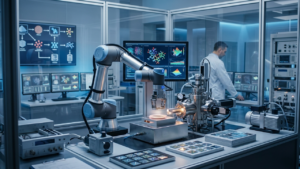
AI-assisted materials discovery workflows operate through the integration of computational modeling, high-throughput screening, and experimental data. Specifically, machine learning models first learn the structure-property relationships of MOFs to predict optimal MOF structures for specific applications (e.g., gas separation, catalytic reactions, water adsorption). Based on these predictions, promising candidates are rapidly identified from virtual libraries, and their performance is evaluated through high-throughput computations or simulations. Furthermore, acquired experimental data and simulation results are fed back to enhance the accuracy of the AI model, forming an iterative optimization cycle. This closed-loop approach enables the efficient screening of thousands of times more MOF candidates compared to conventional methods, significantly reducing the time required to discover MOFs with desired properties.
Background & Context
Metal-Organic Frameworks (MOFs), with their exceptionally high surface areas, tunable pore sizes, and diverse chemical functionalities, are promising for a wide range of advanced technological applications, including gas storage and separation, catalysis, sensors, and drug delivery. However, the astronomical number of possible MOF compositions and structural combinations makes it impossible to explore their full potential using human intuition or conventional experimental methods alone. Given this context, the integration of AI and machine learning has become an indispensable element for achieving ‘accelerated discovery’ in MOF research. Leading research institutions and companies in North America, Europe, and Asia are intensifying investments in AI-driven digital materials discovery platforms to accelerate the commercialization of MOFs.
Strategic Significance & Outlook
AI-assisted MOF discovery platforms are poised to accelerate the creation of groundbreaking MOFs that will contribute to solving global challenges, such as improving energy efficiency, environmental remediation, and developing advanced medical devices. Specifically, it is expected to enable the design of MOFs with highly specific molecular selectivity and those that function stably under extreme conditions. In the future, there is potential for fully automated R&D infrastructures, such as ‘MOF foundries,’ where AI autonomously handles MOF design, synthesis, characterization, and validation. This will dramatically shorten the lead time to MOF-based product commercialization, delivering immense economic and social value to the chemical, environmental, and medical industries globally.
Get our weekly technology intelligence — free
Receive an infographic that lets you judge at a glance whether each field’s analysis report is worth reading.
Subscribe Free — Weekly Tech Intelligence
By subscribing, you’ll receive Troy-Technical’s weekly technology intelligence newsletter.
- Your email and selected fields are used only to deliver the newsletter.
- We never share your information with third parties.
- You can unsubscribe anytime via the link in each email.
See our Privacy Policy for details.
Takes about a minute · Unsubscribe anytime





Comments