Key Findings
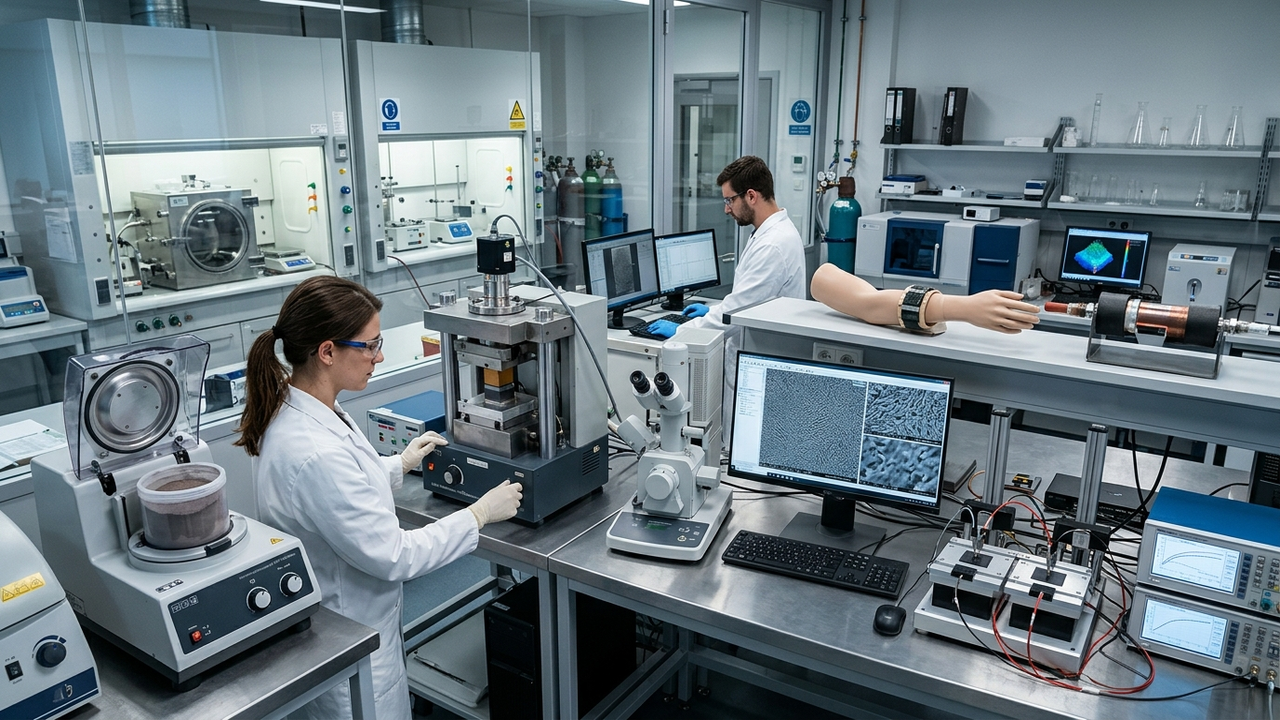
Researchers have developed a groundbreaking method to significantly enhance the thermoelectric (TE) performance of Bi2Te2.7Se0.3. By combining cold-press sintering with controlled particle size refinement, this approach achieved an exceptionally high thermoelectric figure of merit (ZT) of 1.15 at 300 K (approx. 27°C) for undoped n-type Bi2Te2.7Se0.3. This achievement is attributed to a refined porous microstructure that effectively modifies both carrier and heat transport properties.
Technical / Clinical Details
The study involved precise control over the particle size of Bi2Te2.7Se0.3 powder, followed by the application of a specialized cold-press sintering process. This technique created a uniform and refined porous microstructure within the material. This porous structure significantly reduces lattice thermal conductivity (κL) by promoting phonon scattering, while maintaining or even enhancing electrical conductivity by preserving electron mobility. Consequently, the ZT value, which is key to thermoelectric performance (ZT = S²σT/κ, where S is the Seebeck coefficient, σ is electrical conductivity, T is absolute temperature, and κ is total thermal conductivity), was substantially improved over conventional Bi2Te2.7Se0.3, reaching a high value of 1.15 at room temperature.
Background & Context
Thermoelectric materials, as a clean energy technology capable of directly converting waste heat into electricity, have long faced challenges in improving their efficiency. High efficiency, especially near room temperature, is critical for practical applications in diverse fields such as wearable devices, IoT sensors, and automotive waste heat recovery. However, developing materials with high ZT values is challenging due to the need to balance conflicting properties of electrical and thermal conductivity. The results of this study present a new pathway to overcome this inherent trade-off.
Strategic Significance & Outlook
The enhanced thermoelectric performance of Bi2Te2.7Se0.3 will profoundly impact fields like waste heat recovery systems, wearable electronics, and IoT sensors. Achieving high ZT values at room temperature, in particular, will dramatically improve the energy efficiency and autonomy of these devices, contributing to extended battery life and miniaturization. For industry, this not only directly leads to reduced environmental impact and operational costs but also opens up possibilities for creating new product categories and expanding market opportunities. Investors should consider the potential growth of thermoelectric materials as a technology pursuing energy efficiency improvement and sustainability.
Source: https://pubs.rsc.org/en/content/articlelanding/2026/ra/d6ra00789j
Get our weekly technology intelligence — free
Receive an infographic that lets you judge at a glance whether each field’s analysis report is worth reading.
Subscribe Free — Weekly Tech Intelligence
By subscribing, you’ll receive Troy-Technical’s weekly technology intelligence newsletter.
- Your email and selected fields are used only to deliver the newsletter.
- We never share your information with third parties.
- You can unsubscribe anytime via the link in each email.
See our Privacy Policy for details.
Takes about a minute · Unsubscribe anytime







Comments