Key Findings
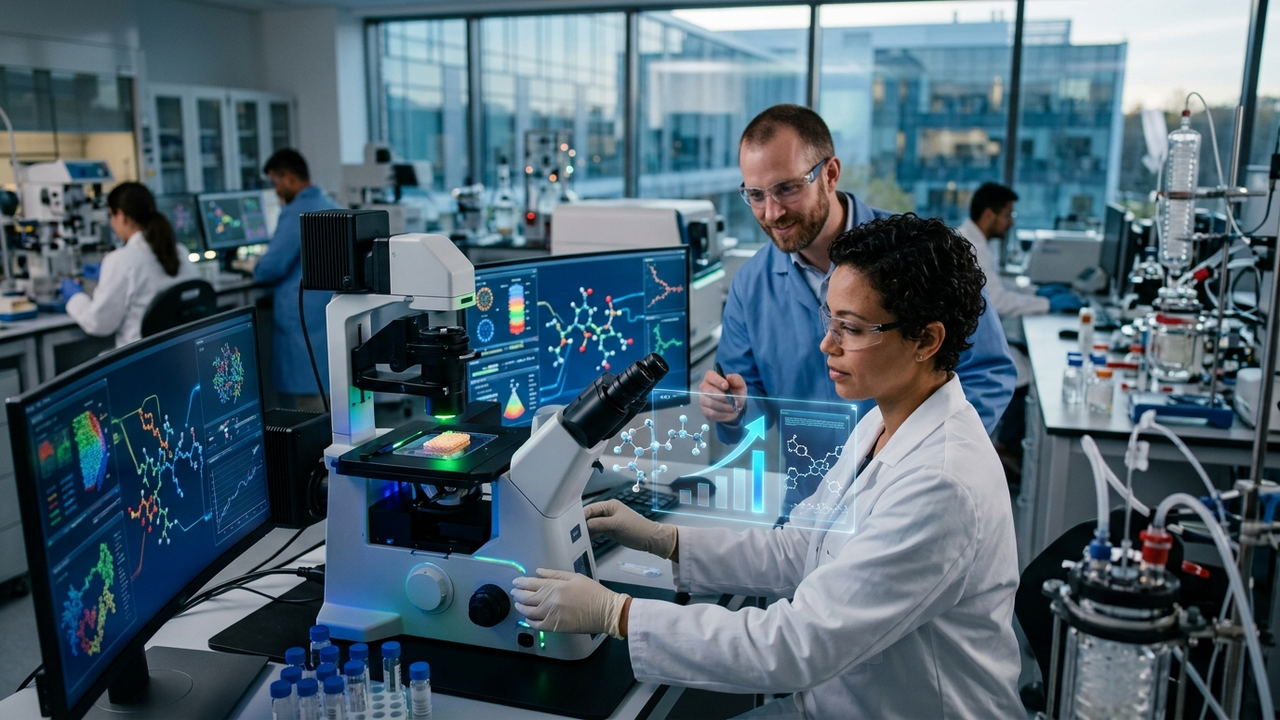
According to an announcement by ACS Publications, an innovative CLIP-based multimodal framework named PolyCLIP has achieved remarkable performance in polymer property prediction, outperforming existing unimodal and multimodal models by up to 13.32%. This research demonstrates that CLIP (Contrastive Language–Image Pre-training) embeddings can very effectively capture complex chemical information of polymers. Specifically, it recorded up to a 13.32% relative R2 improvement in predicting thermophysical, electronic, and optical properties. PolyCLIP establishes a simple yet scalable foundation for multimodal polymer informatics and data-efficient materials discovery, marking a crucial milestone in accelerating the development of new polymers.
Technical & Clinical Details
The PolyCLIP framework applies the principles of CLIP, which maps different types of data (e.g., chemical structure descriptors, textual information, or image representations of polymers) into a common embedding space, to polymer science. While traditional polymer property prediction models often relied on single data modalities (e.g., graph representations of molecular structures), PolyCLIP integrates information from multiple modalities, enabling more comprehensive and accurate predictions. Key to this framework is its ability to combine diverse data, such as SMILES notation, graph structures, and textual descriptions of polymer properties. CLIP embeddings convert this heterogeneous information into physically and chemically meaningful representations, allowing machine learning models to learn deeper complex correlations between subtle structural changes and macroscopic properties of polymers. The achievement of an average R2 improvement of several percentage points, and up to 13.32%, compared to existing models for properties like heat capacity, glass transition temperature, dielectric constant, and refractive index, demonstrates its superiority. This enables rapid design and optimization of high-performance polymers, significantly shortening the material development timeline.
Background & Industry Context
Polymer materials are indispensable in all sectors of modern society, including electronics, automotive, medicine, and packaging. However, the discovery and development of new polymers with desired properties have been time-consuming and costly challenges due to the vast chemical space and complex synthesis processes. Traditional polymer informatics primarily relied on single-modality data, often failing to fully leverage the multifaceted information available for materials. Multimodal approaches like PolyCLIP overcome this challenge, facilitating data-efficient material discovery by achieving high predictive accuracy even with limited experimental data. This is anticipated to be a powerful tool for rapidly developing high-performance and environmentally friendly polymers for sustainable societies.
Strategic Significance & Outlook
The success of PolyCLIP clearly demonstrates the transformative potential that multimodal AI brings to polymer science. In the future, this framework is expected to evolve further and integrate with autonomous research labs (Self-Driving Labs), potentially realizing a ‘closed-loop’ polymer development ecosystem where the entire process of polymer design, synthesis, characterization, and optimization is executed without human intervention. This will enable the discovery and development of new polymers optimized for specific applications, such as medical polymers, smart materials, and recyclable plastics, at unprecedented speeds. PolyCLIP is expected to exponentially improve the efficiency of R&D in polymer materials science, bringing significant economic value and competitive advantage to the industry. This indicates that AI will be an indispensable tool for expanding the frontiers of materials science.
Get our weekly technology intelligence — free
Receive an infographic that lets you judge at a glance whether each field’s analysis report is worth reading.
Subscribe Free — Weekly Tech Intelligence
By subscribing, you’ll receive Troy-Technical’s weekly technology intelligence newsletter.
- Your email and selected fields are used only to deliver the newsletter.
- We never share your information with third parties.
- You can unsubscribe anytime via the link in each email.
See our Privacy Policy for details.
Takes about a minute · Unsubscribe anytime






Comments