Key Findings
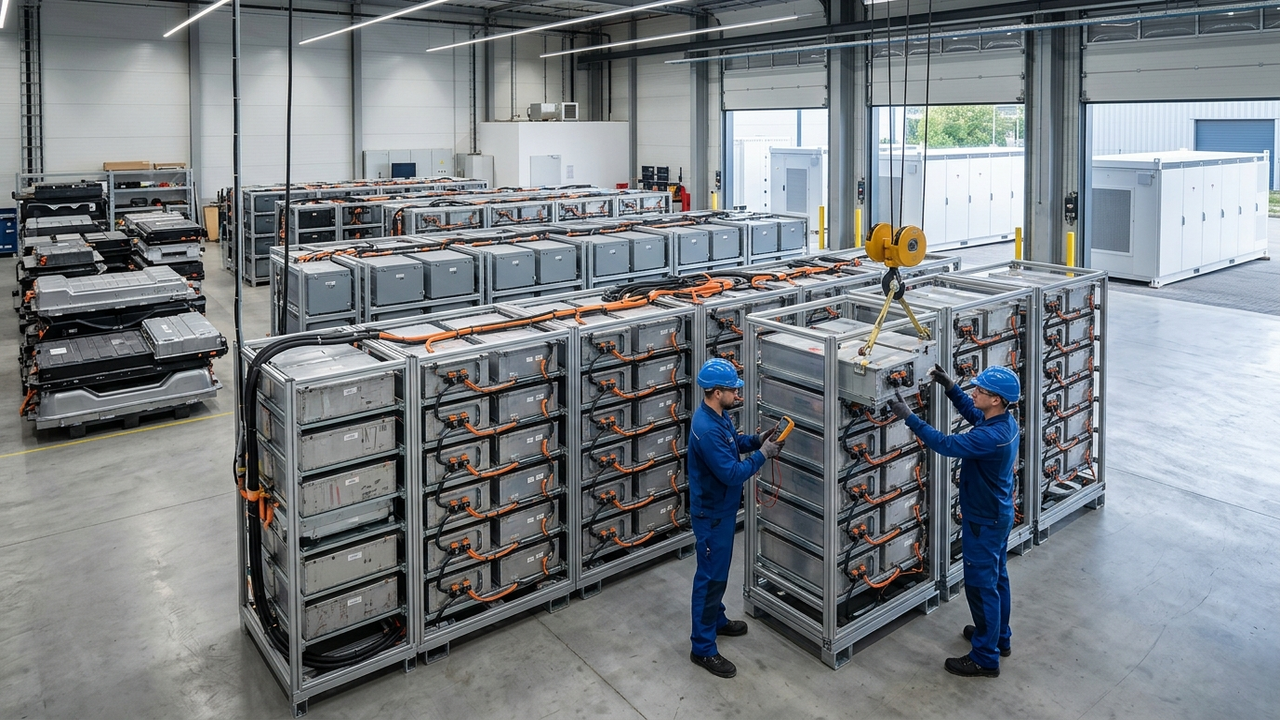
Second-life batteries represent an innovative approach that effectively utilizes the remaining capacity (typically 70% to 80%) of electric vehicle (EV) batteries after they no longer deliver peak performance for automotive applications. This technology extends the battery’s lifecycle, substantially contributing to a sustainable energy future by reducing waste, improving resource efficiency, and fostering greater integration of renewable energy sources.
Technical / Clinical Details
While EV batteries are designed for high power output and long-range performance in vehicles, their capacity and power capabilities degrade over time, making them unsuitable for continued automotive use. However, even at this stage, substantial energy storage capacity remains, which can be repurposed for less demanding applications such as stationary energy storage systems (ESS). Potential applications are diverse, including residential energy storage, peak shaving in commercial buildings, backup power for data centers, and smoothing and storing output from renewable energy sources like solar and wind farms. In these applications, the stringent demands for power fluctuation and frequent charge-discharge cycles seen in EVs are absent, making second-life batteries an economically and technically viable solution. To ensure safety and performance, repurposed batteries undergo rigorous diagnostic and reconditioning processes.
Background & Context
With the widespread adoption of EVs, a massive volume of EV batteries is projected to reach end-of-life in the coming years, making their proper disposal and reuse an urgent challenge. Concurrently, the global transition to renewable energy and the modernization of power grids are generating new demands for large-scale, flexible energy storage solutions. Second-life batteries have emerged as a win-win solution for these dual challenges. Manufacturing new batteries requires significant amounts of critical minerals and energy, thus utilizing second-life batteries reduces reliance on virgin resources and lowers the carbon footprint. Furthermore, by decreasing the total cost of battery ownership and making energy storage systems more affordable, second-life batteries are expected to accelerate the adoption of clean energy technologies.
Strategic Significance & Outlook
The second-life battery market is projected for rapid growth, with many automotive manufacturers and energy companies increasing their investments in this sector. Technologically, advancements in battery diagnostic techniques and modularization technologies, which allow for combining different types of batteries into systems, are anticipated. Additionally, international standardization of performance evaluation and safety protocols for second-life batteries will further boost market confidence and adoption. For investors, engineers, and environmental policymakers, second-life batteries continue to expand their potential as a highly promising investment area and technological frontier for realizing a circular economy and constructing sustainable energy systems.
Source: https://thisistbs.com/en/publications/stories/second-life-battery
Get our weekly technology intelligence — free
Receive an infographic that lets you judge at a glance whether each field’s analysis report is worth reading.
Subscribe Free — Weekly Tech Intelligence
By subscribing, you’ll receive Troy-Technical’s weekly technology intelligence newsletter.
- Your email and selected fields are used only to deliver the newsletter.
- We never share your information with third parties.
- You can unsubscribe anytime via the link in each email.
See our Privacy Policy for details.
Takes about a minute · Unsubscribe anytime








Comments