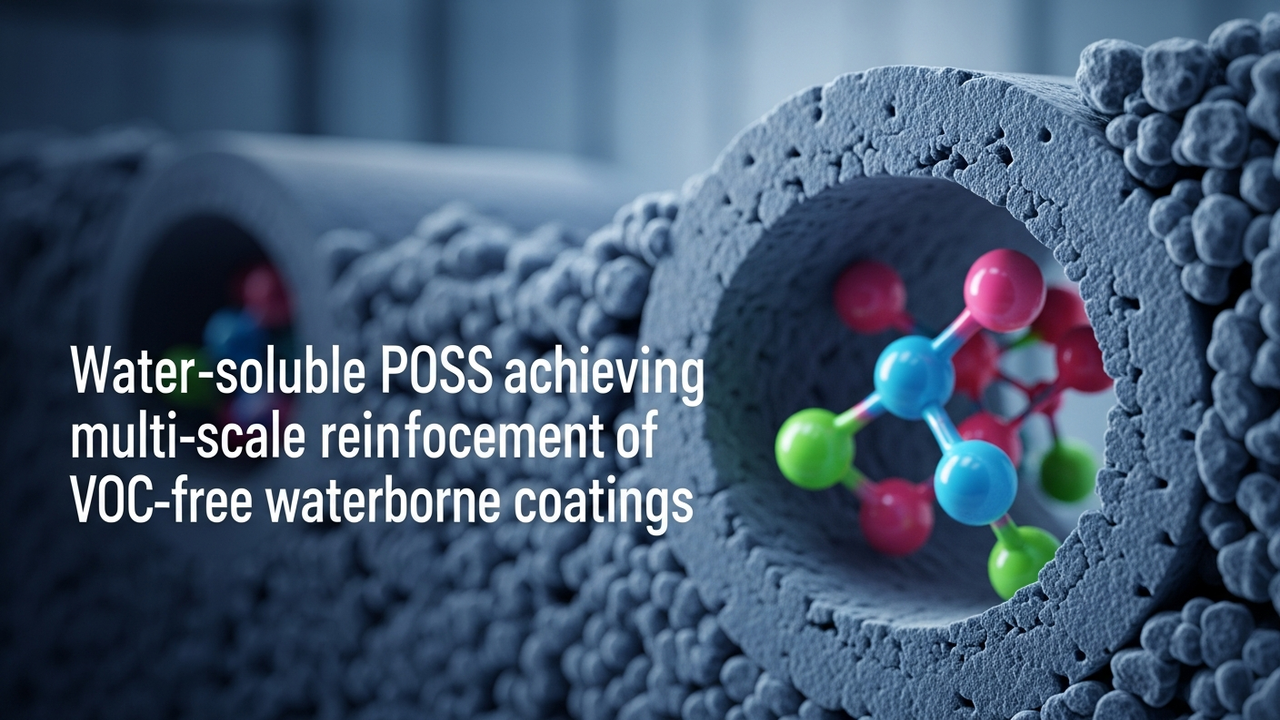
Background: Demand for High-Performance VOC-Free Waterborne Coatings
In contemporary society, driven by stricter environmental regulations and increased awareness of sustainability, there is a rapidly growing demand for eco-friendly coating materials that emit zero volatile organic compounds (VOCs). Industries such as construction, automotive, and electronics specifically seek waterborne coatings that offer excellent mechanical strength, chemical resistance, and durability, while also being VOC-free. However, developing high-performance waterborne thermoset coatings has presented technical challenges in appropriately controlling latex particle coalescence and crosslinking to form uniform, robust films. It has been particularly difficult to construct multiscale reinforcement structures, spanning from molecular to micrometer scales, in a single process.
Key Findings: Concurrent Coalescence and Crosslinking with Water-Soluble NPOSS
This preprint, published on ChemRxiv, reports a groundbreaking process that utilizes water-soluble amine-functionalized polyhedral oligomeric silsesquioxane (NPOSS) as a key component to promote both coalescence and crosslinking simultaneously and in a controlled manner within epoxy-functionalized core-shell microsphere latex. NPOSS, owing to its water solubility and moderately reactive amine functional groups, exhibits unique capabilities:
- Temporary Plasticization and Enhanced Coalescence: NPOSS temporarily acts as a plasticizer for latex particles, increasing the flexibility of their surfaces. This facilitates more intimate contact between particles and promotes efficient coalescence (fusion) as water evaporates after application.
- Inter-particle Diffusion Before Crosslinking: NPOSS allows sufficient time for diffusion between particles at the interface before complete crosslinking. This is crucial for polymer chains from different particles to intermingle, forming a more uniform and robust network.
- Construction of Multiscale-Reinforced Structures: The introduction of NPOSS results in a final coating film that exhibits a unique structure reinforced at multiple scales: a molecular-scale covalent network, nanoscale chemical heterogeneity (microphase separation of NPOSS and polymer), and micrometer-scale compositional homogeneity (uniform latex coalescence).
This entire process is achieved within a completely VOC-free waterborne system, significantly contributing to the reduction of environmental impact.
Technical Significance and Outlook
This concurrent coalescence and crosslinking process, utilizing water-soluble NPOSS, suggests a new direction for the development of high-performance VOC-free waterborne thermoset coatings. Coating films with precisely controlled multiscale reinforcement structures can achieve unprecedented mechanical strength, abrasion resistance, and durability, thereby improving performance across a wide range of application fields. Specific applications are anticipated in areas such as:
- Automotive Coatings: Durable and weather-resistant films with low environmental impact.
- Industrial Protective Coatings: Protection for equipment and structures in harsh environments.
- Insulating Coatings for Electronic Components: Enabling high-reliability and environmentally friendly electronic devices.
This technology serves as an excellent example of achieving both precise molecular-level control in material design and environmentally conscious, sustainable manufacturing processes. In the future, multifunctional hybrid materials like NPOSS are expected to be key to developing next-generation environmentally friendly, high-performance materials.





Comments