Key Findings
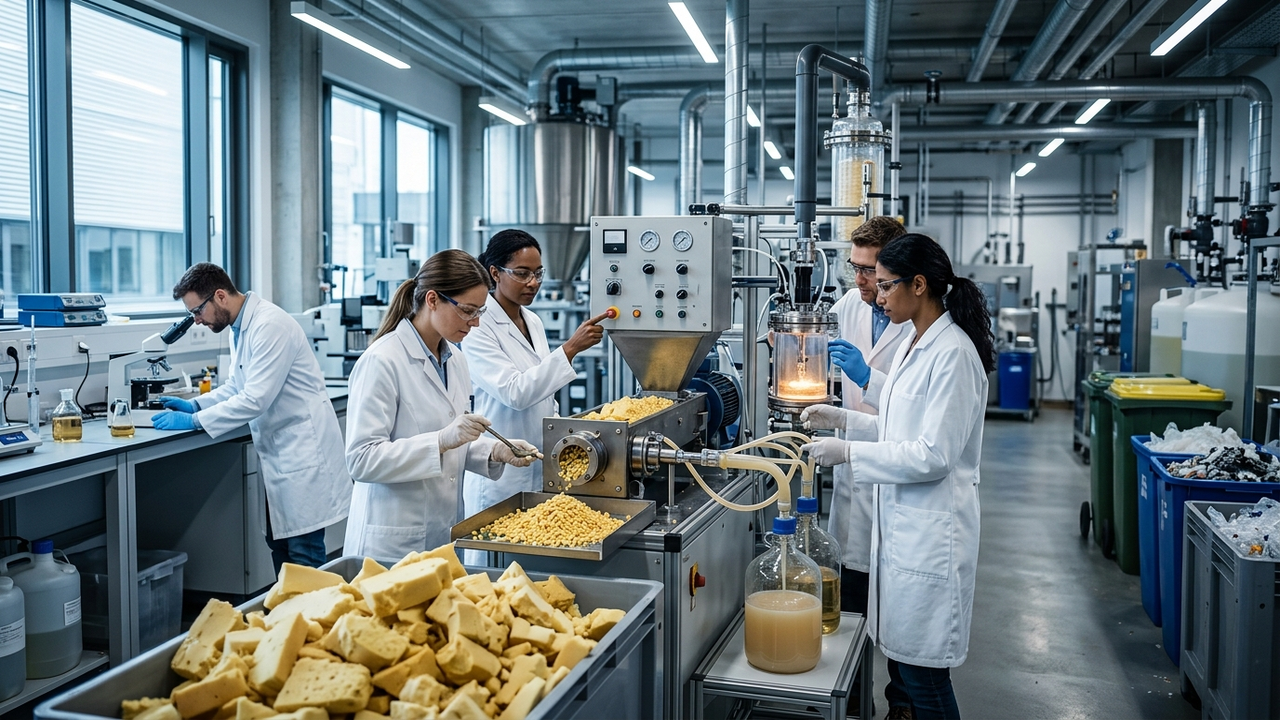
Northwestern University and BASF have been honored with the 2026 ACS Green Chemistry Challenge Award for their groundbreaking solid-state recycling platform targeting cross-linked polyurethane foams. This innovative technology promises to revolutionize the management of polyurethane waste, transforming traditionally non-recyclable thermosets into valuable resources.
Technical / Clinical Details
Led by Professor William Dichtel, the Northwestern team, in partnership with BASF, developed a novel solid-state process that effectively deconstructs the robust chemical bonds of cross-linked polyurethanes. Unlike conventional recycling methods that often degrade material quality, this platform enables the upcycling of polyurethane foams, preserving or even enhancing the properties of the recovered materials. The method involves precise chemical cleavage under mild conditions, allowing for the efficient separation and recovery of constituent monomers or oligomers. This circumvents the high energy demands and quality degradation associated with existing thermal or chemical recycling approaches, presenting a more sustainable and economically attractive pathway.
Background & Context
Polyurethanes are ubiquitous in modern society, found in everything from automotive components and construction insulation to furniture and footwear. Their versatility stems from their unique combination of rigidity, flexibility, and insulating properties. However, their cross-linked thermoset nature has historically rendered them unrecyclable at scale, leading to vast quantities ending up in landfills or incineration. With global pressure mounting for industries to adopt circular economy principles and reduce plastic waste, the absence of an effective polyurethane recycling solution has been a major environmental and economic challenge. This new technology emerges at a critical juncture, offering a pathway to address one of the most persistent issues in polymer waste management.
Strategic Significance & Outlook
The recognition by the ACS Green Chemistry Challenge underscores the significance of this innovation. For the polymer industry, it represents a substantial step towards achieving true material circularity for polyurethanes. The involvement of a major chemical producer like BASF is crucial for accelerating the transition from laboratory proof-of-concept to industrial-scale implementation. Successful deployment of this technology could drastically reduce polyurethane waste streams, lessen reliance on virgin fossil fuel-based feedstocks, and create new market opportunities for recycled polyurethanes across various applications. The focus now shifts to scaling up the process and demonstrating its economic viability in diverse commercial settings, potentially setting a new benchmark for sustainable polymer production and recycling globally.
Source: #
Get our weekly technology intelligence — free
Receive an infographic that lets you judge at a glance whether each field’s analysis report is worth reading.
Subscribe Free — Weekly Tech Intelligence
By subscribing, you’ll receive Troy-Technical’s weekly technology intelligence newsletter.
- Your email and selected fields are used only to deliver the newsletter.
- We never share your information with third parties.
- You can unsubscribe anytime via the link in each email.
See our Privacy Policy for details.
Takes about a minute · Unsubscribe anytime



Comments