Background
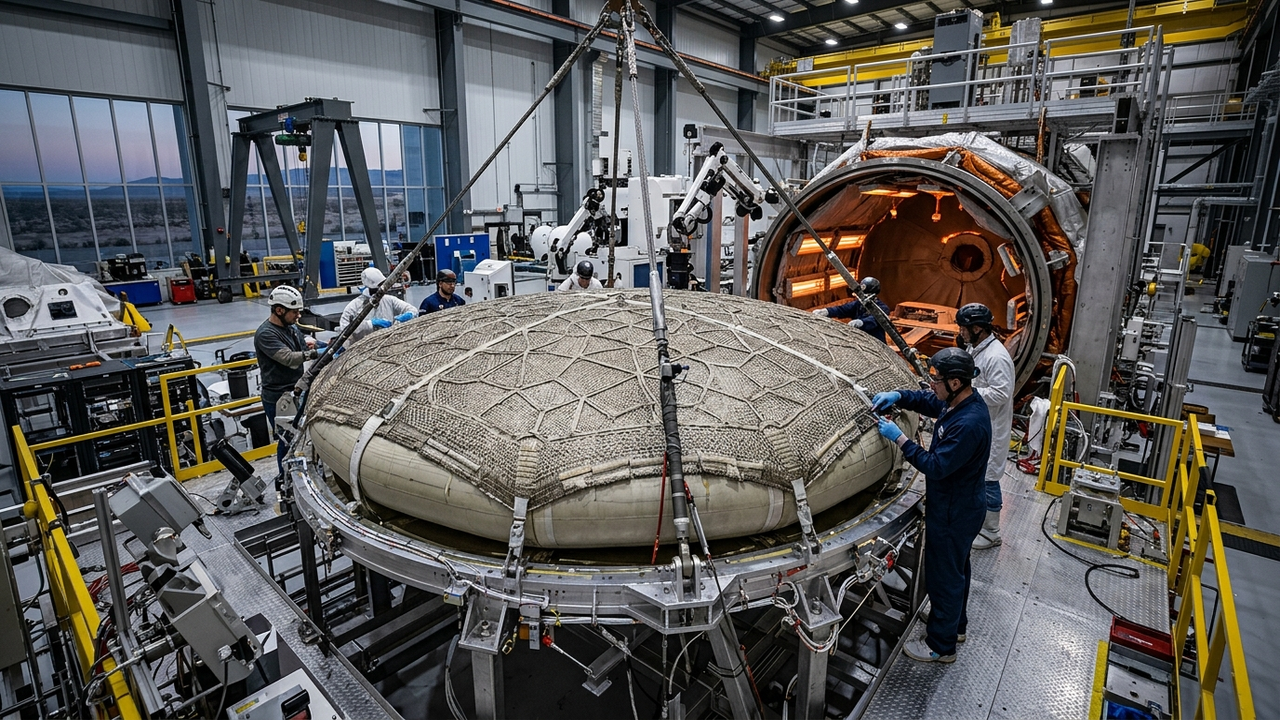
Atmospheric entry remains one of the most hazardous and technically demanding phases of any space mission. For destinations like Mars, which possesses a thin atmosphere, significantly larger heat shields are necessary to achieve sufficient deceleration. This requirement traditionally poses a formidable challenge, as conventional rigid heat shields often exceed the size constraints of standard rocket fairings. Deployable and inflatable heat shield technologies offer a revolutionary solution, enabling the safe transport of larger spacecraft and greater cargo volumes previously deemed impossible. This innovation is indispensable for realizing long-term space exploration strategies, such as human missions to Mars and the construction of lunar bases, and is a critical factor for maintaining the United States’ leadership in the ongoing space race.
Key Findings
NASA is making significant strides in the development and rigorous testing of innovative heat shield technologies, specifically designed to ensure safe atmospheric entry for future human missions to Mars. These cutting-edge solutions include the deployable ‘Spiderweave’ fabric, integral to the Adaptable Deployable Entry Placement Technology (ADEPT) system, and Inflatable Hypersonic Aerodynamic Decelerators (HIADs). A pivotal achievement in this endeavor was the successful demonstration of the Low-Earth Orbit Flight Test of an Inflatable Decelerator (LOFTID) inflatable heat shield system, which flawlessly executed atmospheric re-entry at an astounding Mach 18. This accomplishment represents a critical technical milestone, significantly advancing the prospects for crewed Mars exploration.
Technical Details
The ‘Spiderweave’ fabric, at the heart of the ADEPT system, is engineered from flexible, high-temperature resistant fibers that deploy around a spacecraft to dramatically increase its atmospheric drag. This expansion facilitates efficient deceleration upon entry. Similarly, HIAD technology employs a large, inflatable structure that expands around the spacecraft during re-entry, maximizing its surface area to generate increased friction with the atmosphere for effective deceleration. Both approaches are designed to enable larger payloads and more spacious crewed capsules to perform safe and efficient atmospheric entries, overcoming the fairing size limitations of traditional rigid shields. LOFTID’s successful flight test conclusively demonstrated that such an inflatable structure can not only maintain its structural integrity but also achieve its intended deceleration performance in the extreme conditions of hypersonic re-entry environments. Complementary advancements, such as the lightweight and highly insulating aerogel and ceramic composites utilized in SpaceX’s Starship heat shields, further underscore ongoing efforts to enhance the durability and performance of reusable spacecraft across the industry.
Strategic Significance & Outlook
The progression of these next-generation heat shield technologies dramatically enhances the feasibility of human missions to Mars. Beyond interplanetary travel, these innovations also promise safer re-entry from low Earth orbit and facilitate large-scale cargo transport missions to the Moon. By enabling greater efficiency and capacity, these technologies are poised to play a central role in reducing the overall cost of space travel and significantly boosting spacecraft reusability. Looking ahead, these advanced heat shield capabilities could be extended to support even more ambitious projects, including extensive exploration missions to other planets within our solar system, sustainable space resource extraction efforts, and even complex endeavors such as asteroid capture and redirection.
Get our weekly technology intelligence — free
Receive an infographic that lets you judge at a glance whether each field’s analysis report is worth reading.
Subscribe Free — Weekly Tech Intelligence
By subscribing, you’ll receive Troy-Technical’s weekly technology intelligence newsletter.
- Your email and selected fields are used only to deliver the newsletter.
- We never share your information with third parties.
- You can unsubscribe anytime via the link in each email.
See our Privacy Policy for details.
Takes about a minute · Unsubscribe anytime






Comments