Key Findings
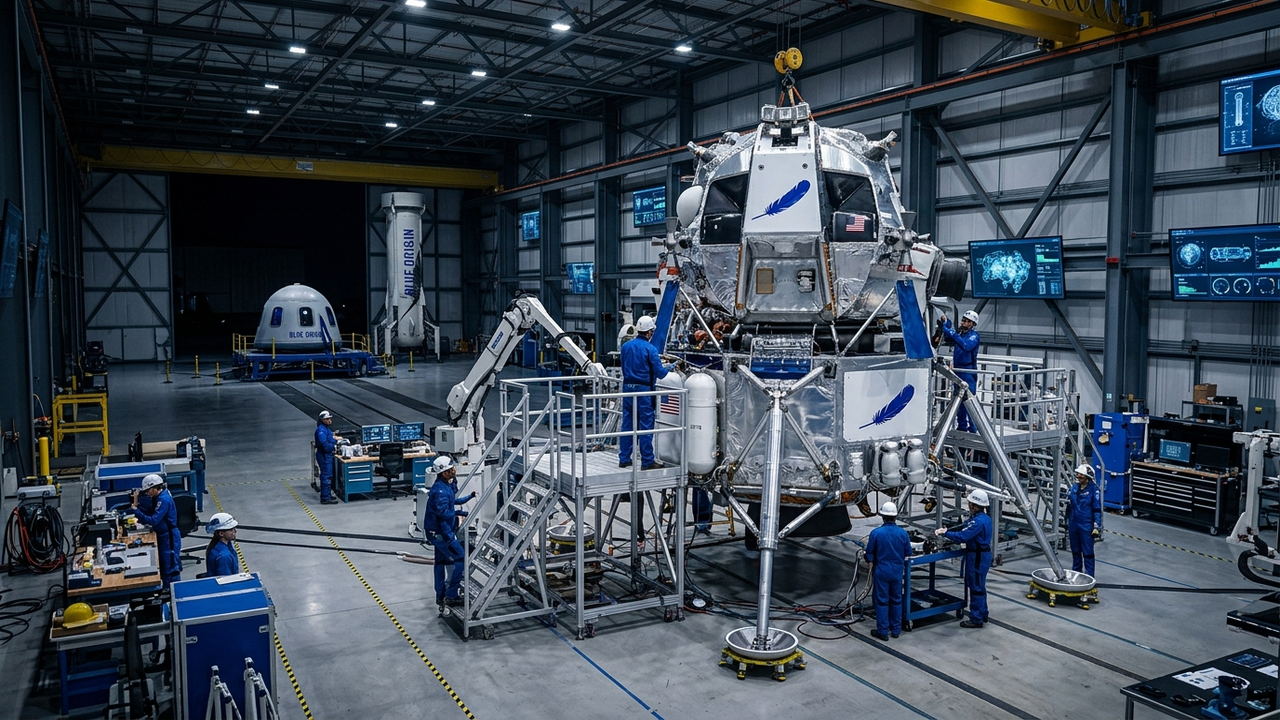
Blue Origin has decided to temporarily suspend its suborbital space tourism flights, effective early 2026, to reallocate a significant portion of its resources and technical expertise towards the development of a lunar lander for NASA’s Artemis program. This strategic pivot signals a clear shift in the company’s operational priorities toward commercial deep space exploration.
Technical & Operational Details
Until this announcement, Blue Origin had pioneered and led the suborbital space tourism market, having transported approximately 100 private citizens beyond the Kármán Line using its New Shepard rocket system. The New Shepard is a fully reusable suborbital rocket, featuring a capsule that lands via parachute and a booster that performs a vertical landing. However, this decision implies a substantial redirection of resources from the New Shepard program. The company is now intensely focused on developing a Human Landing System (HLS) for NASA’s Artemis program, which involves not only a large-scale lunar lander but also in-space refueling technologies and complex docking and landing systems essential for sustained lunar operations. This endeavor requires significant technical and financial investment and demands the resolution of advanced technical challenges while competing against formidable rivals like SpaceX.
Background & Industry Context
The commercial space industry has increasingly seen large government contracts become a critical driver of business growth. NASA’s Artemis program represents one of the most ambitious lunar exploration initiatives in decades, with government contracts offering substantial funding and long-term stability. For Blue Origin, pausing suborbital tourism signifies a choice to prioritize long-term strategic positioning in deep space exploration and securing government contracts over immediate tourism revenues. This move reflects a broader industry trend where private space companies seek to balance niche commercial markets with large-scale government partnerships. Especially with powerful competitors like SpaceX’s Starship in play, Blue Origin aims to leverage its strengths in reliability and proven capabilities to meet NASA’s stringent requirements.
Strategic Significance & Outlook
Blue Origin’s decision has the potential to significantly contribute to the Artemis program’s goal of establishing a sustained human presence on the Moon. Focusing on lunar lander development will accelerate the company’s engineering capabilities and innovation, building a crucial technological foundation for future deep space missions. Should its lunar lander development prove successful, Blue Origin could establish itself as a primary provider for lunar cargo and crew transport services. While the resumption of suborbital space tourism remains uncertain, the success in lunar lander development is expected to dramatically enhance the company’s long-term growth and influence within the industry. This case serves as a notable example of how commercial space companies flexibly adjust their strategies in response to evolving market opportunities and strategic imperatives.
Source: https://www.britannica.com/topic/Blue-Origin
Get our weekly technology intelligence — free
Receive an infographic that lets you judge at a glance whether each field’s analysis report is worth reading.
Subscribe Free — Weekly Tech Intelligence
By subscribing, you’ll receive Troy-Technical’s weekly technology intelligence newsletter.
- Your email and selected fields are used only to deliver the newsletter.
- We never share your information with third parties.
- You can unsubscribe anytime via the link in each email.
See our Privacy Policy for details.
Takes about a minute · Unsubscribe anytime









Comments