Key Findings
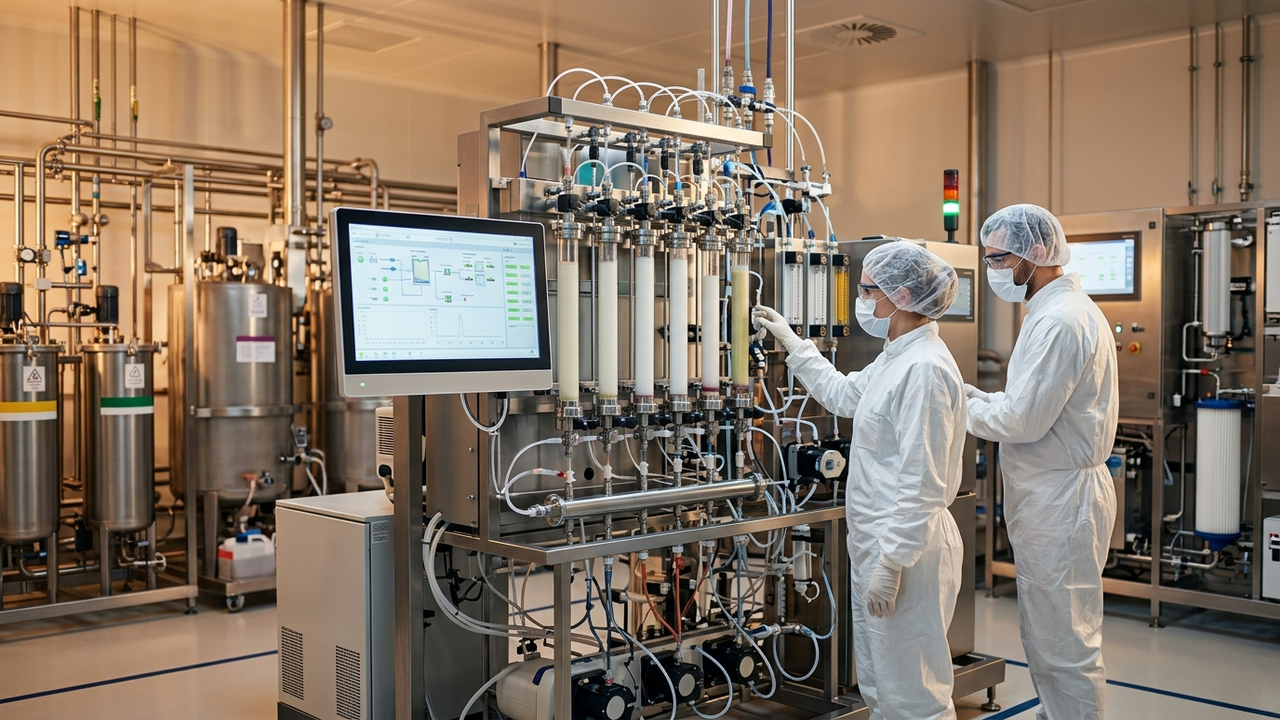
In the manufacturing of monoclonal antibodies (mAbs), the integration and intensification of downstream processing using a continuous multi-column chromatography (MCC) platform has been demonstrated to dramatically enhance the overall efficiency and sustainability of the process. Specifically, integrating two chromatography steps into a single continuous system achieves improvements in productivity, cost reduction, and footprint reduction.
Technical and Business Details
Traditional mAb downstream processing typically involves multiple batch-mode chromatography steps, which are time-consuming, require large-scale equipment, and incur high costs. An MCC system employs several smaller columns arranged in parallel or series, allowing for continuous loading, washing, elution, and regeneration, thereby utilizing resin far more efficiently than batch processes. The approach discussed in this article seamlessly integrates, for example, Protein A chromatography with subsequent purification steps (e.g., ion exchange chromatography). This integration reduces the need for intermediate holding tanks, lowers buffer consumption, increases the level of process automation, and permits the incorporation of in-line viral inactivation steps. Consequently, overall process time is shortened, manufacturing costs are reduced, and product yield is improved. A smaller equipment footprint also helps to curb capital costs for facility construction or expansion.
Background and Industry Context
Biopharmaceuticals, particularly mAbs, play a central role in treating cancer and autoimmune diseases, with their demand continuously increasing globally. However, high manufacturing costs have driven up product prices, limiting patient access. Continuous manufacturing processes are gaining traction as a primary strategy to address this challenge. With advancements in upstream high-cell-density culture, downstream processing bottlenecks have become apparent, making innovative downstream technologies like MCC indispensable. These technologies introduce Industry 4.0 and smart factory concepts into biomanufacturing, potentially revolutionizing the future of biopharmaceutical production.
Strategic Significance and Outlook
The increasing adoption and technological innovation in continuous multi-column chromatography are expected to expand its applications beyond mAbs to other biopharmaceuticals, such as bispecific antibodies, antibody-drug conjugates (ADCs), and recombinant proteins. In the future, further integration with advanced Process Analytical Technology (PAT) and AI-driven control systems is anticipated to achieve autonomous optimization of the entire process, further enhancing quality control. This will lead to further reductions in biopharmaceutical costs, improved manufacturing scalability and flexibility, and faster, more affordable delivery of new therapeutics to patients. This technology will play a central role in increasing the sustainability and competitiveness of the biopharmaceutical industry.
Get our weekly technology intelligence — free
Receive an infographic that lets you judge at a glance whether each field’s analysis report is worth reading.
Subscribe Free — Weekly Tech Intelligence
By subscribing, you’ll receive Troy-Technical’s weekly technology intelligence newsletter.
- Your email and selected fields are used only to deliver the newsletter.
- We never share your information with third parties.
- You can unsubscribe anytime via the link in each email.
See our Privacy Policy for details.
Takes about a minute · Unsubscribe anytime








Comments