
Key Findings
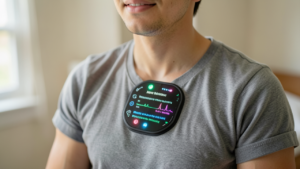
A recent article from Pabau provides a clear exposition on the mechanisms and benefits of AI patient monitoring, highlighting its innovative approach to leveraging machine learning for early detection of changes in patient conditions through continuous sensor data analysis. Crucially, the concept of ‘multimodal sensor fusion’ is presented as central to this technology, wherein data from diverse sensors — monitoring heart rate, sleep patterns, glucose levels, and physical activity — are combined to generate a comprehensive, composite health score. This AI-driven monitoring is proving effective across several applications, including chronic disease management, early deterioration detection, medication adherence, and post-surgical recovery, promising to elevate healthcare quality.
Technical/Clinical Details
AI patient monitoring systems process vast streams of physiological data in real-time, collected from wearables, implanted sensors, and ambient environmental sensors. Machine learning algorithms continuously analyze these data streams to identify subtle deviations from baselines or patterns indicative of disease progression. Multimodal sensor fusion, in particular, significantly enhances diagnostic accuracy by capturing complex interactions that might be missed by single data points. For instance, a concurrent rise in heart rate and decline in sleep quality could trigger an alert for potential stress or incipient infection. This allows healthcare providers to gain a more holistic understanding of a patient’s health status and intervene proactively before symptoms escalate, thereby enabling truly personalized and responsive care.
Background & Context
The increasing global elderly population and the rising prevalence of chronic diseases have dramatically amplified the need for continuous patient monitoring outside traditional hospital settings. Conventional healthcare models often face challenges in the early detection of patient status changes, leading to increased risks of emergency admissions and complications. AI patient monitoring offers a powerful solution to these challenges. Patients can receive medical-grade monitoring while living their daily lives at home or on the go, reducing the burden on healthcare systems while significantly improving patient quality of life. This paradigm shift is moving healthcare towards more preventive and individualized approaches.
Strategic Significance & Outlook
The evolution of AI patient monitoring technology is integral to shaping the future of personalized healthcare. Future advancements are expected to include the detection of an even broader range of biomarkers, the integration of more sophisticated predictive models, and seamless interoperability with electronic health record systems. Equally important will be the development of user-friendly interfaces that empower healthcare professionals to efficiently leverage AI-generated insights and enable patients to actively participate in managing their health data. As this technology matures and becomes more widespread, rigorous monitoring comparable to an intensive care unit could become available in homes, improving outcomes for chronic disease patients and supporting healthier, more independent lives. AI-powered patient monitoring holds the potential to fundamentally transform healthcare delivery.
Source: https://pabau.com/blog/ai-patient-monitoring/
Get our weekly technology intelligence — free
Receive an infographic that lets you judge at a glance whether each field’s analysis report is worth reading.
Subscribe Free — Weekly Tech Intelligence
By subscribing, you’ll receive Troy-Technical’s weekly technology intelligence newsletter.
- Your email and selected fields are used only to deliver the newsletter.
- We never share your information with third parties.
- You can unsubscribe anytime via the link in each email.
See our Privacy Policy for details.
Takes about a minute · Unsubscribe anytime








Comments