
Key Findings
A research team at the University of Delaware has achieved the highest-ever piezoelectric output for a lead-free, textile-compatible material by incorporating strontium-doped barium titanate into flexible polymer fibers. This innovative material generates voltages exceeding 23 volts and power densities greater than 4.5 milliwatts per square meter, marking a significant step towards the realization of self-powered wearable devices.
Technical / Clinical Details
Piezoelectric materials, which convert mechanical stress into electrical energy, are garnering significant attention as self-powering sources for wearable devices. However, many highly efficient piezoelectric materials to date contain lead (e.g., PZT), necessitating the development of alternative materials due to environmental and health concerns.
In this study, the researchers utilized environmentally benign barium titanate (BaTiO3) as a base and dramatically improved its piezoelectric properties by doping it with strontium. The doped barium titanate particles exhibit a high content of the efficient “beta-phase” crystalline structure, approximately 87%, which is the source of their superior piezoelectric performance. These particles were uniformly dispersed within a polymer matrix and processed into flexible fibers through a spinning technique.
- Key Material: Strontium-doped barium titanate (lead-free)
- Form Factor: Flexible polymer fibers
- Beta-Phase Content: Approximately 87%
- Generated Voltage: Over 23 volts
- Power Density: Exceeding 4.5 milliwatts per square meter
- Application Area: Self-powered wearables
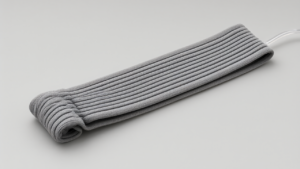
These fibers can efficiently generate electricity from small mechanical vibrations and movements (e.g., body motion, respiration), providing sufficient power for wearable devices to operate without external power sources. Their flexibility also allows for easy integration into smart textiles or adhesion to skin-worn sensors.
Background & Context
The wearable electronics market is experiencing remarkable growth, yet its expansion is heavily reliant on advances in battery technology. The inconvenience of charging, battery weight, lifespan, and environmental impact are significant challenges to the widespread adoption of wearable devices. Self-powered devices offer a fundamental solution to these challenges, with increasing demand, particularly for applications like IoT devices and medical sensors that require continuous operation. Lead-free and flexible piezoelectric fibers are ideal candidates to meet this need and align perfectly with the industry trend towards stricter environmental regulations.
Strategic Significance & Outlook
The record-breaking performance of this lead-free piezoelectric fiber will significantly accelerate the commercialization of self-powered wearables. In the future, applications are anticipated across a wide range of products, including smart clothing, activity trackers, biosensors, and medical diagnostic devices. Key areas of focus for future research will include validating material durability, scaling up manufacturing processes, and developing integration techniques for various wearable products. This technology holds the potential to unlock a future of more liberated and sustainable personal electronics, freed from the constraints of conventional batteries.
Get our weekly technology intelligence — free
Receive an infographic that lets you judge at a glance whether each field’s analysis report is worth reading.
Subscribe Free — Weekly Tech Intelligence
By subscribing, you’ll receive Troy-Technical’s weekly technology intelligence newsletter.
- Your email and selected fields are used only to deliver the newsletter.
- We never share your information with third parties.
- You can unsubscribe anytime via the link in each email.
See our Privacy Policy for details.
Takes about a minute · Unsubscribe anytime