Key Findings
A recent review paper published in MDPI thoroughly analyzes the potential of green hydrogen to serve as a pivotal energy carrier within integrated Multi-Energy Systems (MES), seamlessly connecting diverse energy sectors such as electricity, gas, heat, and transport. The paper provides a comprehensive overview of the current status and future prospects of global hydrogen supply chains, various MES architectures, and existing hydrogen policy instruments across major economies including the EU, the United States, China, Japan, and India. Furthermore, it delves deeply into the primary barriers hindering the large-scale deployment of green hydrogen.
Technical & Clinical Details
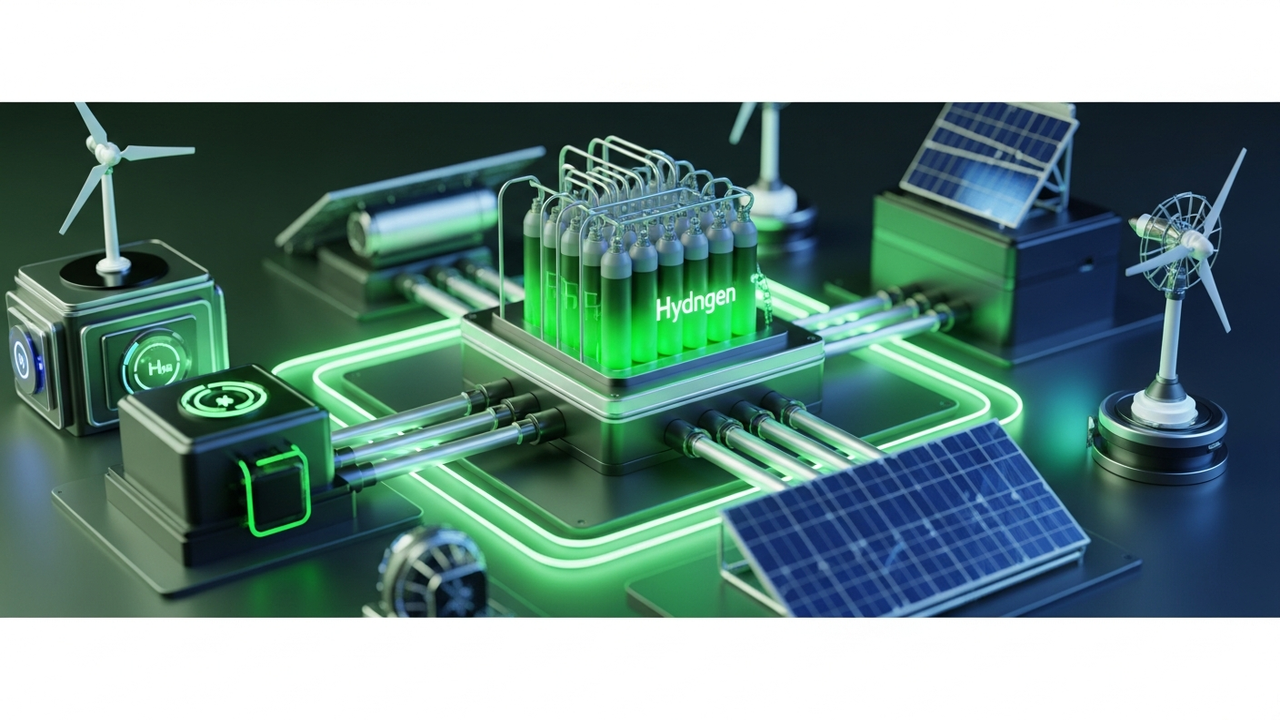
The review paper details the technical facets of how green hydrogen functions within an MES. For instance, in the electricity sector, converting and storing surplus renewable energy as hydrogen helps absorb variability and stabilize the grid. In the gas sector, hydrogen can be blended into existing natural gas infrastructure or transported via dedicated hydrogen pipelines. For the heat sector, the utilization of waste heat from hydrogen-fueled boilers or fuel cells is explored. In the transport sector, the paper emphasizes hydrogen’s role as a direct fuel for Fuel Cell Electric Vehicles (FCEVs), ships, and aircraft, or as a feedstock for synthetic fuels (e-fuels).
-
Role of AI:
The paper also provides an in-depth analysis of the wide-ranging applications of Artificial Intelligence (AI) within green hydrogen systems. Specifically, AI can be leveraged in areas such as:
- Improving the accuracy of renewable energy generation forecasting.
- Optimizing electrolyzer operation and extending its lifespan.
- Enhancing the efficiency and safety management of hydrogen storage and distribution networks.
- Real-time balancing of energy supply and demand across the entire MES.
- Techno-economic assessment and optimization at the system level.
These AI applications are deemed indispensable for maximizing efficiency and reducing costs throughout the entire green hydrogen value chain, from production to consumption.
Background & Context
The global energy system faces a triple challenge: mitigating climate change, enhancing energy security, and improving economic efficiency. Traditional fossil-fuel-dependent energy systems are finding it increasingly difficult to address these challenges comprehensively. MES aims to integrate different energy carriers and infrastructures to create synergies, thereby boosting the overall resilience and efficiency of the system. Green hydrogen, due to its storability, transportability, and diverse applications, is identified as an ideal link between these disparate sectors. This review paper offers invaluable insights for policymakers and industry stakeholders, particularly as national governments set net-zero targets and formulate their respective hydrogen strategies.
Strategic Significance & Outlook
This review paper demonstrates that green hydrogen will function not merely as a clean fuel but as an integrated catalyst connecting various energy forms within future sustainable energy systems. The application of AI is identified as a key factor enabling the optimization of these complex systems and overcoming barriers to large-scale deployment. Researchers and engineers must focus on developing new AI-driven control algorithms and system designs to create more efficient and robust MES. For investors, the green hydrogen sector, especially its convergence with AI, presents significant growth opportunities in the construction of next-generation energy infrastructure. This integration is crucial for accelerating the realization of a more integrated, resilient, and decarbonized society.