

Key Findings
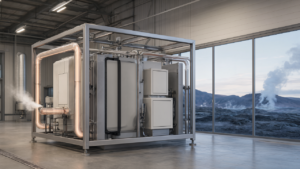
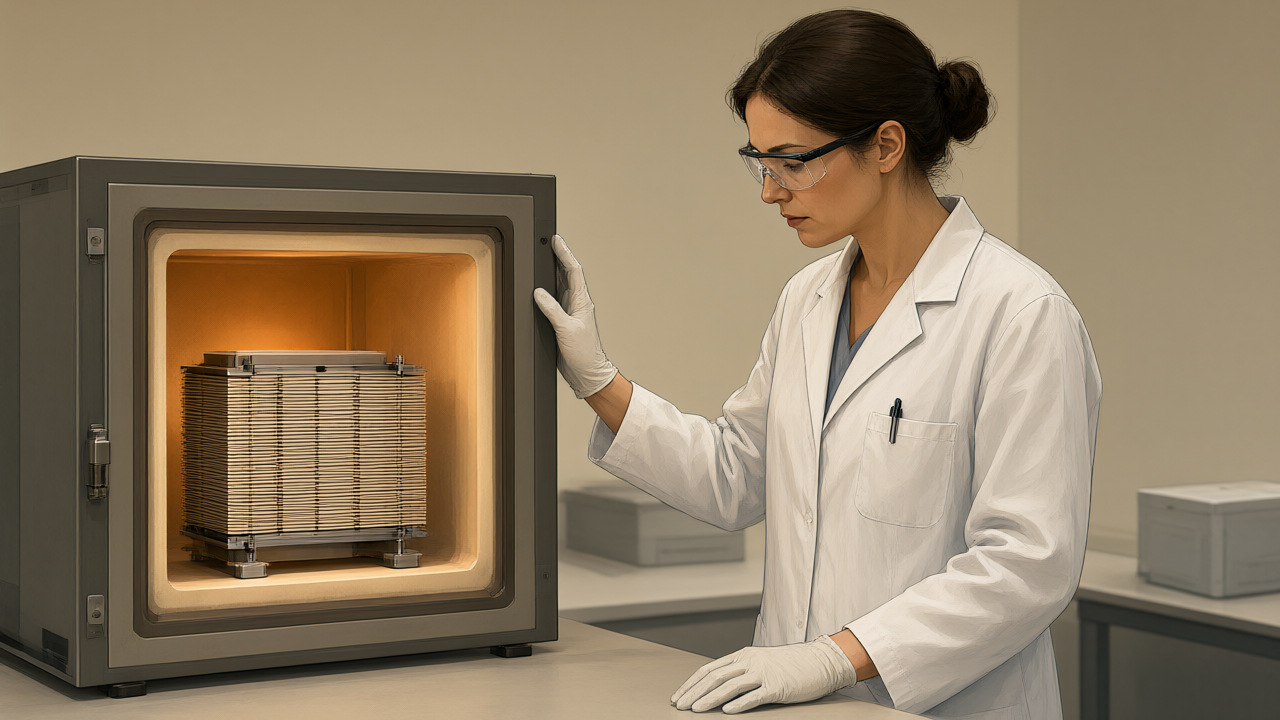
A team of Danish and Italian researchers has achieved a record-breaking durability benchmark for a full industrial-scale solid oxide electrolysis stack. The 70-cell stack operated in steam electrolysis mode for nearly three years, maintaining a stabilized average voltage degradation rate of 0.05 percent per thousand hours (equivalent to 0.65 millivolts per thousand hours per cell). This low degradation rate was sustained for 22,000 hours following an initial break-in phase, representing the longest and lowest-degradation operation ever reported for a complete stack of this type.
Technical Details
The achievement relies on “frequency-dependent electrochemical operation,” or AC:DC operation, rather than the conventional steady direct current (DC). The process involves periodically inverting the polarity of the stack, alternating between:
- Electrolysis mode: Splitting steam into hydrogen and oxygen.
- Fuel-cell mode: Briefly operating as a power-producing fuel cell.
This rhythmic reversal modulates electrochemical polarization and redistributes Joule heating across cell components. Post-mortem microstructural examinations confirmed that the degradation pathways typically activated during DC electrolysis—such as nickel agglomeration, electrode sintering, and oxygen partial pressure gradients—were not engaged under this alternating regime.
Background & Context
Solid oxide steam electrolysis operates at temperatures between 700 and 850 degrees Celsius, using a nickel-based ceramic cathode and a dense ceramic electrolyte, typically yttria-stabilized zirconia. While electrically efficient, these stacks typically suffer from relentless degradation under continuous DC operation. Previous full-stack benchmarks reported degradation rates an order of magnitude higher, often several percent per thousand hours, with tests frequently ending after a few thousand hours.
Significance & Outlook
By demonstrating that durability can be managed via operational strategy rather than the invention of new materials, the researchers have repositioned stack longevity as a solvable engineering problem. Because stack lifetime directly determines how capital costs are amortized, a 25,000-hour lifespan with near-zero degradation fundamentally alters the economics of green hydrogen production. The study involved a stack supplied by commercial manufacturer SolydEra and researchers from the Technical University of Denmark, DynElectro, SolydEra, and Aalborg University.
Get our weekly technology intelligence — free
Receive an infographic that lets you judge at a glance whether each field’s analysis report is worth reading.
Subscribe Free — Weekly Tech Intelligence
By subscribing, you’ll receive Troy-Technical’s weekly technology intelligence newsletter.
- Your email and selected fields are used only to deliver the newsletter.
- We never share your information with third parties.
- You can unsubscribe anytime via the link in each email.
See our Privacy Policy for details.
Takes about a minute · Unsubscribe anytime