


Key Findings
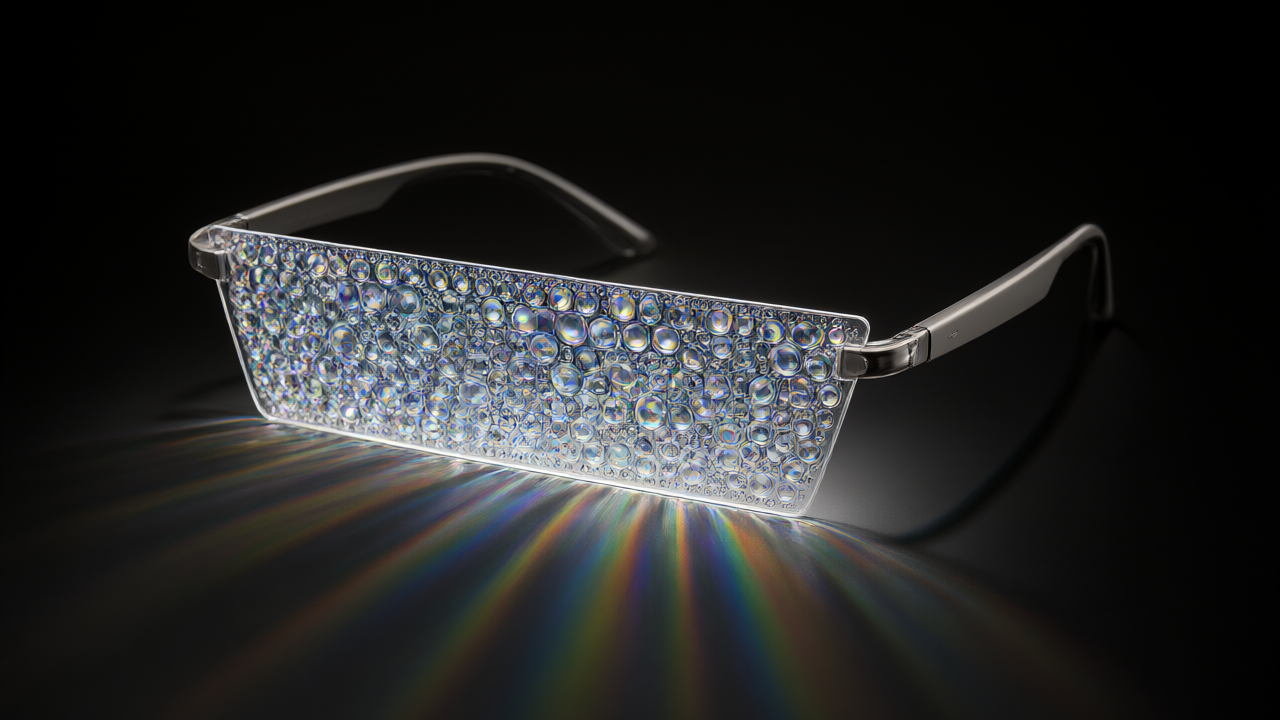
Researchers have developed a heterogeneous metalens array that expands the field of view for light-field near-eye displays to 50 degrees, compared to the 13 degrees seen in conventional light-field displays. The system supports 3D content reconstruction from 10 cm to 70 cm with physically accurate focus and defocus behavior. To support this hardware, a dedicated distortion-correction algorithm using a nonlinear voxel-to-pixel mapping look-up table achieved a rendering rate of 140 frames per second on a laptop with integrated graphics.
Technical Details
Unlike conventional homogeneous microlens arrays where every unit is identical, this architecture employs customized sub-lenses tailored to their assigned FOV region. Each unit integrates two functions: a focusing phase (equivalent to a convex lens) and a deflection phase (equivalent to a prism). This approach simplifies complex off-axis imaging into near-axis imaging and linear deflection.
- Fabrication: The team used a high-refractive-index resist and a low-cost, large-area nanoimprint process to produce centimeter-scale arrays with a 7:1 aspect ratio.
- Optical Performance: The design maintains imaging quality close to the diffraction limit across the demonstrated FOV using a single lightweight optical element.
- Simulation: While experimental results reached 50 degrees, simulations indicate a potential extension to an 86-degree FOV, which would require a larger microdisplay.
Background & Context
Standard near-eye displays relying on binocular parallax often cause vergence-accommodation conflict (VAC), leading to visual fatigue and dizziness. While holographic and light-field displays can provide VAC-free viewing, they are typically limited by diffraction, aberrations, and the volume constraints of near-eye devices. Conventional microlens arrays suffer from severe off-axis aberrations that degrade image quality as the FOV increases.
Significance & Outlook
The use of heterogeneous metalens arrays provides a hardware path toward immersive extended-reality (XR) devices that retain natural monocular 3D depth cues. By reducing the barriers to mass production through nanoimprint fabrication and optimizing real-time rendering, this technology addresses the critical trade-off between FOV and image quality in VAC-free displays.
Source: https://bioengineer.org/heterogeneous-metalens-array-widens-light-field-xr-displays/
Get our weekly technology intelligence — free
Receive an infographic that lets you judge at a glance whether each field’s analysis report is worth reading.
Subscribe Free — Weekly Tech Intelligence
By subscribing, you’ll receive Troy-Technical’s weekly technology intelligence newsletter.
- Your email and selected fields are used only to deliver the newsletter.
- We never share your information with third parties.
- You can unsubscribe anytime via the link in each email.
See our Privacy Policy for details.
Takes about a minute · Unsubscribe anytime