


Key Findings
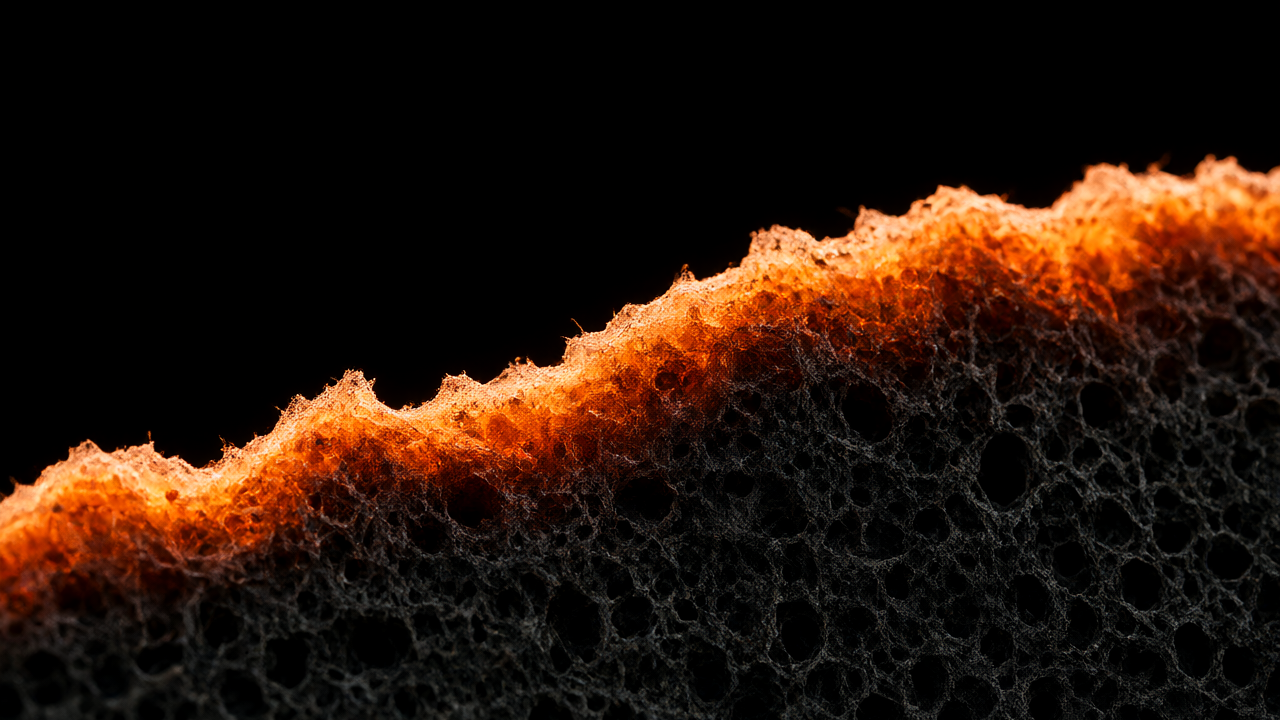
The study demonstrates a 3D simulation capable of reproducing the morphological evolution of individual fibers and the non-steady pace of surface recession in porous carbon materials. In production simulations initialized at 3000 kelvin with oxygen concentrations of 2.713 moles per cubic meter, less than 30 percent of the original solid volume remained after 20 seconds of reaction. The results showed better agreement with the Lachaud model than previous two-dimensional models.
Technical Details
The researchers re-developed the dbsFoam solver on the open-source OpenFOAM platform to couple porous flow, heat transfer, and heterogeneous chemical reactions. The model utilizes a Darcy-Brinkman-Stokes momentum equation, which functions as the Navier-Stokes equation in pure gas regions and reduces to Darcy’s law where gas and solid coexist. Key technical specifications include:
- Chemistry: Focused on the dominant carbon monoxide-producing pathway (solid carbon reacting with half a molecule of oxygen), releasing approximately 110 kilojoules per mole.
- Material Parameters: A 3D carbon fibrous preform with an initial porosity of 0.85, fibers of 11 micrometer diameter, and a maximum fiber length of 100 micrometers.
- Computational Scale: A grid of approximately 10.2 million cells was selected to balance accuracy and efficiency.
- Physics: Volume-averaged convection-diffusion equations track species, while fiber reactivity follows an Arrhenius-type temperature dependence.
Background & Context
Ablation is a self-protective mechanism where heat shields sacrifice layers of material to protect critical components. Modeling porous carbon/carbon composites is challenging because ablation is non-uniform; recession patterns depend on pore-scale geometry, fiber volume fractions, and orientations. Previous lattice Boltzmann methods often lacked clear physical quantities for direct experimental comparison or required excessive computational resources.
Significance & Outlook
By resolving the complex interactions between gas flow and the skeletal architecture of carbon composites, this hybrid approach allows engineers to better predict how surfaces roughen and reshape during atmospheric re-entry. The authors plan to incorporate more complex surface chemistry in future versions of the model.
Source: https://bioengineer.org/new-3d-simulation-tracks-moving-ablation-interfaces-in-porous-heat-shields/
Get our weekly technology intelligence — free
Receive an infographic that lets you judge at a glance whether each field’s analysis report is worth reading.
Subscribe Free — Weekly Tech Intelligence
By subscribing, you’ll receive Troy-Technical’s weekly technology intelligence newsletter.
- Your email and selected fields are used only to deliver the newsletter.
- We never share your information with third parties.
- You can unsubscribe anytime via the link in each email.
See our Privacy Policy for details.
Takes about a minute · Unsubscribe anytime