


Key Findings
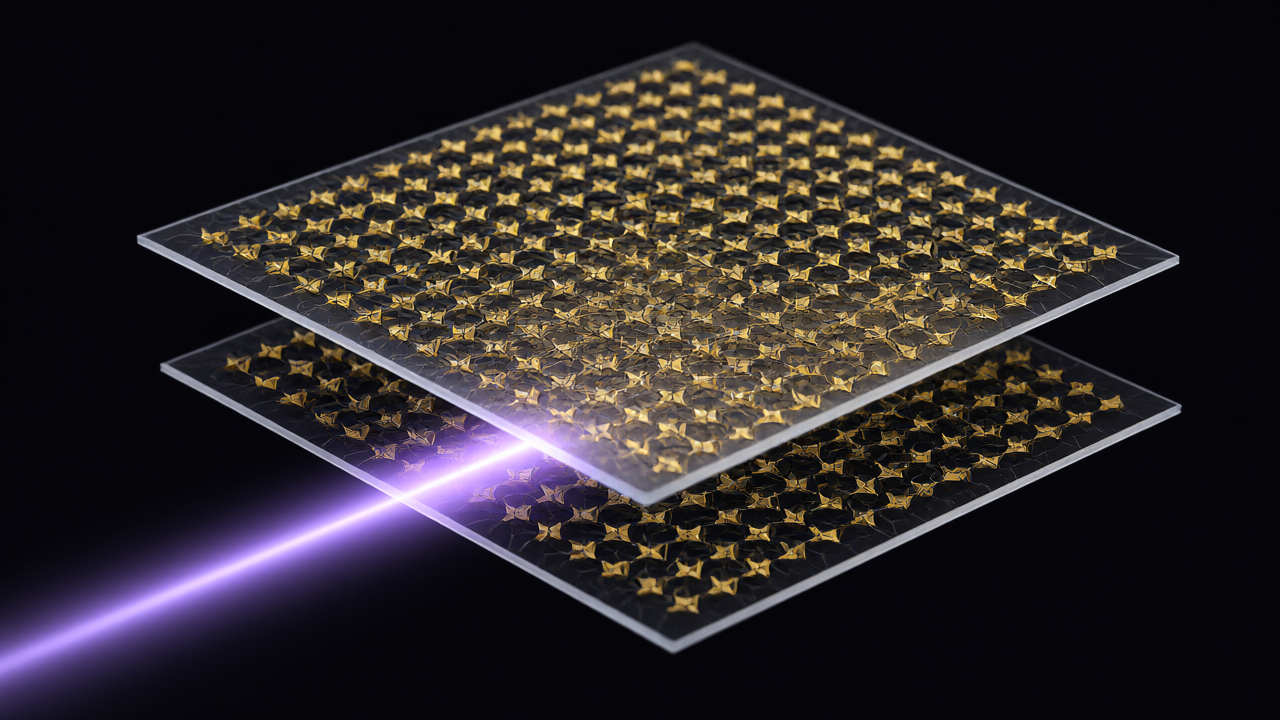
The proposed bilayer terahertz metasurface achieves high-Q resonance characteristics with exceptional resistance to fabrication defects. Experimental validation using terahertz time-domain spectroscopy (THz-TDS) on samples with offsets of -15 μm and 20 μm confirmed that the structure maintains double-resonance transmission dips despite significant interlayer misalignment. Numerical simulations show that within a lateral displacement range of |Dx| ≤ 42 μm, relative resonance frequency fluctuations remain under 0.33%.
Technical Details
The design utilizes S4 point-group symmetry, consisting of two identical monolayer metasurfaces rotated by 90° along the z-axis with broken inversion symmetry. At the Γ-point, the free-space continuum belongs to the two-dimensional degenerate E representation of S4, while TM1 and TM2 modes correspond to one-dimensional irreducible representations A and B. This configuration creates two discrete dark modes (SP-BICs) when upper elliptical cylinders are parallel (θ = 0°). Introducing angular perturbation transforms these into QBICs, following an inverse-square power law (Q ∝ α^-2) for Q-factor evolution.
- Symmetry Roles: S4 protects two sets of BIC modes at the overall representation level, while the C2(z) subgroup independently suppresses radiation within each layer.
- Topological Charges: The two modes exhibit counter-winding polarization distributions with topological charges V1 = -1 and V2 = +1.
- Multipole Response: QBIC 1 is dominated by magnetic dipole resonance, while QBIC 2 is dominated by electric quadrupole resonance.
Background & Context
Conventional monolayer metasurfaces with in-plane C2 symmetry are highly sensitive to wavevector perturbations and fabrication defects, which often lead to severe Q-factor degradation. While multilayer architectures can introduce out-of-plane degrees of freedom, they typically require ultra-high-precision nanofabrication to avoid performance deterioration.
Significance & Outlook
By coupling in-plane rotation with out-of-plane reflection, this S4 symmetry strategy overcomes the bottleneck of narrow fabrication tolerances. The ability to maintain stable resonance performance under structural perturbations relaxes the precision requirements for the production of terahertz lasers, filters, and sensing devices.
Source: https://www.miragenews.com/s4-terahertz-metasurface-creates-robust-quasi-1765735/
Get our weekly technology intelligence — free
Receive an infographic that lets you judge at a glance whether each field’s analysis report is worth reading.
Subscribe Free — Weekly Tech Intelligence
By subscribing, you’ll receive Troy-Technical’s weekly technology intelligence newsletter.
- Your email and selected fields are used only to deliver the newsletter.
- We never share your information with third parties.
- You can unsubscribe anytime via the link in each email.
See our Privacy Policy for details.
Takes about a minute · Unsubscribe anytime