


Key Findings
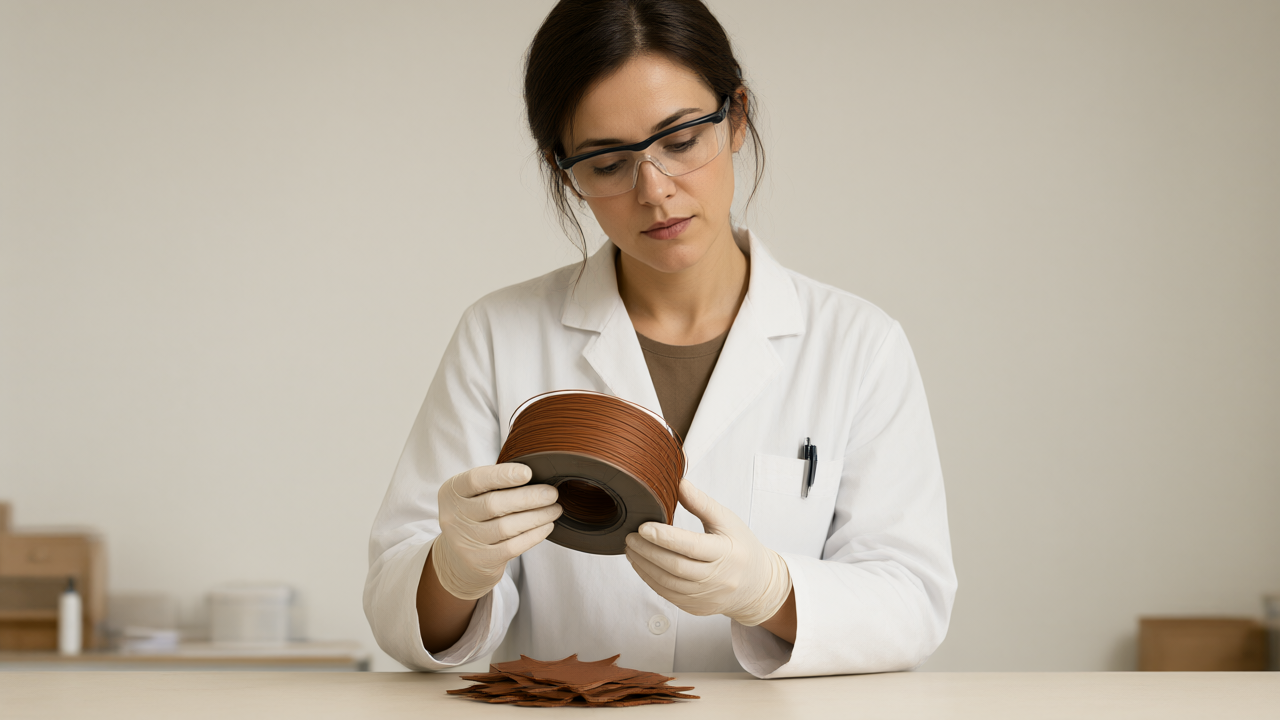
The study identifies a technological ceiling of 30 percent leather waste content by weight for producing composite filaments suitable for fused filament fabrication. While composites containing up to 30 percent leather maintain good printability, a 40 percent filler content renders the material too brittle, causing the filament to break during spool preparation and handling within the printer feeding system. The optimal processing window was determined to be a printing speed of 50 millimeters per second with nozzle temperatures between 220 and 225 degrees Celsius.
Technical Details
The researchers used glutaraldehyde-tanned wet-white bovine automotive leather from the tannery Pasubio. The preparation process involved:
- Drying shavings at 50 degrees Celsius for 16 hours.
- Grinding shavings into a fibrous powder using a 0.5 millimeter sieve at 400 rpm, keeping temperatures below 40 degrees Celsius per ISO 4044:2017.
- Ensuring particle size: over 90 percent of particles were below 1.3 times ten to the fifth square micrometers to prevent nozzle clogging.
Composites were created by compounding TPU pellets and leather powder at 210 degrees Celsius and 100 rpm for two minutes. Thermal analysis showed that adding leather filler shifted the TPU melting temperature from 205 to 221 degrees Celsius and raised the crystallization temperature from 106 to 162 degrees Celsius. Thermogravimetric analysis confirmed thermal stability, as pure TPU only begins to decompose at 323 degrees Celsius.
Background and Context
The tanning industry generates significant waste; in the Italian cycle, 31 percent of solid waste occurs during tanning, averaging 0.5 kilograms per square meter of finished leather. Globally, the industry produces roughly 2.0 billion square meters of leather annually, resulting in 1.0 million tons of solid waste. Leather shavings, used to uniform thickness, account for 75 percent of tannery solid waste and 33 percent of total waste.
Significance and Outlook
The developed filler complies with the European REACH Regulation (Annex XVII), the EU regulation on persistent organic pollutants, the Oeko-Tex Leather Standard, and Japan Automobile Manufacturers Association requirements. This creates a sustainable, high-value outlet for leather waste, addressing pressure from automotive manufacturers and fashion brands to adopt sustainable business models.
Source: https://bioengineer.org/leather-waste-becomes-3d-printing-filament-with-a-30-percent-ceiling/
Get our weekly technology intelligence — free
Receive an infographic that lets you judge at a glance whether each field’s analysis report is worth reading.
Subscribe Free — Weekly Tech Intelligence
By subscribing, you’ll receive Troy-Technical’s weekly technology intelligence newsletter.
- Your email and selected fields are used only to deliver the newsletter.
- We never share your information with third parties.
- You can unsubscribe anytime via the link in each email.
See our Privacy Policy for details.
Takes about a minute · Unsubscribe anytime