

Key Findings
The study confirms that the alignment of hexagonal boron nitride (hBN) platelets in 3D-printed composites is governed by the relationship between platelet size and layer thickness. The strongest basal-plane alignment occurs when using the largest platelets (BN45) combined with the thinnest layers (10 micrometers). Conversely, smaller platelets (BN0.9) remain largely randomly oriented due to their greater rotational freedom within the printing gap.
Technical Details
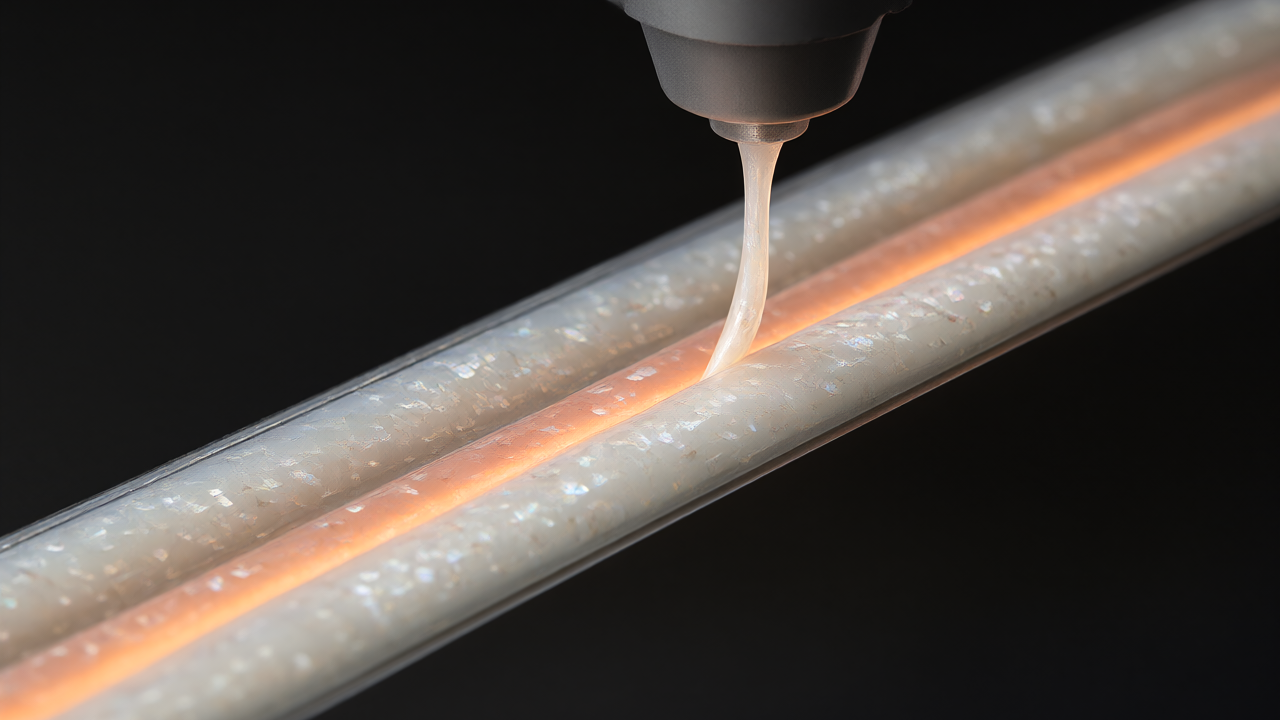
The team utilized MSLA printing with a 405 nanometer light source and an XY resolution of 0.05 millimeters. They dispersed three grades of hBN microplatelets—with average lateral sizes of 0.9, 12, and 45 micrometers (BN0.9, BN12, and BN45)—into Anycubic Standard Resin+ at weight loadings of 5 to 20 percent. Layer thicknesses were varied between 10, 20, 30, and 50 micrometers.
- Rheology: All formulations showed shear-thinning. Viscosity increased with higher loadings and smaller platelets; the 20 percent BN0.9 formulation was too viscous for reliable measurement and was excluded.
- Density: Archimedes principle measurements showed density rose consistently with filler loading, with deviations from theoretical rule-of-mixtures calculations remaining at or below 2 percent.
- Orientation Analysis: X-ray diffraction (XRD) and optical microscopy confirmed that decreasing layer thickness from 50 to 10 micrometers steadily increased the alignment function for BN45 composites at 15 percent loading.
Background & Context
Hexagonal boron nitride is highly valued for its electrical insulation and thermal stability, but it is stubbornly anisotropic; heat conducts efficiently along basal planes but poorly across the stack. In traditional composites, randomly oriented platelets waste much of this potential. While extrusion methods use nozzle-induced shear for alignment, MSLA relies more heavily on geometric confinement when layer thickness is comparable to or smaller than the platelet’s lateral dimension.
Significance & Outlook
By using platelet size and layer thickness as “control knobs,” engineers can now precisely tune the thermal anisotropy of 3D-printed parts. This capability enables the design of components that direct heat flow along specific paths while maintaining electrical insulation.
Get our weekly technology intelligence — free
Receive an infographic that lets you judge at a glance whether each field’s analysis report is worth reading.
Subscribe Free — Weekly Tech Intelligence
By subscribing, you’ll receive Troy-Technical’s weekly technology intelligence newsletter.
- Your email and selected fields are used only to deliver the newsletter.
- We never share your information with third parties.
- You can unsubscribe anytime via the link in each email.
See our Privacy Policy for details.
Takes about a minute · Unsubscribe anytime