Key Findings
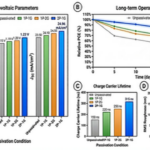
The research team, led by Professors Yang Jung-yeop and Lee Yong-je of Kunsan National University in collaboration with Professor Park Ju-sang of Korea Polytechnic University Asan Campus, demonstrated that precise control of additive concentration is critical for optimizing perovskite solar cell performance. The most significant result was achieved with the addition of 0.50 wt% PEAI, which resulted in a maximum power conversion efficiency of 20.98%, compared to 18.33% for devices without the additive. The average efficiency across 20 devices also rose from 18.03% to 20.52%, confirming the reproducibility of the improvement.
Technical Details
The study utilized triple-cation perovskites consisting of cesium (Cs), formamidinium (FA), and methylammonium (MA). The team analyzed how varying concentrations of the organic additive PEAI affected crystal structure and electrical properties. Key technical improvements include:
- Charge Carrier Dynamics: The average lifetime of charge carriers generated by light increased approximately 2.2 times, from 94.53 nanoseconds (ns) to 206.46 ns.
- Defect Reduction: Trap density, which captures charges, decreased by approximately 33%, indicating the suppression of non-radiative recombination.
- Structural Integrity: Low concentrations of PEAI maintained the 3D perovskite crystal structure while reducing charge loss. Conversely, higher concentrations led to structural changes associated with the formation of low-dimensional crystal phases.
Environmental Stability
The devices were tested under extreme conditions of 85°C and 85% relative humidity. After 1,000 hours, the 0.50 wt% PEAI-added devices maintained approximately 57% of their initial efficiency. In contrast, the additive-free devices maintained only about 6% of their initial efficiency after 740 hours.
Significance and Outlook
By optimizing PEAI concentration, the researchers successfully mitigated charge loss caused by defects within the material and at grain boundaries without compromising the 3D crystal structure. These findings, published in Cell Reports Physical Science, provide foundational data for material design and process optimization to develop high-efficiency, high-stability next-generation solar cells.
Source: http://www.mjeonbuk.com/news/articleView.html?idxno=149836
Get our weekly technology intelligence — free
Receive an infographic that lets you judge at a glance whether each field’s analysis report is worth reading.
Subscribe Free — Weekly Tech Intelligence
By subscribing, you’ll receive Troy-Technical’s weekly technology intelligence newsletter.
- Your email and selected fields are used only to deliver the newsletter.
- We never share your information with third parties.
- You can unsubscribe anytime via the link in each email.
See our Privacy Policy for details.
Takes about a minute · Unsubscribe anytime