

Key Findings
A study by Futing Yin, Hong Tang, and their team at the Chinese Academy of Sciences reveals that different types of organic matter exhibit varying levels of resistance to solar wind. When subjected to helium ion (He⁺) irradiation, aliphatic hydrocarbons showed the most significant changes, whereas aromatic hydrocarbons demonstrated higher stability. The researchers observed an overall increase in structural disorder and a decrease in the total amount of organic matter due to the breaking of carbon bonds in high-molecular-weight organics and subsequent sputtering.
Technical Details
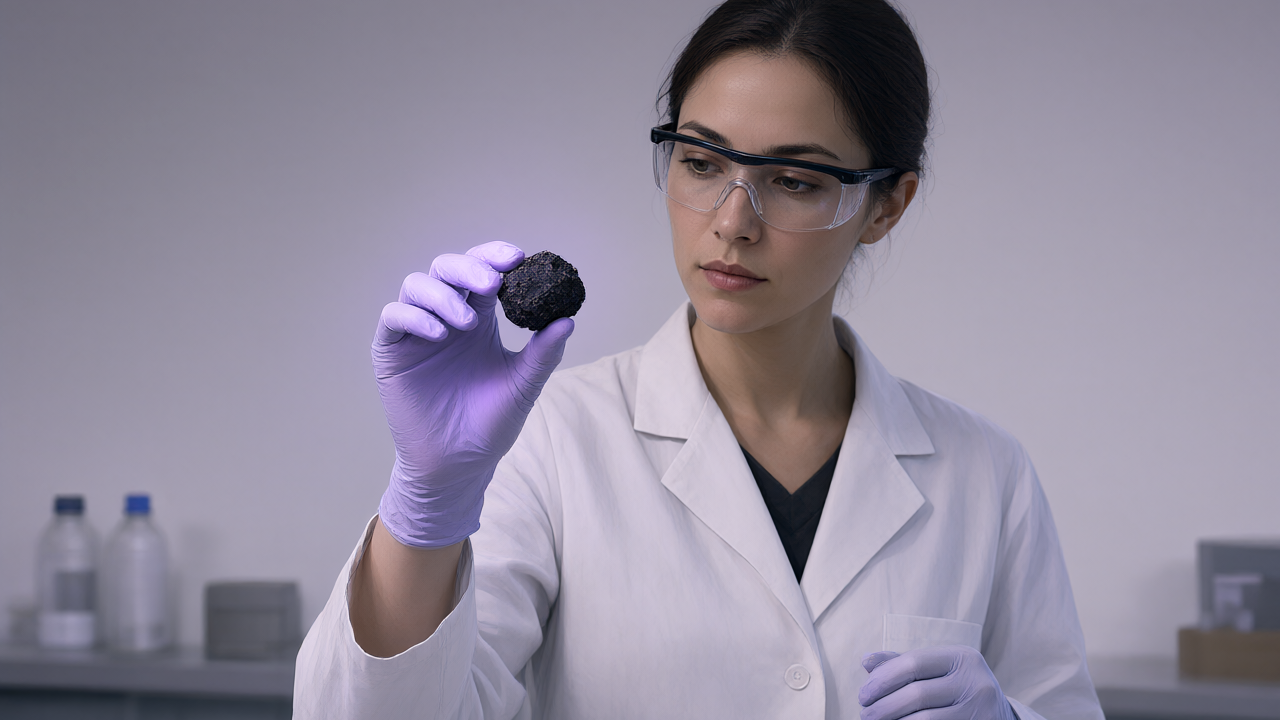
The team used the Murchison meteorite, a CM2 carbonaceous chondrite, as the experimental subject. The irradiation dose was set at 1.2×10¹⁷ ions per square centimeter, simulating approximately 800 years of solar wind exposure on a C-type asteroid surface. To analyze the changes, the team combined Raman spectroscopy—which identifies structural disorder via D and G bands—with nano-IR (nanoscale infrared spectroscopy). Nano-IR, combining atomic force microscopy and infrared spectroscopy, allowed the team to analyze chemical structures in micro-regions of tens of nanometers, maintaining the spatial relationship between minerals and organics.
Background and Context
The Murchison meteorite contains both insoluble organic matter (IOM), consisting of complex high-molecular-weight aromatic and aliphatic structures, and soluble organic matter (SOM), including amino acids and carboxylic acids. Solar wind consists of plasma including protons, electrons, and helium ions traveling at 400–800 km/s near Earth’s orbit, with energy of approximately 1 keV per nucleon. This process contributes to “space weathering,” which alters the surface properties of airless bodies.
Significance and Outlook
These results help explain the presence of aromatic components on the surfaces of asteroids like Ryugu and Bennu. Specifically, the degradation of aliphatic components may weaken the 3.4µm infrared absorption feature used in remote sensing. By comparing these experimental results with returned samples—such as the 5.4g from Ryugu and 121.6g from Bennu—researchers can better distinguish between original chemical compositions and subsequent surface alterations caused by the space environment.
Source: https://zaikei.co.jp/article/20261103/875955.html
Get our weekly technology intelligence — free
Receive an infographic that lets you judge at a glance whether each field’s analysis report is worth reading.
Subscribe Free — Weekly Tech Intelligence
By subscribing, you’ll receive Troy-Technical’s weekly technology intelligence newsletter.
- Your email and selected fields are used only to deliver the newsletter.
- We never share your information with third parties.
- You can unsubscribe anytime via the link in each email.
See our Privacy Policy for details.
Takes about a minute · Unsubscribe anytime