Key Findings
Bimetallic clusters designed and developed on copper-benzimidazole metal-organic frameworks (MOFs) and their derived materials have been proven to function as highly efficient electrocatalysts for both water electrolysis and hydrogen fuel cell applications. Specifically, the PtRu@Cu–N/C electrocatalyst recorded exceptional performance, exhibiting superior stability, an energy density of 165.78 Wh kg⁻¹, and a power density of 497.33 W kg⁻¹. This achievement underscores the immense potential of bimetallic MOF-derived materials in shaping the future of renewable energy storage and conversion.
Technical / Measurement Details
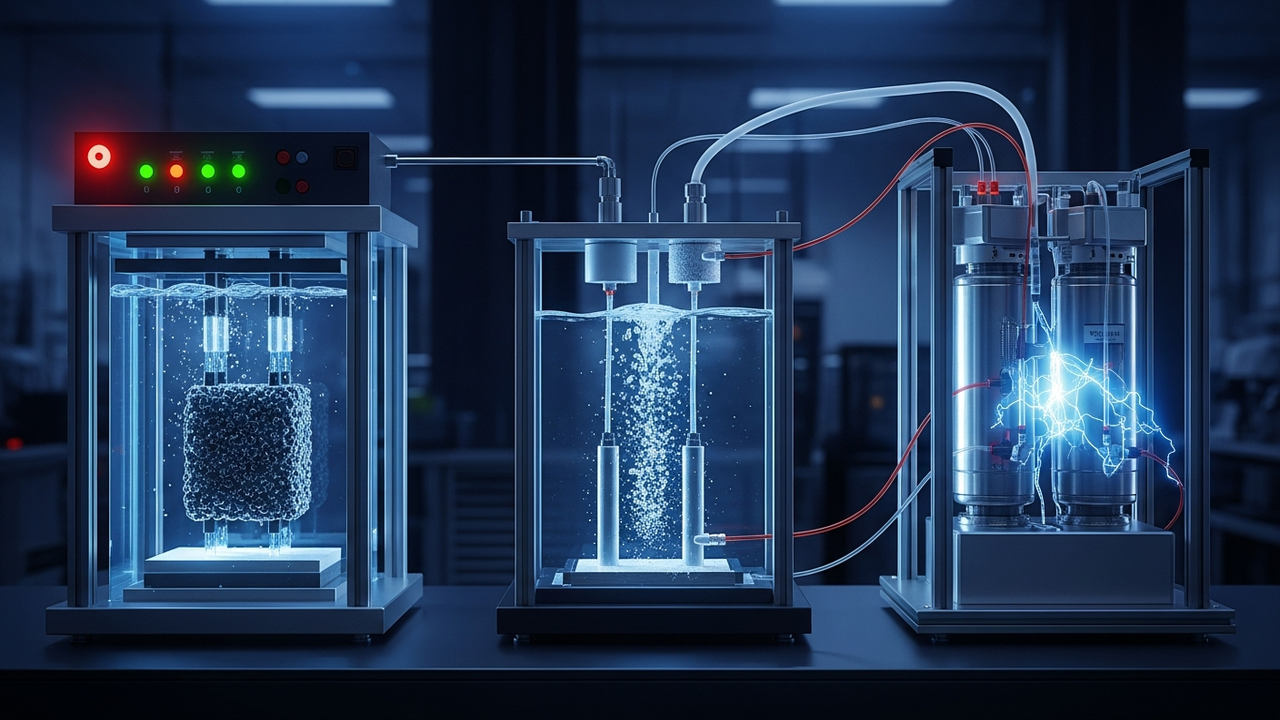
The research team first synthesized a MOF based on copper (Cu) and benzimidazole. This MOF features a porous structure with high surface area and uniform pore sizes, providing an ideal scaffold for anchoring bimetallic clusters. By calcining the MOF, a Cu–N/C composite material was formed, and platinum (Pt) and ruthenium (Ru) bimetallic nanoclusters were decorated onto its surface, optimizing the catalyst’s active site density and electrical conductivity. Performance evaluation was conducted for both water electrolysis (oxygen evolution reaction, OER, and hydrogen evolution reaction, HER) and hydrogen fuel cells (oxygen reduction reaction, ORR). The PtRu@Cu–N/C catalyst demonstrated superior performance in the following aspects:
- Water Electrolysis Performance: Achieved low overpotentials and high current densities for both OER and HER, enabling efficient water splitting.
- Fuel Cell Performance: Exhibited high catalytic activity and stability in ORR, contributing to increased fuel cell output.
- Energy Density: 165.78 Wh kg⁻¹. This metric indicates the amount of energy that can be stored per unit mass, signifying high storage capacity.
- Power Density: 497.33 W kg⁻¹. This represents the maximum power output per unit mass, indicating rapid energy delivery capability.
- Long-Term Stability: Maintained high performance even under continuous operating conditions, demonstrating the catalyst’s durability.
These results suggest a synergistic effect arising from the combination of bimetallic clusters and MOF-derived nanocarbon materials.
Background & Context
The transition to sustainable energy sources is one of the most pressing challenges facing modern society. Hydrogen is gaining attention as a clean energy carrier, but its efficient production (water electrolysis) and utilization (fuel cells) have been significantly hampered by reliance on expensive precious metal catalysts (e.g., Pt, Ru). Developing new catalyst materials that reduce precious metal usage while maintaining or surpassing equivalent performance and stability is crucial for commercialization. Metal-organic frameworks (MOFs), with their tunable structures, high surface areas, and diverse combinations of metal atoms and organic ligands, have shown great potential as catalytic materials. This research offers an innovative solution to this challenge by integrating bimetallic clusters with MOF-derived materials.
Strategic Significance & Outlook
The success of the PtRu@Cu–N/C electrocatalyst provides a significant impetus for the development of integrated energy systems involving water electrolysis and hydrogen fuel cells. Future research will focus on optimizing the catalyst to further reduce precious metal loading while maintaining or enhancing performance, developing large-scale production processes, and evaluating long-term reliability and durability in actual energy systems. If commercialized, this technology is expected to accelerate the realization of a hydrogen energy economy and reduce dependence on fossil fuels, contributing to global climate change mitigation and energy security. Bimetallic MOF-derived materials hold the potential to become a cornerstone of next-generation clean energy technologies.
Source: https://pubs.acs.org/doi/10.1021/acsomega.5c05057
Get our weekly technology intelligence — free
Receive an infographic that lets you judge at a glance whether each field’s analysis report is worth reading.
Subscribe Free — Weekly Tech Intelligence
By subscribing, you’ll receive Troy-Technical’s weekly technology intelligence newsletter.
- Your email and selected fields are used only to deliver the newsletter.
- We never share your information with third parties.
- You can unsubscribe anytime via the link in each email.
See our Privacy Policy for details.
Takes about a minute · Unsubscribe anytime









Comments